
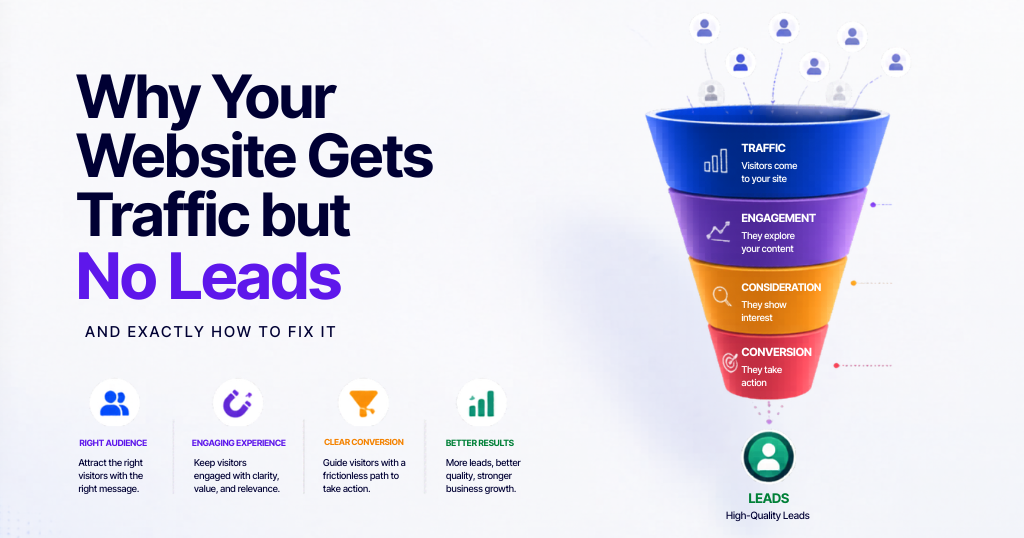
A website that gets traffic but generates no leads has a conversion problem, not a traffic problem — and the most common causes are mismatched visitor intent, weak value propositions, poor trust architecture, and conversion friction that makes the effort of contacting you feel greater than the perceived benefit. More traffic to a broken conversion system produces more of the same result: numbers on a dashboard that don’t translate to enquiries, pipeline, or revenue.
This guide diagnoses every common reason a website generates visitors without generating leads — and provides the specific fixes that connect traffic to outcomes. Whether you’ve invested in SEO, paid media, or both, and whether you manage your site in-house or work with a performance marketing agency in Chennai, the diagnostic framework here will tell you exactly which problem you’re solving.
The Traffic-Without-Leads Problem: Why It’s More Common Than You Think
Most businesses that have invested in digital marketing eventually encounter this problem. Traffic grows — Google Analytics shows a green arrow, impressions are up, rankings have improved — but the phone doesn’t ring more. The contact form submissions don’t increase. The pipeline stays flat.
The scale of this gap is documented:
- According to WordStream’s 2024 industry benchmark data, the average website conversion rate across all industries is just 2.35% — meaning 97.65% of visitors to a typical website leave without taking any action
- Forrester Research found that a well-designed conversion experience can increase conversion rates by up to 400% — which means most websites are generating at most 25% of the leads they could from identical traffic
- HubSpot’s 2024 research found that 74% of businesses say converting leads is their top marketing priority — yet only 22% are satisfied with their conversion rates. Most are addressing the symptom (more traffic) rather than the cause (poor conversion).
- A Baymard Institute study found that 69.9% of all online checkout/form sessions are abandoned before completion — primarily due to friction in the conversion process, not lack of intent
The reason this problem persists despite investment in SEO and paid media is that traffic acquisition and conversion optimization are treated as separate disciplines. An SEO company in Chennai increasing organic traffic, and a web developer managing the site, operate without a shared conversion mandate — and the gap between them is where leads disappear.
Diagnosis First: The 7 Root Causes of Traffic Without Leads
Before implementing any fixes, identify which root cause is primary for your specific website. Applying the wrong solution wastes time and investment.
Root Cause 1: You’re Attracting the Wrong Traffic
Traffic that doesn’t convert is often traffic that was never going to convert — because it comes from keywords, channels, or audiences that don’t match your buyer profile.
Diagnostic questions:
- What are the top 10 landing pages by traffic volume? Are these pages you’d expect buyers to arrive on, or informational/educational pages that attract researchers?
- What are the top organic search queries bringing traffic? Are they commercial-intent queries (“hire SEO agency Chennai”) or informational queries (“what is SEO”)?
- What is the geography of your traffic? If you serve Chennai businesses but significant traffic comes from outside your service area, that traffic won’t convert regardless of the page experience.
- What is the device breakdown? High mobile traffic on a non-mobile-optimized site will always produce poor conversion rates.
The intent mismatch table:
| Traffic Source | Likely Intent | Conversion Expectation |
|---|---|---|
| Branded search (“your company name”) | High — navigational, already knows you | Should convert at 5–15% |
| Transactional keywords (“hire X”) | High — evaluating and ready to act | Should convert at 3–8% |
| Commercial keywords (“best X for Y”) | Medium — comparing options | Should convert at 1–4% |
| Informational keywords (“how to X”) | Low — researching, not buying | Expected: 0.5–1% |
| Social media referral (generic) | Very Low — casual discovery | Expected: 0.2–0.8% |
If most of your traffic is informational and you’re measuring overall conversion rate, the number will look bad even with a perfectly optimized conversion experience for the minority of buyers in that traffic mix.
The fix: Segment your analytics. Measure conversion rates separately for high-intent traffic (branded search, transactional queries, direct traffic) versus informational traffic. If high-intent traffic is converting poorly, the problem is on the page. If only informational traffic is converting poorly, the problem is traffic quality — and you need either more commercial-intent traffic or a longer-term nurture strategy for the informational visitors.
Root Cause 2: Your Value Proposition Isn’t Clear Enough
A visitor who lands on your website and cannot immediately articulate — within 5–10 seconds — what you do, who you do it for, and why you’re different from alternatives, will leave. This is not because they’re impatient; it’s because the first 5 seconds on any unfamiliar website are spent answering the question “Am I in the right place?” If the answer isn’t immediately clear, the default is to return to Google.
Diagnosis: Show your homepage to five people who have never seen it before, for exactly 5 seconds. Ask them: “What does this company do? Who is it for? Why would you choose them over a competitor?” If fewer than four can answer all three questions, your value proposition is your primary conversion problem.
What a clear above-the-fold value proposition includes:
- What you specifically do (not vague like “grow your business online” — specific like “PPC management for Chennai service businesses”)
- Who it’s for (your specific target audience, named explicitly)
- What outcome they get (the measurable result, not the service description)
- Why you specifically (one specific differentiator — not “experienced team” but “managed ₹15 crore+ in Google Ads spend for Chennai businesses”)
The specificity test:
Generic (fails): “We are a digital marketing agency offering comprehensive solutions for businesses.” Specific (converts): “We help Chennai-based B2B companies generate qualified leads through Google Ads — with transparent reporting and no long-term lock-ins.”
The second version passes the 5-second test. The first could describe any of 500 agencies.
Root Cause 3: Your CTAs Are Too Generic or Buried
A call-to-action (CTA) is the mechanism by which visitor intent becomes measurable action. When CTAs are generic (“Contact Us,” “Learn More,” “Click Here”), insufficiently visible, or absent from key pages, visitors who are interested don’t know how to act on that interest — and the moment passes.
The CTA audit checklist:
- [ ] Is there a CTA above the fold on the homepage (visible without scrolling)?
- [ ] Is the CTA button visually distinct from surrounding design elements?
- [ ] Does the CTA copy describe what the visitor receives, not what they do? (“Get My Free Website Audit” not “Submit”)
- [ ] Are there CTAs at multiple points on long pages (after social proof, after FAQ, at the footer)?
- [ ] Does every major service page have a specific, relevant CTA?
- [ ] Does the blog have inline CTAs that are contextually relevant to the post topic?
High-converting CTA formulas:
- Outcome-framed: “Get a Free Campaign Audit”
- Risk-removal framed: “Book a Free Call — No Pitch, Just Analysis”
- Specificity-framed: “Get Your Free 30-Minute Strategy Session”
- Social proof framed: “Join 300+ Chennai Businesses — Book a Demo”
CTA placement study by Crazy Egg: Websites with CTAs placed above the fold, after testimonials, and in the footer convert at 1.5x the rate of sites with a single CTA only at the bottom of the page.
Root Cause 4: Your Landing Pages Don’t Match the Traffic Source
This is the message match problem — and it’s responsible for a significant proportion of traffic-without-leads across businesses running paid campaigns. A visitor who clicks a Google Ad promising “Free PPC Audit for Chennai Businesses” and arrives on a generic “Digital Marketing Services” page feels a mismatch between expectation and reality — and bounces.
According to Unbounce research, message match improvement alone increases conversion rates by an average of 212% — making it the single highest-impact, lowest-cost conversion improvement available to most businesses.
Message match audit process:
- Open your top 5 paid ads in one browser tab
- Open their destination pages in adjacent tabs
- Read the ad, then immediately read the landing page headline
- Ask: “Does the page feel like a direct fulfillment of the ad’s promise?”
- Any mismatch is a conversion-killing disconnect
Organic search message match: The same principle applies to organic traffic. A blog post ranking for “how to reduce Google Ads cost per lead” that ends without a contextually relevant CTA (like “Want us to audit your campaigns for wasted spend?”) misses the conversion opportunity that the content’s relevance has created.
Root Cause 5: Your Social Proof Is Absent or Unconvincing
98% of consumers read reviews before making a purchase decision (BrightLocal 2024 Consumer Review Survey). For service businesses and agencies, social proof isn’t just helpful — it’s the primary mechanism by which a stranger decides whether to trust you enough to make contact.
The social proof problem takes two forms:
No social proof: A website with no testimonials, no case studies, no client logos, and no review badges is asking visitors to take a risk on an unknown quantity. Most visitors won’t.
Generic social proof: “Great service, highly recommend!” — Anonymous. This is not social proof. It’s a placeholder that trained audiences now recognize and dismiss. Unconvincing social proof can actually reduce conversion rates by raising the question “Why are their testimonials so vague? What are they hiding?”
The social proof conversion hierarchy:
| Social Proof Type | Conversion Impact | What Makes It Effective |
|---|---|---|
| Specific testimonials with results | Very High | “We went from 8 leads/month to 34 in 60 days” |
| Video testimonials | Highest | Real person, real voice, impossible to fabricate |
| Recognizable client logos | High | Borrowed authority from brands the visitor knows |
| Third-party review badges (Google, Clutch, G2) | High | External validation not controlled by the business |
| Case studies with data | Very High | Documented, verifiable, detailed proof |
| Generic text testimonials | Low | Unattributed, unverifiable, expected |
| “Award-winning” claims | Low | Vague, unverifiable claims reduce trust |
The specific testimonial formula:
“[Specific before state] + [Specific action/solution] + [Specific measurable outcome] + [Timeframe] + [Full name, title, company]”
Root Cause 6: Your Forms Are Too Long or Poorly Designed
Every additional form field reduces the number of people who complete it. HubSpot’s analysis of 40,000+ landing page forms found that reducing fields from 11 to 4 increased conversions by 120%. The research consensus is clear: every unnecessary form field is a barrier between your visitor’s interest and your lead.
The minimum viable form by business type:
| Business Type | Minimum Fields Required | Sufficient For |
|---|---|---|
| Service business (consultation) | Name + Phone OR Email | Starting a conversation |
| Agency (free audit) | Name + Email + Website URL | Delivering the audit |
| B2B (enterprise) | Name + Email + Company | Initial qualification |
| Free resource download | Email only | Content delivery |
| Quote request | Name + Email + Brief description | Pricing discussion |
Form design conversion killers:
- Required fields that are only useful after the sale (company size, budget, team size) — move these to the sales conversation
- Non-descriptive submit button (“Submit,” “Send”) — replace with benefit-framed copy (“Get My Free Audit”)
- No trust signals near the form — privacy policy link, response time commitment, security badge
- Mobile forms that require zooming or horizontal scrolling — every extra tap is lost conversions
Root Cause 7: Your Page Speed Is Killing Pre-Conversion Interest
A visitor who abandons your website before seeing your CTA — because the page took 6 seconds to load — is invisible in your conversion analysis. They’re counted as a “bounce” in analytics, not as a conversion failure. But they were conversion-eligible traffic that never got a chance to evaluate your offer.
The speed-conversion relationship is directly documented:
- Google’s research found that a 1-second delay in mobile load time reduces conversion rates by 20%
- Pages that load in under 2 seconds convert at 2x the rate of pages loading in 4+ seconds (Portent study)
- 53% of mobile visitors abandon pages that take longer than 3 seconds to load (Google/SOASTA research)
Speed diagnostic: Run your top 5 highest-traffic pages through Google PageSpeed Insights (pagespeed.web.dev). Any LCP (Largest Contentful Paint) above 4 seconds is actively reducing your lead volume. LCP above 6 seconds is a critical conversion blocker.
The Complete Traffic-to-Leads Audit: A Structured Diagnostic Process
Rather than addressing root causes in isolation, run this structured audit to identify which combination of factors is responsible for your specific traffic-without-leads problem.
Step 1: Segment Your Traffic Quality
In Google Analytics 4:
- Go to Reports → Acquisition → Traffic Acquisition
- Filter by session conversion rate (not just sessions)
- Identify which sources and mediums have >1% conversion rate vs. <0.5%
Low-converting sources are either: wrong audience, wrong landing page, or both.
Step 2: Run the 5-Second Homepage Test
Show your homepage to 5 people who don’t know your business. After 5 seconds, ask:
- What does this company do?
- Who is it for?
- Why would you choose them?
Score 0–5. Under 4/5 = value proposition is the primary problem.
Step 3: Map CTAs to Pages
Create a spreadsheet listing your top 20 pages by traffic. For each, note:
- Is there a CTA present?
- Is it above the fold?
- Does the CTA copy describe an outcome?
- Is the CTA visually distinct?
Pages with missing or weak CTAs are lost conversion opportunities.
Step 4: Run the Message Match Check
For each active paid campaign:
- Does the landing page headline mirror the ad copy?
- Is the specific offer in the ad the first thing visible on the landing page?
- Is the CTA in the ad reflected in the landing page CTA?
Any “no” answer is a message match failure costing conversions.
Step 5: Audit Social Proof
For your top service pages:
- Is there at least one specific, attributed testimonial with measurable results?
- Is there a third-party review badge or platform rating?
- Is there any named client reference or logo?
Pages with zero social proof are trust failures that will never convert at potential.
Step 6: Run a Form Audit
For every form on your site:
- Count the required fields
- Evaluate whether each field is needed before the first conversation
- Check the submit button copy
- Test on mobile personally
The Conversion Fix Priority Matrix
Not every fix is equal. This matrix prioritizes implementation by impact potential and ease of execution:
| Fix | Conversion Impact | Ease of Implementation | Priority |
|---|---|---|---|
| Value proposition rewrite (above fold) | Very High | Medium | 1 — Do first |
| Form field reduction | High | Easy | 2 — Quick win |
| Message match (ad → landing page) | Very High | Medium | 3 — High urgency for paid traffic |
| CTA copy improvement | High | Easy | 4 — Quick win |
| Social proof addition | Very High | Medium | 5 — High leverage |
| Page speed improvement | High | Medium-Hard | 6 — Technical priority |
| CTA placement (above fold) | High | Easy | 7 — Quick win |
| Mobile form optimization | Medium-High | Medium | 8 |
| Trust signals near form | Medium | Easy | 9 — Quick win |
| Traffic quality improvement | High | Medium-Hard | 10 — Channel strategy |
How Weboin Diagnoses and Fixes the Traffic-Without-Leads Problem
At Weboin — a specialist digital marketing agency in Chennai combining performance marketing, SEO, and conversion rate optimization — this problem is one of the most common briefs we receive. Businesses that have invested in digital marketing and are generating traffic but not leads are typically suffering from a combination of Root Causes 2–6, operating simultaneously.
Our diagnostic and fix process:
Week 1 — Full Conversion Audit: We install Hotjar or Microsoft Clarity on all key pages to capture heatmaps, session recordings, and form analytics. This shows us exactly where visitors click, where they stop reading, and where they abandon forms — providing the qualitative evidence that quantitative analytics can’t. We simultaneously run the structured audit steps above across all top-traffic pages.
Week 2 — Priority Fix Implementation: We implement the highest-impact, lowest-effort fixes first: CTA copy, form field reduction, trust signal additions, and above-fold layout improvements. These changes are made in parallel with the deeper work of value proposition refinement and landing page rebuilds.
Week 3–4 — Landing Page Rebuild and Message Match: For businesses running paid media, we build dedicated landing pages with proper message match for each campaign. For organic traffic, we add contextually relevant inline CTAs to the highest-traffic blog posts. We implement A/B testing for the top 3 priority changes.
Ongoing — Measurement and Iteration: We track weekly lead volume against the same traffic volume to measure conversion rate improvement. Each testing cycle produces a validated learning that informs the next — compounding conversion gains over successive months.
As a PPC agency in Chennai managing paid campaigns and as a digital marketing company in Chennai managing broader digital strategy, Weboin treats conversion rate as equally important to traffic volume — because the lead is where marketing investment becomes business revenue.
Preventing the Traffic-Without-Leads Problem: The Proactive Conversion System
The businesses that consistently avoid the traffic-without-leads problem are those that build conversion infrastructure before scaling traffic — not after.
The proactive conversion system:
- Define conversion goals before SEO or paid media campaigns launch Every campaign should have a primary conversion event (contact form, phone call, demo booking) configured as a conversion in GA4, with a CPL target that informs budget decisions.
- Build dedicated landing pages before driving traffic to them Running Google Ads to a homepage is driving traffic to a page that isn’t optimized for conversion from that specific traffic source. Every campaign should have a purpose-built landing page.
- Establish a minimum viable trust architecture before acquisition Before investing in traffic, ensure the site has: a named testimonial with specific results, a third-party review badge, contact information visible in the header, and a response time commitment near the form.
- Test conversion rate on existing traffic before scaling paid If your organic traffic is converting at 0.3%, scaling paid traffic to the same pages will produce the same 0.3% conversion rate — at significantly higher cost. Fix conversion rate first, then scale traffic.
- Monthly conversion rate review Add conversion rate by traffic source to your monthly marketing review. A conversion rate decline in a specific source that isn’t explained by a page change is a signal of either traffic quality degradation or emerging page experience problems.
Frequently Asked Questions About Traffic Without Leads
The most common causes are: (1) traffic that doesn't match your buyer profile (informational visitors rather than commercial-intent buyers), (2) a weak or unclear value proposition above the fold, (3) absent or generic social proof that fails to build trust, (4) CTAs that are hidden, generic, or missing, and (5) form friction that makes contacting you feel effortful. Most websites suffer from a combination of these — identify which are most severe through the structured audit process.
Only if your current traffic is converting at rate. If your website converts at 0.5% and you double traffic, you'll double leads — but you'll still be converting 99.5% of visitors into nothing. Improving conversion rate from 0.5% to 2% generates 4x as many leads from the same traffic volume — without additional acquisition spend.
For initial contact forms, 2–4 fields is optimal for most service businesses. Required fields: name and email (or phone). Optional: a brief description of the enquiry. Everything else — budget, team size, timeline — should be gathered in the first sales conversation after contact is established.
The industry average is 2.35% across all traffic. The top 25% of websites convert at 5.31%+. The top 10% convert at 11.45%+. For service businesses with targeted, commercial-intent traffic, a conversion rate of 3–8% is achievable and represents a significant improvement from the typical 1–2% most service businesses achieve. High-intent traffic (branded search, direct) should convert at 5–15%.
Fix conversion rate first. Acquiring traffic to a poorly converting site is expensive and inefficient. The same budget that would bring 1,000 additional visitors at 1% conversion (10 new leads) generates 10 leads if conversion rate stays the same — but 40 leads if conversion rate improves to 4%. The conversion rate improvement is almost always the higher-ROI investment.
Final Thought: Traffic Is Potential — Conversion Rate Is Performance
Organic rankings and paid media campaigns bring potential customers to your digital door. Conversion rate is whether they come in. A beautifully crafted SEO strategy or a precisely targeted Google Ads campaign that delivers visitors to a website that can’t convert them is a machine running at 5% capacity.
The businesses generating the most leads from their digital investment are not necessarily those with the most traffic. They’re the ones that have closed the gap between the visitors they attract and the customers those visitors could become — by answering “Am I in the right place?” immediately, making the next step obvious, giving visitors enough evidence to trust them, and removing every unnecessary barrier between interest and contact.
That gap is where the leads are hiding. The audit in this guide tells you exactly where the gap is in your specific website.
Whether you close that gap independently or with the support of a specialist digital marketing agency in Chennai like Weboin, the diagnostic and fix framework here is your complete guide — from traffic quality segmentation through landing page message match, social proof architecture, and form optimization — to build a website that converts the traffic you’re already working hard to earn.
About Weboin: Weboin is a full-service digital marketing company in Chennai offering performance marketing, PPC management, SEO, conversion rate optimization, and content strategy. As a trusted performance marketing agency in Chennai and PPC agency in Chennai, Weboin helps businesses turn website traffic into qualified leads and measurable pipeline — through systematic conversion diagnosis and evidence-based optimization.

No comment yet, add your voice below!