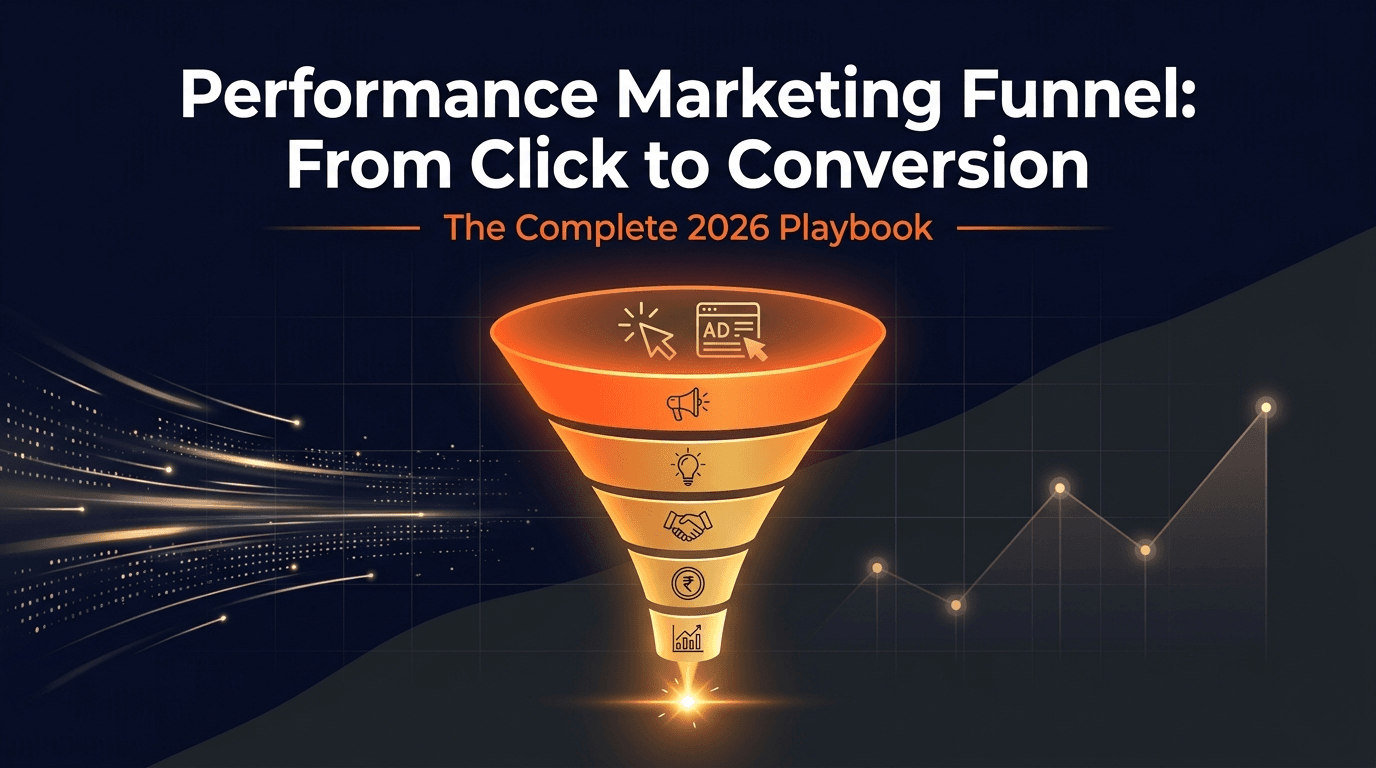
Introduction: You’re Getting Clicks. So, Why Isn’t the Phone Ringing?
Let’s set the scene.
You’ve launched your ad campaigns. You’ve briefed your team, reviewed the creatives, approved the budgets, and hit “Publish.” A few days in, you open your dashboard and feel a small surge of satisfaction — your Click-Through Rate (CTR) looks solid. Traffic is up. People are actively clicking on your ads. You’re in the game.
Then you open your CRM. Or your lead sheet. Or your Shopify orders.
Silence.
Not the peaceful kind of silence. The expensive kind. The kind that means real money is flowing out of your account, and nothing — nothing of equivalent value — is flowing back in.
If you’ve experienced this exact scenario, you are in the overwhelming majority. It is one of the most common, most frustrating, and most misunderstood problems in digital marketing today. Businesses investing thousands in PPC services in Chennai, partnering with a performance marketing agency, or running aggressive Meta campaigns often find themselves staring at this same paradox: enormous traffic, negligible conversions.
The instinct is to blame the ads. To demand “better creatives.” To switch agencies. To try a new platform. But here’s the uncomfortable truth that very few marketers will say to your face:
Your ads are not the problem. Your funnel is.
You have a leaky bucket problem. You’re pouring water into the top as fast as you can — paying for click after click, impression after impression — and it’s all draining out the bottom before it can become revenue. More water doesn’t fix a leaky bucket. Patching the holes does.
This guide exists to help you patch those holes.
In the pages that follow, we’re going to deconstruct the performance marketing funnel from the ground up. We’ll examine each stage with the forensic detail it deserves, explore the psychology behind why customers convert (or don’t), walk through the architecture of a landing page that actually sells, and give you a framework for continuous optimisation that transforms your funnel from a one-time setup into a living, data-driven growth engine.
Whether you’re a founder running your own campaigns, a marketing manager collaborating with a digital marketing agency in Chennai, or a seasoned PPC professional looking to sharpen your systems — this is the framework you need.
Let’s begin.
Part One: What Is a Performance Marketing Funnel, Really?
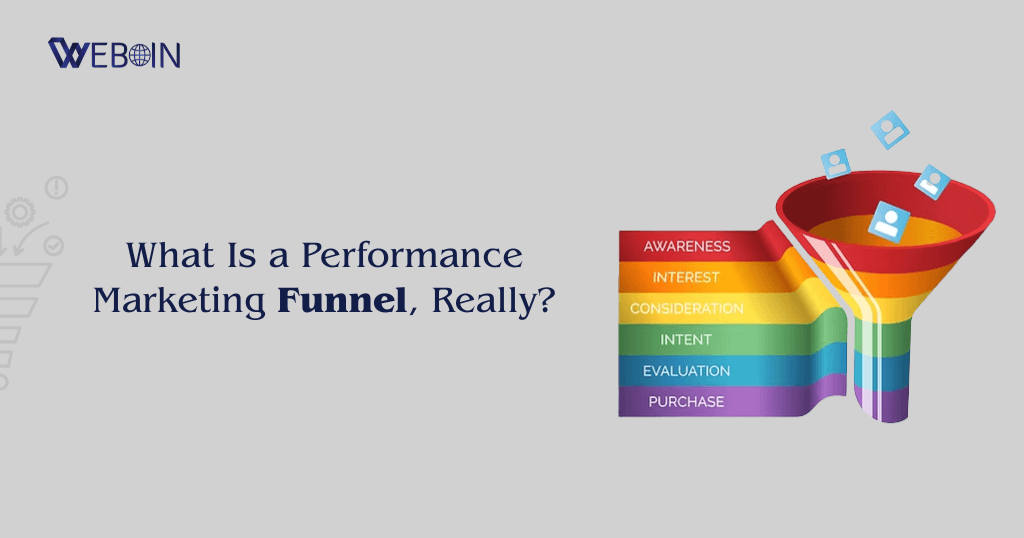
The word “funnel” gets thrown around so casually in marketing circles that it has almost lost its meaning. People slap the term onto everything — email sequences, ad campaigns, landing pages, entire websites — without truly understanding what a funnel is and, more importantly, what it does.
At its core, a performance marketing funnel is a designed, trackable journey that moves a complete stranger from their first exposure to your brand all the way through to becoming a paying customer — and ideally, a loyal repeat buyer.
The word “performance” is critical here. It’s what separates this framework from traditional marketing. Performance marketing is governed by one law above all others: every action must be measurable, and every measurement must serve optimisation.
In traditional marketing, a brand might spend crores on a television campaign and assess its success by asking, “Did people seem to like it? Did it ‘feel’ right?” That approach is fine if you have unlimited budgets and decades to build brand equity. For most businesses — especially growth-stage companies competing in a market as dynamic and price-sensitive as Chennai — you don’t have that luxury.
Performance marketing demands accountability. Not just from your ad platforms, but from every element of your marketing system: your landing pages, your forms, your copy, your call-to-action buttons, your follow-up sequences. Every component is either contributing to conversion or working against it.
The simplified flow of a performance marketing funnel looks like this:
Ad Impression → Click → Landing Page → Engagement → Trust Building → Micro-Commitment → Conversion → Retention
But describing it as a simple linear flow undersells its complexity. In reality, a high-performing funnel is more like an ecosystem — a series of interconnected touchpoints, each designed to address a specific psychological state that your prospect is in at that moment in time.
The funnel has four core purposes:
- Filtering: Not all traffic is created equal. A well-built funnel naturally attracts high-intent users and creates exit points for those who were never going to buy — saving you money and improving your data quality.
- Education: Most potential customers don’t buy because they don’t fully understand how your solution solves their specific problem. The funnel creates the space to teach, demonstrate, and illuminate.
- Trust: There is always a gap between “I’ve heard of this company” and “I’m willing to give them my money.” Closing that trust gap is perhaps the most important job a funnel performs.
- Direction: Every step of the funnel exists to move the user toward a single, specific action. Confusion is the enemy of conversion. The funnel eliminates confusion by providing one clear path forward.
Part Two: Why Your Funnel Matters More Than Your Ads
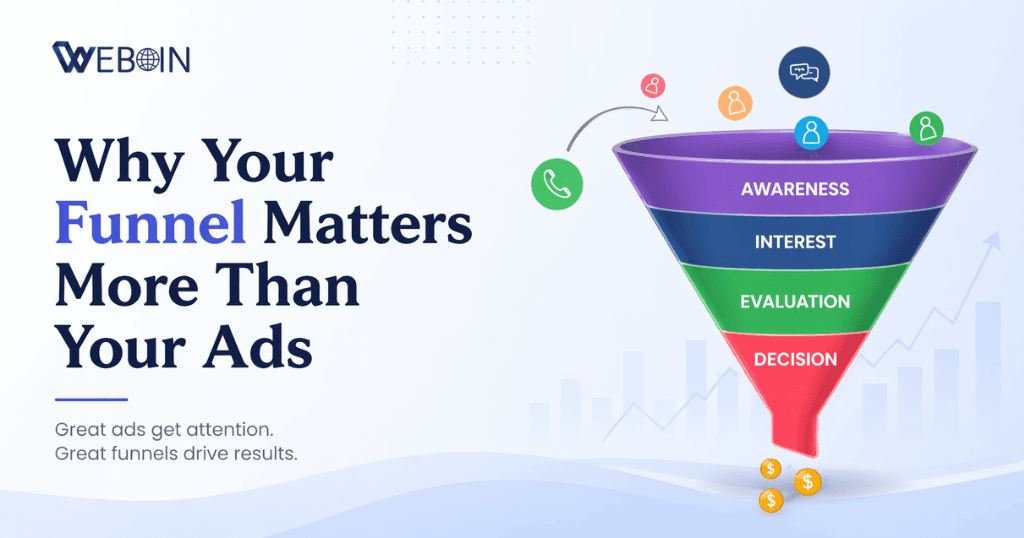
This is the section that many business owners need to hear but resist accepting.
When conversions are low, the reflex is to blame the advertising. The creative isn’t compelling enough. The targeting is off. The agency isn’t doing their job. And while those factors certainly matter, they are rarely the root cause of a conversion problem.
Here’s a thought experiment. Imagine you hire one of the finest PPC services in Chennai. They build a technically perfect campaign — precision targeting, compelling ad copy, strong bid strategy. They deliver high-intent users to your website for a competitive cost. Those users click the ad, arrive on your site, and then… encounter a cluttered, slow-loading homepage with no clear next step, a contact form that asks for twelve pieces of information, and no tangible reason to trust your brand over any competitor.
Those clicks evaporate. That budget is gone. And the agency gets blamed.
The math is stark. If your landing page converts at 1% and you’re spending ₹1,00,000 a month on ads, you get a certain number of leads. If you improve your conversion rate to 3% — without spending a single extra rupee on advertising — you’ve tripled your lead volume overnight. The funnel, not the ad spend, was the lever.
The Hidden Costs of a Poorly Built Funnel
Beyond the obvious loss of revenue, a leaky funnel creates several compounding problems that business owners rarely account for:
- Damage to Your Quality Score: Google’s ad auction is not purely about who bids the most. It accounts for the relevance and quality of your landing page. When users click your ad and immediately bounce, Google interprets this as a signal that your page doesn’t deliver on the ad’s promise. This lowers your Quality Score, which raises your Cost Per Click (CPC), making every future click more expensive. Pairing your paid efforts with a solid SEO foundation helps counteract this over the long term.
- Brand Damage at Scale: If someone clicks on your ad, arrives at a confusing or slow page, and leaves frustrated, they don’t just cost you that click — they leave with a negative impression of your brand. In a city like Chennai, where word-of-mouth and community reputation matter enormously, this kind of brand erosion can be invisible but deeply damaging.
- Wasted Remarketing Potential: Retargeting campaigns work by reconnecting with people who have already visited your site. But if those visitors had a poor initial experience, serving them more ads simply reinforces the negative association. Remarketing without a fixed funnel is like calling a customer back to apologise for a bad experience without actually fixing what went wrong.
- Data Pollution: Bad funnels generate bad data. When you can’t track which steps are causing drop-off, you can’t make intelligent optimisation decisions. You end up making changes based on intuition rather than evidence — a recipe for compounding mistakes.
Part Three: The Five Stages of a Performance Marketing Funnel — A Deep Dive
Let’s now walk through each stage of the funnel with the depth it deserves. At every stage, we’ll examine the user’s psychological state, the marketer’s goal, the tactics that work best, and the metrics that tell you whether things are working.
Stage 1: Awareness (Top of Funnel — TOFU)
The User’s Mindset: At this stage, your prospect may not know your brand exists. They may not even have fully articulated their problem. They experience what marketers call a “symptom” — a vague dissatisfaction, a recurring frustration, a business challenge they haven’t yet named. They are not searching for your service; they are searching for relief from a problem.
The Marketer’s Goal: Generate quality attention. Reach the right people at the right moment, and do it in a way that makes them lean in rather than scroll past.
Channel Strategy:
- Google Search Ads are the gold standard for awareness at the intent level. When someone types “performance marketing agency Chennai” or “how to get more leads for my business,” they are already experiencing the symptom. A well-placed search ad meets them exactly at that moment of need.
- Meta Ads (Facebook & Instagram) operate differently. Users aren’t actively searching; they’re scrolling. Your creative must interrupt their pattern and create a moment of recognition — “this is speaking to me.” This makes Meta exceptionally powerful for targeting based on interests, behaviours, and demographics rather than explicit search intent.
- LinkedIn is essential for B2B contexts. If you’re selling services to businesses, decision-makers — founders, marketing directors, procurement heads — are active on LinkedIn in a professional mindset. The CPCs are higher, but the intent quality can be exceptional.
Creative Strategy at This Stage: The biggest mistake brands make at the awareness stage is trying to close the sale. Don’t do it. The user isn’t ready, and the attempt will repel them. Instead, sell the problem solved, not the product itself.
Effective TOFU hooks include:
- “Why Chennai Businesses Are Wasting 60% of Their Ad Budget (And How to Stop)”
- “The Hidden Reason Your Website Visitors Aren’t Converting”
- “5 Signs Your Digital Marketing Funnel Has a Leak”
Notice that none of these directly mention your agency or your services. They speak to the pain, which is what your prospect is feeling right now.
Metrics to Watch: CTR (Click-Through Rate), Impressions, Cost Per Click (CPC), and Reach. At this stage, you’re not expecting conversions — you’re measuring the quality of your traffic pipeline.
Stage 2: Interest (Middle of Funnel — MOFU)
The User’s Mindset: The prospect has clicked. They’re “in your house.” They have enough curiosity to investigate further, but they haven’t made any commitment. They’re evaluating whether what you offer is worth their time.
The Marketer’s Goal: Sustain attention and begin building authority. This is the stage where you transform from “some company I clicked on” to “a source I trust.”
What Works Here:
- Dedicated Landing Pages: Not your homepage. A homepage is designed for exploration — it contains navigation links, multiple calls to action, and information about every aspect of your business. A landing page has one job: guide this specific visitor, who arrived with this specific intent, toward one specific next step.
- Lead Magnets: Offer something genuinely valuable in exchange for an email address. Not “Subscribe to our newsletter” (nobody wants that), but “Download our Free 10-Step Checklist: How to Audit Your PPC Campaigns in 30 Minutes.” A lead magnet works because it provides immediate, tangible value while qualifying the lead — only someone genuinely interested in your service will invest the time to download and read it. This is the backbone of any strong lead generation strategy.
- Educational Content: Blog posts, explainer videos, case study previews. At this stage, the goal is to demonstrate that you understand the prospect’s problem better than they understand it themselves. When a prospect reads your content and thinks “this is exactly what I’ve been dealing with” — you’ve established a powerful connection.
The Critical Insight — Benefits Over Features: This is perhaps the most important copywriting principle in marketing, and it’s violated constantly. Features describe what something is. Benefits describe what it does for you.
Don’t say: “We use AI-powered bid management and multi-touch attribution modelling.”
Say: “We make sure every rupee you spend on ads is working as hard as possible — and we prove it with numbers you can actually understand.”
One speaks to your capability. The other speaks to their relief.
Metrics to Watch: Time on Page, Scroll Depth, Bounce Rate, Lead Magnet Download Rate, Email Opt-In Rate.
Stage 3: Consideration
The User’s Mindset: This is where things get competitive. The prospect is now actively evaluating their options. They’ve visited your site, they’ve perhaps downloaded your lead magnet, but they’ve also visited three competitor sites. They’re building a shortlist. They want to know: Why you? Why not someone else?
The Marketer’s Goal: Win the comparison. Position your brand as the most logical, most trustworthy, most compelling choice — not just one option among several.
What Works Here:
- Case Studies: Not generic testimonials, but narrative-driven success stories. “A Chennai-based e-commerce brand in the fashion category came to us with a ₹50,000 monthly ad budget and a 0.8% conversion rate. Here’s the exact process we used to take them to a 3.2% conversion rate in 90 days.” Real numbers. Real context. Real results.
- Video Testimonials: Written testimonials can be fabricated, and sophisticated buyers know this. A video of a real client explaining what changed for their business — in their own words, with their face visible — carries an order of magnitude more trust.
- Third-Party Review Platforms: Google Business Profile reviews, Clutch ratings, G2 listings. These matter enormously because they exist outside your control, which is exactly what makes them credible. Actively cultivate your presence on these platforms.
- Comparison Content: “How We’re Different from Other Digital Marketing Agencies in Chennai” pages work exceptionally well. Be specific and honest. Don’t just say “we care more” — explain what you do differently and why it produces better results.
The Psychology of Social Proof: Human beings are fundamentally tribal. We take our behavioural cues from others, especially others who are similar to us. This is not irrationality — it’s evolved risk management. When your prospect sees that 47 other Chennai-based businesses like theirs have worked with you and experienced measurable improvement, the psychological risk of choosing you drops dramatically.
The goal at this stage is to make the prospect feel not like a pioneer, but like someone joining a well-established group of successful, satisfied clients.
Metrics to Watch: Case Study Page Views, Time on Testimonials/Reviews Page, Return Visit Rate, Direct Brand Searches.
Stage 4: Conversion (Bottom of Funnel — BOFU)
The User’s Mindset: The prospect is ready. Or nearly ready. The intellectual and emotional work is largely done — they believe you can help them, they trust your brand, they’ve compared their options. What’s holding them back now is usually one of three things: friction, doubt, or procrastination.
The Marketer’s Goal: Remove every possible obstacle between the prospect and the “yes.” Make the act of converting feel easy, obvious, and urgent.
Friction Reduction Tactics:
- Shorten Your Forms: Every additional form field is a gate that some percentage of prospects won’t walk through. Research consistently shows that each field added to a form reduces conversion rate by roughly 10%. If you’re asking for name, email, phone, company name, company size, role, budget, and timeline — you’re losing the majority of your leads before they submit. Start with just name and email. Collect additional information in the follow-up.
- Speed is Non-Negotiable: Page load time has a direct, measured relationship with conversion rate. A one-second delay in page load reduces conversions by approximately 7%. At two seconds, you’ve lost a measurable portion of your traffic. At three seconds, mobile users are gone. Test your page speed on Google PageSpeed Insights and treat it as a conversion issue, not just a technical one.
- Single, Unmistakable CTA: Decision fatigue is real. When a prospect arrives at your page and sees three different calls to action — “Call Us,” “Email Us,” “Fill This Form,” “Download Our Brochure” — the mental cost of choosing between them causes many to choose none. Pick one action and build everything on the page around driving that single action.
Creating Urgency Without Manipulation:
Urgency is a legitimate psychological lever when applied honestly. “Only 4 client slots available for May onboarding” is a genuine scarcity statement if it’s true. “This offer expires in 10 minutes” on a timer that resets every time someone visits is manipulation, and modern consumers recognise it immediately — destroying the trust you’ve worked so hard to build.
Honest urgency tactics include:
- Seasonal or quarterly pricing adjustments (“rates increase in Q3 due to higher demand”)
- Genuine capacity limitations (“we work with a maximum of 12 active clients at a time”)
- Time-sensitive bonus inclusions (“free SEO audit included with all new clients who sign on before April 30”)
Metrics to Watch: Conversion Rate, Cost Per Lead (CPL), Cost Per Acquisition (CPA), Form Abandonment Rate.
Stage 5: Retention and Remarketing
The User’s Mindset: This stage covers two distinct groups. First: people who almost converted but didn’t — they left at some point in the funnel, perhaps because of timing, distraction, or unresolved doubts. Second: people who did convert and are now existing customers.
The Marketer’s Goal for Non-Converters: Re-engage them with relevant, personalised messaging that addresses the likely reason they didn’t follow through.
The Marketer’s Goal for Existing Customers: Delight them to the point where they don’t consider leaving, where they naturally refer others, and where they’re receptive to additional services.
Remarketing Strategy:
Using Meta Pixel and Google Remarketing Tags, you can segment your non-converted visitors with remarkable precision:
- People who viewed the pricing page but didn’t fill the form (likely price objection)
- People who read three blog posts but never visited the services page (interest, no intent yet)
- People who started filling the form but didn’t submit (friction or hesitation)
Each of these segments deserves a different re-engagement message. Someone who got to the pricing page probably needs social proof or a risk-reduction offer (free consultation, money-back guarantee). Someone who consumed your content needs a stronger nudge toward “here’s the logical next step.” Someone who abandoned a form needs a simpler path to conversion.
Email Nurture Sequences: A well-designed email sequence after a lead magnet download can single-handedly transform the performance of your top-of-funnel content. The sequence should: deliver immediate value, build familiarity over multiple touchpoints, address common objections, and ultimately move the lead toward a conversation with your sales team. Aim for a 5-7 email sequence over 2-3 weeks.
Customer Retention Economics: The data on this is unambiguous. Acquiring a new customer costs five to seven times more than retaining an existing one. Increasing customer retention by just 5% can increase profitability by 25-95%. And yet, most businesses invest 90% of their marketing budget in acquisition and almost nothing in retention. This is a structural error.
Part Four: The Anatomy of a High-Converting Landing Page
If your ad is the handshake that brings a prospect to the door, your landing page is the conversation that determines whether they come inside.
A dedicated landing page — not your homepage, not your general services page — is the single highest-leverage asset in your entire funnel. Getting this right can double or triple your conversion rate without changing a single thing about your ad campaigns.
The Eight Essential Components
1. The Headline (The Hook)
Your headline has one job: make the visitor believe that they are in exactly the right place. It must echo the language and promise of the ad that brought them here. If your ad says “Affordable PPC Management for Chennai Small Businesses,” your headline should not say “Welcome to Our Agency.” It should say “Affordable, Accountable PPC Management Built for Chennai Small Businesses.”
The psychological principle here is called “message match.” When the promise in the ad aligns perfectly with the promise on the landing page, cognitive dissonance disappears. The visitor feels continuity. They stay.
2. The Sub-headline (The Promise Expanded)
One sentence that expands on the headline and clarifies what the visitor will get. “We manage your Google and Meta campaigns with full transparency — you see every metric, every rupee, every result.”
3. The Hero Section (The Emotional Proof)
Whether it’s an image or a short video, the hero section’s job is to make the solution feel real and achievable. Show your team at work. Show a client’s face during a positive moment. Show a dashboard with impressive numbers. Whatever you choose, it should communicate: “This is what success looks like, and it’s attainable.”
4. The Pain-and-Solution Section
Before you explain what you do, briefly articulate the problem your visitor is experiencing. “You’re spending money on ads, but leads are inconsistent and you can’t tell what’s actually working.” This isn’t negativity — it’s empathy. It tells the visitor that you understand their world, which is the foundation of trust.
Then pivot to your solution and how it specifically addresses that problem.
5. The Benefits Stack
Use scannable bullet points or icon-based layouts to communicate your core benefits. Humans scan before they read — your most important benefits need to be visible without requiring linear reading. Keep each benefit to one or two lines. Lead with the outcome, not the mechanism.
6. Social Proof (The Evidence Layer)
This section should include multiple proof formats:
- Client logos (brand association)
- Quantified results (“Generated ₹1.2 crore in attributed revenue for clients in Q1 2025”)
- Written or video testimonials (human validation)
- Ratings from third-party platforms (independent credibility)
Never underestimate the power of a single well-placed, specific testimonial. “Working with [Agency Name] was the best business decision we made last year” is forgettable. “In 60 days, they cut our Cost Per Lead from ₹800 to ₹320 while maintaining lead quality. We’ve since scaled our budget 4x.” — that is persuasive.
7. The FAQ Section
The FAQ section is where you handle objections before they become reasons not to convert. What are the top three to five reasons people hesitate before working with you? Answer them here, clearly and confidently. This section is often overlooked but consistently proves its worth in conversion rate tests.
8. The CTA (The Single Point of Commitment)
Everything on the page builds toward this moment. Make it visible, prominent, and action-oriented. “Get My Free PPC Audit” outperforms “Submit” every time. Make the button colour contrast sharply with the page background. Repeat the CTA at the top, middle, and bottom of long pages so there’s always one within reach wherever the visitor is reading.
Part Five: Conversion Rate Optimisation — The Engine That Never Stops
Building a funnel is not a one-time project. It is a continuous process of hypothesis, testing, measurement, and improvement. This is what Conversion Rate Optimisation (CRO) means in practice, and it is what separates businesses that plateau from businesses that compound.
A/B Testing — The Foundation
A/B testing (also called split testing) is the process of running two versions of a page element simultaneously and measuring which one produces better results. The key rules:
- Test one variable at a time. If you change the headline, the hero image, the CTA text, and the form position simultaneously, you won’t know which change produced the result.
- Run tests long enough. Don’t call a winner after 50 visitors. Wait until you have statistical significance — typically 300-500 conversions per variant.
- Test high-impact elements first. Headlines drive more conversion difference than button colours. CTA text matters more than background gradients.
The elements worth testing, in order of typical impact: headline, CTA text and placement, hero image or video, form length, social proof placement, page load speed, mobile layout.
Heatmapping and Session Recording
Tools like Hotjar and Microsoft Clarity show you exactly how visitors behave on your pages — where they click, how far they scroll, where they pause, and where they give up. This qualitative data is priceless because it shows you things that conversion rate numbers alone never can.
Common discoveries from heatmap analysis include:
- Visitors are clicking on non-clickable elements (indicating confusion about page structure)
- Visitors are dropping off consistently at the same point on the page (indicating that section is causing doubt or friction)
- Mobile users are experiencing layout issues that desktop users don’t (requiring mobile-specific fixes)
Page Speed Optimisation
We mentioned this in the conversion stage, but it deserves dedicated attention. Every second of load time costs you conversions. Practically speaking:
- Compress all images before uploading (use WebP format where possible)
- Use a Content Delivery Network (CDN) to serve assets faster to users across different geographic locations
- Minimise JavaScript and CSS files
- Leverage browser caching
- Use fast, reliable hosting — shared hosting is false economy when you’re paying for ad traffic
Target a load time under 2 seconds on desktop and under 3 seconds on mobile. Test regularly using Google PageSpeed Insights and GTmetrix.
Exit-Intent Technology
Exit-intent popups trigger when a user’s mouse movement indicates they’re about to leave the page (typically moving toward the browser’s back button or address bar). When deployed intelligently — not as a generic “don’t go!” popup but as a contextually relevant offer — they can recover 5-10% of otherwise lost visitors.
Effective exit-intent offers: a reduced-friction alternative (instead of a full consultation, “Just answer 3 quick questions and we’ll send you a custom audit”), a content upgrade (a downloadable resource related to what they were reading), or a direct answer to the likely objection (a one-click access to pricing or case studies).
Part Six: The Psychology of Conversion — Why People Actually Buy
No amount of technical optimisation will fully compensate for a failure to understand why human beings make purchasing decisions. The most effective funnels are built on psychological insight, not just marketing mechanics.
Reciprocity — Give First
Robert Cialdini’s landmark research on influence identified reciprocity as one of the most powerful forces in human social behaviour. When someone gives us something of value, we feel a genuine, often subconscious, obligation to reciprocate. In marketing, this means offering something genuinely useful before asking for anything in return.
This is why the lead magnet strategy works so effectively. A free audit, a useful template, a well-researched guide — these are not just traffic acquisition tools. They create a psychological dynamic in which the prospect feels they owe you engagement in return.
The key word here is genuinely. A lead magnet that promises value and delivers fluff breaks the reciprocity principle and breeds resentment instead. Your free content should be good enough that you could justifiably charge for it.
Authority — Credibility as Currency
We defer to experts, especially in domains where we know our own knowledge is limited. This is rational — life would be impossible if we had to independently verify everything. In your funnel, establishing authority means demonstrating — not just claiming — that you know what you’re talking about.
Authority signals include: certifications and partnerships (Google Premier Partner status, Meta Business Partner recognition), data-backed results (specific numbers, not vague superlatives), published thought leadership (articles, talks, podcasts), industry recognition, and the sophistication of your own content and creative.
“We are the best digital marketing agency in Chennai” establishes no authority. “Our clients’ average Cost Per Lead dropped 42% in the first 90 days of engagement, across 37 campaigns in 2025” establishes a great deal of it.
Scarcity and Urgency — The Fear of Missing Out
Scarcity and urgency are legitimate and powerful psychological levers when applied honestly. The human brain assigns higher value to things that are rare or disappearing. This is not manipulation — it’s an accurate reflection of supply and demand.
Real scarcity in a service business: you genuinely can only serve a certain number of clients well. If you take on too many, quality drops and everyone suffers. Communicating this honestly — “we work with a maximum of 15 active retainer clients and currently have 2 spots open” — is not a sales trick. It’s accurate information that helps the prospect make a timely decision.
The rule: don’t manufacture scarcity that doesn’t exist. Fake countdown timers and invented limited spots destroy trust when prospects notice them — and they do notice.
Liking — The Human Element
People buy from people they like. This sounds obvious but has profound implications for how you present your brand in a funnel context.
Like-ability in a business context is built through: conversational, non-corporate tone; visible human faces (the team, the founders, real clients); local cultural resonance (references and examples that feel specifically relevant to the Chennai market); responsiveness and warmth in all communications; and genuine enthusiasm for what you do.
The brands that win long-term are those that make prospects feel understood and respected, not processed and sold to.
Part Seven: Scaling a Funnel That’s Working
Once your funnel is generating consistent conversions at an acceptable CPA (Cost Per Acquisition), the goal shifts from building to scaling. This is where most businesses either get stuck or make costly mistakes.
Horizontal Scaling — Expanding Your Audience
When you’ve found a winning ad creative and funnel combination, the first scaling move is to expand your reach. On Meta, this means creating Lookalike Audiences — algorithmically generated audiences that share characteristics with your existing converters. If 100 people have purchased from you, Meta can find 1 million people who look statistically similar and are therefore more likely to purchase.
On Google, horizontal scaling means expanding your keyword targets, testing new match types, and reaching into adjacent intent categories.
Vertical Scaling — Increasing Budget on Winners
Once you have a consistently performing campaign, you can increase spend. The critical rule: increase budgets gradually. A sudden 300% budget increase disrupts the algorithm’s learning phase and often causes performance to deteriorate. A 20% budget increase every three to five days allows the algorithm to adapt while maintaining efficiency.
Platform Expansion — Taking Your Winning Funnel Elsewhere
A funnel that works on Google Search can often be adapted to other platforms. The messaging, the offer, the landing page structure — these can be ported to LinkedIn (for B2B), to YouTube (for video-led awareness), or to programmatic display. Each platform requires creative adaptation, but the strategic foundation transfers.
Funnel Deepening — Adding Revenue Without Adding Cost
The most capital-efficient growth strategy is increasing Average Order Value from existing converters. After someone says “yes” to your core offer, they are maximally receptive to additional offers. A well-designed upsell sequence — presented immediately post-conversion — can increase revenue per customer by 20-40% without a single additional rupee of ad spend.
Part Eight: The Future of Performance Funnels in 2026
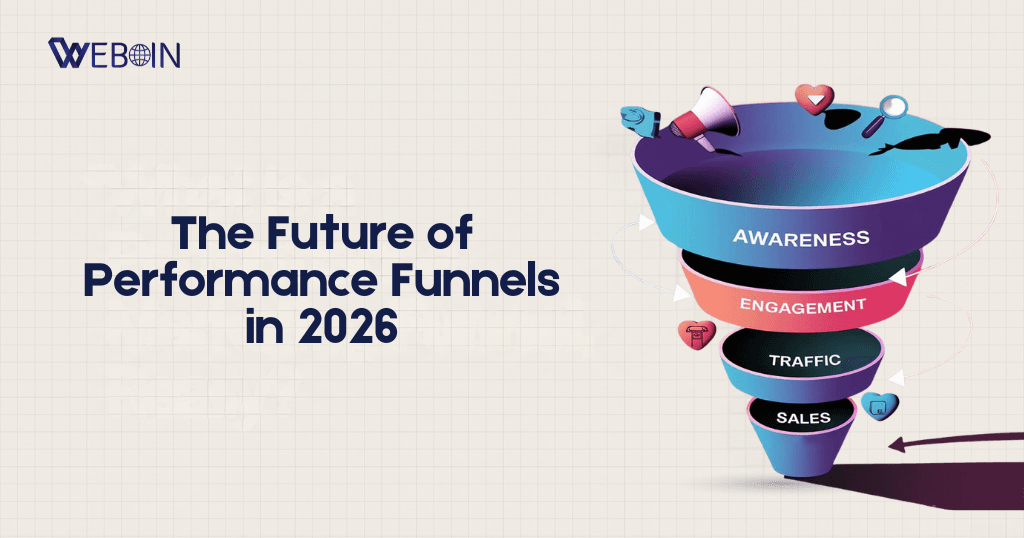
The funnel landscape is changing, and businesses that understand where things are heading will have a significant advantage over those reacting to changes after they happen.
- AI-Driven Personalisation: Static landing pages are giving way to dynamically personalised experiences. In 2026, a sophisticated funnel can serve different page content based on the user’s industry, company size, past interactions with your brand, geographic location, and device type. What the CEO of a manufacturing company sees on your landing page can — and arguably should — be different from what a freelance consultant sees.
- First-Party Data Strategy: With third-party cookies effectively deprecated and increasing privacy regulation, the funnels of 2026 are built on first-party data — information that users voluntarily share with you. This makes every lead magnet, every quiz, every survey, and every consultation form not just a conversion tool but a data collection asset. Building rich first-party profiles of your prospects is now a competitive differentiator.
- Conversational Funnels: WhatsApp-based and chatbot-enabled funnels are growing rapidly, particularly in markets like India where WhatsApp penetration is extraordinarily high. Rather than sending prospects to a traditional landing page, some of the most innovative funnels in 2026 begin a WhatsApp conversation directly from the ad click — creating an immediately personal, low-friction entry point.
- Predictive Lead Scoring: AI tools can now analyse behavioural signals across your funnel to predict which leads are most likely to convert. This allows you to prioritise follow-up, adjust ad bids in real time for high-value prospects, and create segmented nurture sequences that reflect the lead’s likelihood and urgency.
Conclusion: Stop Counting Clicks. Start Building Systems.
We’ve covered an enormous amount of ground in this guide, and it’s worth stepping back to see the complete picture before you close this tab and return to your dashboard.
The central truth of performance marketing is this: a click has no intrinsic value. It only has value when it enters a system designed to convert it.
The most expensive thing in digital marketing is not a high CPC. It’s a high CPC attached to a broken funnel. Every rupee you spend driving traffic to a poorly designed, poorly tracked, or psychologically naive conversion experience is a rupee that will never come back.
Building a performance marketing funnel is not a campaign — it is an investment in infrastructure. Done correctly, it becomes the most valuable commercial asset your business owns: a predictable, scalable, data-driven machine that turns advertising spend into revenue at a known, improvable rate.
The businesses dominating digital marketing in Chennai right now — whether they’re working with a specialist performance marketing agency or building capabilities in-house — share one characteristic. They have stopped treating marketing as a series of one-off campaigns and started treating it as a compounding system. Every test teaches them something. Every piece of data makes the next decision smarter. Every optimisation makes the next rupee work harder.
That’s the power of the funnel. Not just the architecture, but the discipline of continuous improvement that it demands.
Here is your final checklist before you move forward:
- Message Match: Does every ad land on a page that mirrors its promise exactly?
- Page Speed: Is your landing page loading in under 2 seconds on mobile?
- Single CTA: Is there exactly one action you’re asking visitors to take?
- Social Proof: Is there specific, verifiable evidence that you’ve delivered results for others?
- Tracking: Are you running GA4 with proper conversion events, and have you set up the Meta Pixel and Google Remarketing Tag?
- Remarketing: Are you reaching back out to the people who visited but didn’t convert?
- CRO Process: Do you have a documented, ongoing testing programme to improve conversion rates?
- Retention Strategy: Are you investing in keeping the customers you’ve already paid to acquire?
Answer “yes” to all eight, and you’re operating at a level that puts you ahead of the overwhelming majority of businesses competing for the same attention online.
The clicks are already out there. The question is whether you’ve built something worth converting them.

No comment yet, add your voice below!