
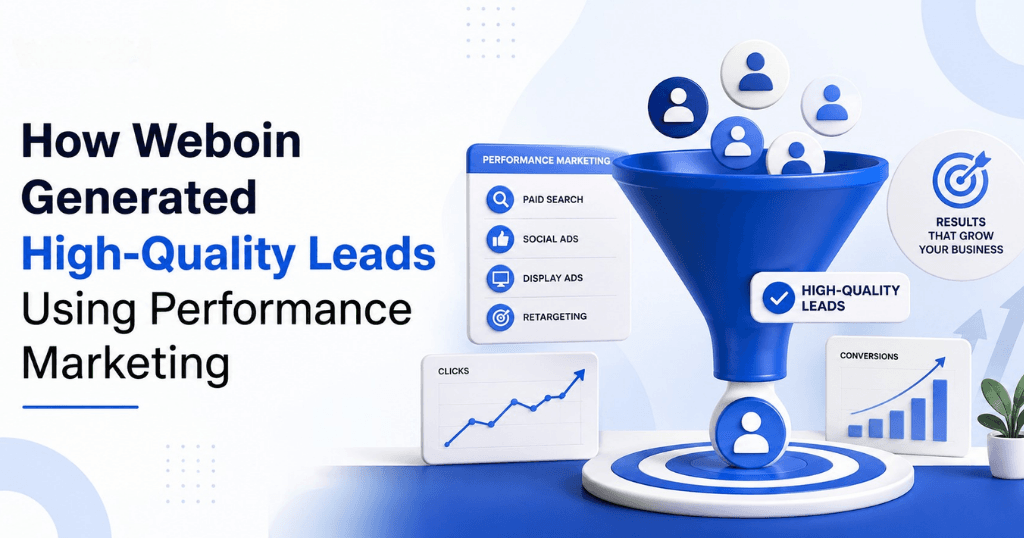
There is a metric that almost every business tracks and almost every business misunderstands: lead volume.
More leads feel like progress. A dashboard showing 300 leads this month compared to 200 last month feels like marketing is working. But lead volume, in isolation, is one of the most misleading numbers in digital marketing. Three hundred leads that convert at 1% generate three customers. One hundred leads that convert at 9% generate nine. The second scenario produces three times the revenue at one-third the volume — and typically at a lower cost per customer, because high-quality leads require less sales effort and close faster.
This distinction — between lead quantity and lead quality — is the central tension in performance marketing. Most businesses, and most agencies, optimise for the metric they can most easily control: volume. Weboin’s approach is built around optimising for the metric that actually matters: quality. And the methodology that emerges from that orientation is fundamentally different from conventional campaign management.
This guide explains exactly how Weboin’s performance marketing framework generates high-quality leads — the seven-step methodology that drives consistent results, the specific tools and techniques applied at each stage, the results that methodology produces across industries, and the common mistakes that prevent most businesses from achieving comparable outcomes.
What Performance Marketing Actually Is — and What It Isn’t
Performance marketing is a digital marketing approach where every activity is tied to a measurable, commercially meaningful outcome. You pay for results — leads, conversions, sales — not for exposure. You optimise based on data, not assumptions. You scale what works and cut what doesn’t, as quickly as the data allows you to be confident in those decisions.
This sounds like the obvious way to manage marketing. In practice, the majority of marketing spend — even “digital” marketing spend — is still managed against activity metrics that are one, two, or three steps removed from actual business outcomes. Impressions, clicks, page views, session duration, social media reach — these are inputs to business results, not results themselves. Performance marketing insists on measuring the outputs: leads, cost per lead, lead-to-customer conversion rate, customer acquisition cost, and return on ad spend.
Google’s research shows that businesses using data-driven marketing strategies are 23 times more likely to acquire customers than those that don’t. WordStream reports that properly optimised Google Ads campaigns can improve conversion rates by up to 200%. HubSpot’s data shows companies that prioritise lead quality over lead quantity achieving 50% higher rates of sales-ready leads. These are not marginal improvements — they are structural advantages that compound over time.
The Core Channels of Performance Marketing
| Channel | Primary Function | Funnel Stage |
|---|---|---|
| PPC Advertising (Google, Meta, LinkedIn) | Immediate traffic capture for specific intent | Bottom/Mid Funnel |
| SEO | Long-term organic visibility and lead generation | Top/Mid Funnel |
| Retargeting | Re-engaging previous visitors to drive conversion | Mid/Bottom Funnel |
| Conversion-Optimised Landing Pages | Capturing and qualifying leads from paid traffic | Bottom Funnel |
| Email Marketing | Nurturing warm leads through the consideration stage | Mid Funnel |
| Analytics and Attribution | Understanding what is driving results and what isn’t | All stages |
The key distinction between performance marketing and traditional marketing is not the channels — many channels appear in both approaches. It is the measurement discipline and the willingness to make budget allocation decisions based on what the data says rather than what feels right or what has always been done.
Why Lead Quality Is the Real Performance Metric
Before diving into the methodology, it is worth spending time on the lead quality principle, because it shapes every decision in the Weboin approach and is frequently underappreciated by businesses evaluating their marketing programmes.
A “lead” in most tracking systems is defined as any contact who provides their information through a form, a phone call, or a chat conversation. Under this definition, a student researching the industry for an academic project is counted the same as a CFO evaluating a software purchase. A homeowner making a casual enquiry with no timeline or budget is counted the same as a developer ready to sign a contract within weeks.
When marketing is optimised for lead volume, it naturally gravitates toward the cheapest traffic and the lowest-friction conversion actions — which systematically attracts the least qualified audience. When marketing is optimised for lead quality, every decision — keyword selection, audience targeting, ad messaging, landing page content, form design — is made with the question: does this attract and qualify the right people, or does it inflate the count at the expense of the conversion rate?
The business case for lead quality optimisation is straightforward. A sales team that spends 80% of its time on leads that will never close is an expensive, demoralised sales team. A sales team that spends 80% of its time on genuinely qualified prospects is a high-performing one. Marketing that generates fewer, better-qualified leads often produces better commercial outcomes than marketing that generates higher volume at lower quality — because the downstream conversion rate improvement multiplies the value of every lead.
This is the orientation that Weboin brings to every performance marketing engagement — and it requires a different methodology than conventional campaign management.
Weboin’s Seven-Step Performance Marketing Methodology
Step 1: Deep Audience Research and High-Intent Targeting
The most expensive form of performance marketing is reaching the wrong people. Budget spent acquiring traffic from audiences that will never convert is not just wasted — it pollutes your analytics with low-quality data that makes subsequent optimisation decisions harder.Weboin begins every performance marketing engagement with a structured audience research process designed to identify the specific people who are most likely to become high-quality customers, and to understand them with sufficient depth to reach them effectively.Customer persona development: Creating a detailed profile of the ideal customer — not a demographic abstraction, but a specific person with a specific role, specific challenges, specific information needs, and specific decision-making triggers. For a B2B SaaS client, the ideal customer might be a specific job title at companies of a specific size in specific industries, experiencing a specific operational problem at a specific growth stage. For a B2C ecommerce client, the ideal customer might be characterised by specific behavioural patterns, purchase frequency indicators, and demographic signals. The more specific the persona, the more precisely the campaign can be targeted.Search intent mapping: Not all keywords with high volume are high value. The same product can be searched with vastly different intent — “what is CRM software” (early awareness, very low purchase intent), “best CRM for small business Chennai” (active evaluation, moderate purchase intent), “CRM software pricing plans” (high purchase intent, near conversion). Weboin maps target keywords not just by volume and competition but by the specific commercial intent behind each query — and allocates budget accordingly, concentrating spend on high-intent terms that predict conversion.Competitor analysis: Understanding what competitors are bidding on, what messaging they’re using, where they’re strong and where gaps exist — provides the intelligence to position campaigns for differentiation rather than head-on competition in the most expensive keyword clusters. Gaps in competitor coverage represent opportunities to reach high-value audiences at lower cost.Historical data analysis: For clients with existing campaign history, Weboin’s initial audit examines which audience segments, which keywords, which ad formats, and which geographic targeting have historically produced the best-quality leads — not just the most leads. This historical quality data is the most reliable available signal for where to concentrate investment.The output of this research phase is not just a targeting plan but a deep understanding of the customer’s decision journey — which informs every subsequent decision about messaging, landing page content, and nurture strategy.Step 2: High-Converting Landing Page Architecture
The single biggest performance gap in most businesses’ paid advertising programmes is not the ads — it is the pages the ads send traffic to. Sending paid traffic to a generic homepage or a broad services page is the most common and most costly mistake in performance marketing. It is the equivalent of paying to bring a highly qualified prospect to your front door and then making them search through your entire building for what they came to find.
A high-converting landing page is a purpose-built conversion environment: designed for a specific audience with a specific intent, delivering a specific message, asking for a specific action. Every element on the page should serve the single objective of converting the visitor into a lead or customer.
Message match as the foundational principle: The headline and primary message of a landing page must precisely match the promise of the ad that sent traffic there. If the ad says “Free SEO Audit for Chennai Businesses,” the landing page headline should not say “Welcome to Our Agency.” It should say “Claim Your Free SEO Audit — For Chennai Businesses Only.” When there is a gap between the ad promise and the landing page message, visitors experience a moment of cognitive dissonance that triggers immediate back-click behaviour. Conversion rates drop dramatically. The entire ad spend that generated that traffic is wasted.
Above-the-fold clarity: The area of the page visible before scrolling must communicate, within three seconds, what the page offers, who it is for, and what the visitor should do next. Headlines must be specific and benefit-oriented, not clever or vague. Subheadlines must expand on the headline’s promise without requiring the visitor to read further to understand the basic proposition.
Trust signals in the right places: Trust is the prerequisite for conversion. No rational person submits their contact information to a business they don’t trust. Trust signals — client logos, specific testimonials with names and companies, review ratings from credible platforms, certifications, case study data — must appear near the conversion point, not buried at the bottom of the page. The visitor should see evidence of credibility before they are asked to provide their information.
Friction-minimised conversion actions: Every field in a contact form is a gate that some percentage of visitors won’t walk through. The optimal form length for lead generation is the minimum information needed to qualify the lead and follow up effectively. Weboin’s standard practice is to begin with the absolute minimum — typically name, email, and phone — and only add qualification fields where the improvement in lead quality demonstrably outweighs the reduction in form completion rate.
Mobile-first design as a non-negotiable baseline: The majority of paid traffic arrives from mobile devices. A landing page that is not fully functional, visually clean, and fast-loading on a 375px smartphone screen is converting a fraction of the traffic it should. Mobile optimisation is not a secondary consideration — it is where the primary design effort should be concentrated.
According to Unbounce, purpose-built landing pages consistently outperform generic pages by 30% or more in conversion rate. For businesses running significant paid advertising budgets, this improvement translates directly to a proportional reduction in cost per lead.
Step 3: PPC Campaign Execution with Revenue as the North Star
With audience research complete and landing pages built, Weboin deploys paid campaigns across the platforms most relevant to each client’s audience and objectives. As a results-driven ppc agency in Chennai, the approach to campaign construction is built entirely around the commercial outcomes the campaigns need to produce — not the platform-level metrics that are easy to optimise for.
Google Search Ads for high-intent capture: Search campaigns targeting purchase-intent keywords are the most direct form of performance marketing — reaching people who are actively searching for exactly what the business offers, at the moment of maximum purchase intent. Weboin’s search campaign construction focuses on: precise keyword match types that control which queries trigger ads, negative keyword lists that systematically exclude low-quality traffic, ad copy that directly addresses the search intent and sets expectations that the landing page can fulfill, and bid strategies calibrated to conversion value rather than click volume.
Performance Max campaigns for broad coverage: Google’s AI-driven Performance Max campaigns, when properly configured with strong conversion data and creative assets, extend coverage across Search, Display, YouTube, and Discover simultaneously. Weboin’s Performance Max approach requires significant upfront investment in creative asset quality — multiple headline variants, multiple description variants, high-quality image and video assets — because the AI optimises heavily based on creative performance signals.
Meta Ads for audience-based targeting and retargeting: While Google Search captures demand that already exists, Meta Ads create demand by reaching audiences based on interests, behaviours, and lookalike profiles from existing customers. Weboin’s Meta strategy for lead generation focuses on: Advantage+ audience configurations that allow Meta’s AI to optimise audience selection across a broad initial pool, creative testing frameworks that identify which visual formats and messaging angles perform best, and conversion-optimised campaign objectives that signal to Meta’s algorithm what outcomes to prioritise.
LinkedIn Ads for B2B audience precision: For clients selling to businesses — SaaS platforms, professional services, B2B manufacturers — LinkedIn’s professional audience targeting provides a level of intent-signal precision that no other paid platform matches. Job title, company size, industry, seniority level, and company growth rate targeting allows B2B campaigns to reach exactly the decision-makers who are relevant, reducing the lead qualification burden that comes with broader targeting.
Campaign funnel structure: Weboin structures paid campaigns as funnels rather than isolated campaigns — different campaign types serving different funnel stages and working in
coordination:
| Funnel Stage | Campaign Type | Goal |
|---|---|---|
| Awareness | Display, YouTube, Meta reach | Brand exposure to target audience |
| Consideration | Retargeting, Meta engagement | Re-engagement of previous visitors |
| Conversion | Search, Performance Max | Direct lead or sale generation |
| Win-back | Gmail ads, Meta retargeting | Re-engagement of lapsed leads |
This funnel structure ensures that the investment in awareness and consideration campaigns creates a warmer audience for conversion campaigns, improving conversion rates and reducing cost per acquisition.
Step 4: SEO Integration for Sustainable, Compounding Lead Generation
Performance marketing built exclusively on paid advertising has a structural vulnerability: traffic and leads stop the moment the budget stops. Every month, a business relying primarily on paid acquisition must spend the same or more to generate the same or more leads. There is no asset being built; there is only a tap being opened or closed.
Weboin’s performance marketing approach integrates SEO as the compounding component that builds sustainable lead generation capability alongside the immediate results of paid campaigns. As a trusted seo agency in Chennai, Weboin’s SEO work is designed not just to rank pages but to generate the specific leads that matter to each client’s business.
Technical SEO as the prerequisite: Before content or link building can work, the technical infrastructure must allow search engines to efficiently access, crawl, and index the site. Weboin’s technical SEO programme addresses Core Web Vitals performance (directly affecting both rankings and paid ad quality scores), crawlability and indexation management, schema markup for rich results and AI search citability, JavaScript rendering verification for AI crawler accessibility, and site architecture optimisation for crawl efficiency.
Commercial-intent keyword targeting: Organic SEO for lead generation focuses on a different keyword universe than top-of-funnel awareness SEO. Commercial-intent queries — “best [service type] in Chennai,” “[specific problem] solution,” “[product category] for [specific use case]” — represent organic traffic that is near conversion intent. Ranking for these terms generates leads directly from organic traffic without paid cost per click.
Topic cluster content strategy: Beyond commercial-intent pages, Weboin builds the topical authority infrastructure — comprehensive pillar content and supporting cluster content — that signals to search engines that the client’s domain is a genuine authority in its field. This authority building improves rankings across the entire keyword portfolio, not just the specific terms the cluster content targets.
Paid-organic integration for maximum efficiency: The integration of paid and organic data produces synergies that neither channel achieves alone. Keyword conversion data from paid search campaigns reveals which organic content topics are most worth prioritising. Organic ranking coverage for high-volume terms reduces the need for expensive paid bids on those terms, freeing budget for terms where organic coverage is weak. Over time, as organic rankings accumulate, the business’s overall customer acquisition cost decreases even as paid spend remains stable — because an increasing proportion of qualified traffic arrives without paid cost.
BrightEdge research confirms that organic search drives over 53% of trackable website traffic. For businesses that commit to building organic authority alongside paid performance, organic search eventually becomes their single largest and lowest-cost lead generation channel.
Step 5: Conversion Rate Optimisation — Making Every Visit Work Harder
Driving traffic to a website or landing page is only half the performance marketing equation. Converting that traffic into leads and customers is the other half — and it is the half that most businesses underinvest in.
The economics of CRO are compelling. A website converting at 1% that receives 10,000 monthly visitors generates 100 leads. The same traffic at 3% generates 300 leads — without any increase in acquisition spend. For a business paying ₹50 per click, the 1% conversion represents ₹5,000 per lead. The 3% conversion represents ₹1,667 per lead. The CRO investment that produces that improvement pays for itself many times over in reduced per-lead cost.
Weboin’s CRO programme operates as a continuous improvement system — not a one-time optimisation project.
Heatmapping and session recording analysis: Tools like Hotjar and Microsoft Clarity provide qualitative insight into user behaviour that analytics alone cannot reveal. Heatmaps show where visitors click, how far they scroll, and which page elements attract attention. Session recordings show actual visitor journeys — where they hesitate, where they get confused, and where they abandon. This data reveals the specific friction points that are preventing conversion, allowing targeted interventions rather than guesswork redesigns.
Common findings from heatmap analysis include: key information positioned below the scroll threshold where most visitors don’t reach it; CTA buttons positioned where users are not looking; form fields that cause high abandonment rates; and trust signals absent from the areas where visitors make their conversion decisions.
A/B testing with statistical rigour: Every significant variable on a high-traffic page — headline, CTA button text and colour, hero image, form length, social proof positioning — is a candidate for A/B testing. Weboin’s testing protocol requires: a clear hypothesis for what change is being tested and why, a sample size sufficient for statistical significance before declaring a winner, a single variable changed per test to isolate the causal factor, and a systematic testing calendar that ensures learnings accumulate continuously.
CTA optimisation as a high-leverage activity: The specific words on a call-to-action button have outsized impact on conversion rate. “Submit” consistently underperforms against benefit-specific alternatives. “Get My Free Audit” outperforms “Submit Form.” “Start Growing Today” outperforms “Contact Us.” The CTA is the final moment before conversion — the text that communicates what value the visitor will receive in exchange for their information — and it deserves proportional creative investment.
Form optimisation for quality-quantity balance: Every form field addition reduces completion rate but potentially increases lead quality by filtering less committed visitors. Finding the optimal balance requires testing. Weboin’s standard starting position is the minimum viable information for follow-up (name, email, phone), with qualification fields tested incrementally to understand their conversion rate impact before committing to their inclusion.
Page speed as a conversion factor: Google research shows that conversion rates drop significantly when page load time exceeds three seconds. This is both a ranking factor (Core Web Vitals) and a direct conversion factor — impatient visitors who abandon before a page loads fully are lost leads that no amount of optimisation can recover. Weboin treats page speed not as a technical nicety but as a commercial requirement.
Step 6: Retargeting — Converting the 97% Who Don’t Convert on First Visit
Most visitors who click on an ad — even a highly targeted one with a compelling offer and a well-designed landing page — do not convert on their first visit. Research consistently shows that 96-97% of website visitors leave without taking a conversion action. This is not primarily because they are uninterested; it is because the moment of their visit often doesn’t align with their readiness to convert. They may need time to evaluate, compare, consult colleagues, or simply wait until their timing is right.
Retargeting is the mechanism that maintains brand presence during this evaluation period — keeping the business visible to potential customers who have demonstrated interest but haven’t yet converted.
Audience segmentation for relevant retargeting: Not all website visitors are equal, and not all retargeting audiences should receive the same message. Weboin segments retargeting audiences by behaviour — specifically by what they did on the site — and crafts messages relevant to that behaviour:
Visitors who viewed the pricing page are close to purchase decision and respond to direct conversion offers or risk-reduction messages (free trial, money-back guarantee, case study social proof).
Visitors who read multiple blog posts but never visited service pages are still in awareness/consideration and respond to educational content that moves them toward evaluation.
Visitors who started but didn’t complete a form have the highest purchase intent and respond to simplified conversion paths or direct outreach offers.
Cart abandoners (for ecommerce) respond to specific product reminders, sometimes with a time-limited discount.
Frequency and timing management: Retargeting that follows a prospect too aggressively — too many impressions, too frequently, over too long a period — creates the opposite of its intended effect. Rather than building familiarity, it breeds annoyance. Weboin’s retargeting management includes frequency caps and time-based audience exclusions that ensure retargeting remains a positive touchpoint, not a harassment channel.
Creative evolution across the retargeting window: Showing the same creative to the same audience repeatedly produces creative fatigue — declining click rates and increasing irritation. Weboin’s retargeting creative strategy rotates messaging across the consideration window, progressing from brand reinforcement in the early post-visit period to specific objection handling in the middle period to direct conversion incentives (where appropriate) in the later period.
Email retargeting for known contacts: For visitors who have previously provided their email address — through a lead magnet, a previous enquiry, or a purchase — email retargeting through personalised sequences is significantly more effective than display retargeting because it reaches known individuals with fully personalised messages rather than generic audience segments.
Step 7: Data Tracking, Attribution, and Continuous Optimisation
Performance marketing without rigorous tracking is not performance marketing — it is expensive experimentation without feedback. Every spend decision, every creative change, every targeting adjustment should be informed by data that connects marketing activity to commercial outcomes.
Weboin’s tracking and analytics infrastructure is built to answer the questions that actually matter to business decision-making.
Conversion tracking across the full journey: Most businesses track last-click conversions — attributing a lead or sale to the final touchpoint before conversion. This systematically undervalues the channels and content that generate initial awareness and consideration, leading to underinvestment in top and middle funnel activities that are critical to the overall acquisition journey. Weboin implements multi-touch attribution models that distribute credit across the customer journey, providing a more accurate picture of what is driving results.
The metrics that matter for performance marketing:
| Metric | What It Measures | Why It Matters |
|---|---|---|
| Cost Per Lead (CPL) | Total spend divided by leads generated | Efficiency of acquisition investment |
| Lead Quality Score | Percentage of leads that qualify as sales-ready | Effectiveness of targeting and messaging |
| Lead-to-Customer Rate | Percentage of leads that convert to customers | Quality of the full acquisition system |
| Customer Acquisition Cost (CAC) | Total marketing spend divided by new customers | True cost of growth |
| Return on Ad Spend (ROAS) | Revenue generated divided by ad spend | Commercial return on paid investment |
| Organic vs Paid Lead Ratio | Proportion of leads from each channel | Balance between short-term and long-term investment |
Monthly performance review and optimisation cycle: Weboin’s performance marketing engagements operate on a structured monthly cycle: data collection and analysis in the first week, identification of the highest-impact optimisation opportunities in the second week, implementation of changes in the third week, and monitoring of impact and iteration in the fourth week. This cycle ensures that every month’s investment is informed by the previous month’s learnings, creating continuous improvement rather than static campaign management.
Scaling decisions based on performance data: When a campaign is generating leads at a quality and cost that meets or exceeds targets, the right decision is to scale it. Weboin’s scaling methodology increases budgets in measured steps — typically 15-20% increments — to avoid triggering algorithm learning resets that can temporarily degrade performance. Horizontal scaling (expanding to new audience segments or geographic targets) is used to reach new audiences with proven messaging before vertical scaling (increasing budget on existing campaigns) is maximised.
Performance Marketing Results: What the Weboin Methodology Achieves
The performance outcomes that Weboin’s methodology consistently produces across client engagements reflect the compounding effect of all seven steps working as an integrated system.
| Metric | What It Measures | Why It Matters |
|---|---|---|
| Cost Per Lead (CPL) | Total spend divided by leads generated | Efficiency of acquisition investment |
| Lead Quality Score | Percentage of leads that qualify as sales-ready | Effectiveness of targeting and messaging |
| Lead-to-Customer Rate | Percentage of leads that convert to customers | Quality of the full acquisition system |
| Customer Acquisition Cost (CAC) | Total marketing spend divided by new customers | True cost of growth |
| Return on Ad Spend (ROAS) | Revenue generated divided by ad spend | Commercial return on paid investment |
| Organic vs Paid Lead Ratio | Proportion of leads from each channel | Balance between short-term and long-term investment |
These improvements do not typically manifest immediately — the compounding effect of SEO integration, retargeting audience building, and continuous CRO accumulates over three to six months before it reaches full velocity. But the direction is consistent from the first month, and the rate of improvement accelerates as data volume increases and optimisation decisions become more precise.
Industries Where the Weboin Performance Marketing Approach Delivers the Strongest Results
Ecommerce
Ecommerce performance marketing requires simultaneous optimisation across the three variables that determine commercial success: traffic quality, conversion rate, and average order value. Weboin’s ecommerce approach combines Google Shopping and Performance Max for product discovery, Meta catalogue advertising for audience-based product promotion, and conversion-focused product page and checkout flow optimisation that reduces abandonment.Healthcare
Healthcare lead generation requires navigating the intersection of high patient intent, strict content standards, and the trust-intensive nature of healthcare decisions. Weboin’s healthcare performance marketing focuses on: local SEO for clinic and practice discovery, Google Ads for appointment-specific queries, landing pages that build clinical credibility before asking for contact information, and retargeting funnels that provide educational content to prospects who aren’t ready to book immediately.Real Estate
Real estate performance marketing in Chennai involves long consideration cycles, high transaction values, and the need to qualify leads against specific budget and timeline criteria before passing them to sales teams. Weboin’s real estate approach builds lead funnel architectures that capture enquiries, qualify them through structured form flows, and nurture unconverted leads through longer email sequences calibrated to typical property purchase timelines.SaaS
B2B SaaS performance marketing requires reaching specific decision-makers with specific messages calibrated to specific stages of a typically long evaluation cycle. Weboin’s SaaS approach combines LinkedIn targeting for precise role-based reach, content marketing for educational top-of-funnel engagement, SEO for commercial-intent organic discovery, and retargeting funnels that nurture trial sign-ups through activation and toward paid conversion.Education
Educational institution marketing involves seasonal demand peaks, high competition for specific programme searches, and the need to reach both prospective students and their parents as decision-influencers. Weboin’s education performance marketing integrates Google Search for programme-specific intent capture, YouTube for campus and faculty content that builds preference, and local SEO for institution discovery by geographically relevant audiences.Common Performance Marketing Mistakes That Limit Results
Driving paid traffic to non-dedicated pages: Sending campaign traffic to a homepage or general services page is one of the most common and most costly conversion rate suppressors. Every paid campaign should have a purpose-built landing page with message match to the ad.
Optimising for volume rather than quality at every stage: If keyword targeting is too broad, audience targeting is too generic, or ad messaging is positioned to attract the widest possible audience, the leads generated will reflect that — high volume, low quality, high downstream sales burden.
Ignoring the organic foundation: Businesses that invest exclusively in paid advertising are paying perpetually for visibility that disappears the moment the budget stops. Integrating SEO as a parallel investment builds the asset that reduces paid dependency over time. Any digital marketing company in Chennai that manages paid and organic as separate, uncoordinated programmes is leaving the most valuable synergies unrealised.
Treating CRO as a one-time project: Landing page optimisation is not a one-time activity — it is a continuous improvement programme. The businesses that achieve the best conversion rates are those that test systematically and continuously, accumulating marginal improvements that compound into significant performance advantages.
Setting tracking up incorrectly and making decisions on bad data: If conversion tracking is not properly implemented — if GA4 events aren’t firing correctly, if offline conversions aren’t being imported, if attribution is purely last-click — every optimisation decision based on that data is directionally incorrect. Before any campaign launches, Weboin verifies that tracking is complete and accurate.
Abandoning retargeting audiences: Most businesses set up basic retargeting campaigns and then neglect them — same creative, same audience, no frequency management, no progression in messaging. Retargeting requires the same creative and strategic attention as prospecting campaigns to remain effective.
Common Performance Marketing Mistakes That Limit Results
Driving paid traffic to non-dedicated pages: Sending campaign traffic to a homepage or general services page is one of the most common and most costly conversion rate suppressors. Every paid campaign should have a purpose-built landing page with message match to the ad.
Optimising for volume rather than quality at every stage: If keyword targeting is too broad, audience targeting is too generic, or ad messaging is positioned to attract the widest possible audience, the leads generated will reflect that — high volume, low quality, high downstream sales burden.
Ignoring the organic foundation: Businesses that invest exclusively in paid advertising are paying perpetually for visibility that disappears the moment the budget stops. Integrating SEO as a parallel investment builds the asset that reduces paid dependency over time. Any digital marketing company in Chennai that manages paid and organic as separate, uncoordinated programmes is leaving the most valuable synergies unrealised.
Treating CRO as a one-time project: Landing page optimisation is not a one-time activity — it is a continuous improvement programme. The businesses that achieve the best conversion rates are those that test systematically and continuously, accumulating marginal improvements that compound into significant performance advantages.
Setting tracking up incorrectly and making decisions on bad data: If conversion tracking is not properly implemented — if GA4 events aren’t firing correctly, if offline conversions aren’t being imported, if attribution is purely last-click — every optimisation decision based on that data is directionally incorrect. Before any campaign launches, Weboin verifies that tracking is complete and accurate.
Abandoning retargeting audiences: Most businesses set up basic retargeting campaigns and then neglect them — same creative, same audience, no frequency management, no progression in messaging. Retargeting requires the same creative and strategic attention as prospecting campaigns to remain effective.
Performance Marketing Trends Shaping 2026
AI-Powered Campaign Optimisation Has Become Mandatory, Not Optional
Google’s Performance Max and Meta’s Advantage+ campaigns require fundamentally different management approaches than the manual campaign structures of three years ago. The creative assets, audience signals, and conversion data provided to these systems determine their performance — meaning the agency’s job has shifted from tactical campaign management to strategic asset development and signal quality management. Agencies still operating on manual campaign structures are surrendering significant performance efficiency to competitors working with current methodology.First-Party Data Is Now a Competitive Moat
With third-party cookie deprecation substantially complete and privacy regulations strengthening in India and globally, the targeting advantage historically available through third-party audience data has diminished significantly. Businesses with large, rich first-party data assets — email lists, CRM data, website behavioural data, purchase history — have targeting capabilities that businesses without these assets cannot replicate. Performance marketing programmes that systematically build first-party data assets — through lead magnets, email capture, progressive profiling in CRM — are building a compounding competitive advantage.Video Advertising Has Moved From Supplementary to Essential
Short-form video — YouTube Shorts, Instagram Reels, Meta video formats — has become a primary performance advertising format, not just a brand awareness vehicle. Video ads in direct response configurations (with specific CTAs and conversion tracking) consistently outperform static image ads for specific audience segments. Performance marketing programmes that don’t include video creative in their mix are systematically excluded from the highest-performing placements.Attribution Complexity Requires Sophisticated Measurement
As customer journeys become more complex — more channels, more devices, longer consideration periods — the limitations of last-click attribution become more consequential. A customer who converts on a brand search ad after reading three blog posts, watching a YouTube ad, and engaging with an Instagram story is attributing that conversion to the last click while the preceding seven touchpoints remain invisible. Weboin’s attribution infrastructure tracks the full journey, providing the data needed to make channel investment decisions that reflect actual impact.Performance Marketing Trends Shaping 2026
AI-Powered Campaign Optimisation Has Become Mandatory, Not Optional
Google’s Performance Max and Meta’s Advantage+ campaigns require fundamentally different management approaches than the manual campaign structures of three years ago. The creative assets, audience signals, and conversion data provided to these systems determine their performance — meaning the agency’s job has shifted from tactical campaign management to strategic asset development and signal quality management. Agencies still operating on manual campaign structures are surrendering significant performance efficiency to competitors working with current methodology.First-Party Data Is Now a Competitive Moat
With third-party cookie deprecation substantially complete and privacy regulations strengthening in India and globally, the targeting advantage historically available through third-party audience data has diminished significantly. Businesses with large, rich first-party data assets — email lists, CRM data, website behavioural data, purchase history — have targeting capabilities that businesses without these assets cannot replicate. Performance marketing programmes that systematically build first-party data assets — through lead magnets, email capture, progressive profiling in CRM — are building a compounding competitive advantage.Video Advertising Has Moved From Supplementary to Essential
Short-form video — YouTube Shorts, Instagram Reels, Meta video formats — has become a primary performance advertising format, not just a brand awareness vehicle. Video ads in direct response configurations (with specific CTAs and conversion tracking) consistently outperform static image ads for specific audience segments. Performance marketing programmes that don’t include video creative in their mix are systematically excluded from the highest-performing placements.Attribution Complexity Requires Sophisticated Measurement
As customer journeys become more complex — more channels, more devices, longer consideration periods — the limitations of last-click attribution become more consequential. A customer who converts on a brand search ad after reading three blog posts, watching a YouTube ad, and engaging with an Instagram story is attributing that conversion to the last click while the preceding seven touchpoints remain invisible. Weboin’s attribution infrastructure tracks the full journey, providing the data needed to make channel investment decisions that reflect actual impact.Final Thoughts: Performance Marketing as a Commercial Growth System
The businesses that achieve the best results from performance marketing are those that understand it as a system, not a service. A system of interconnected components — audience research, landing page architecture, paid campaign management, organic SEO integration, retargeting, and conversion optimisation — each working in coordination with the others, each improving in efficiency as data accumulates and learnings compound.
Building this system requires a partner that manages all of its components with genuine expertise and genuine accountability for outcomes rather than activity. It requires a seo company in Chennai that understands how organic authority reduces paid dependency. It requires a ppc agency in Chennai that builds campaigns against revenue metrics rather than impression metrics. It requires a digital marketing company in Chennai that integrates landing page performance, retargeting intelligence, and attribution data into a coherent picture of what is actually driving business growth.
That is what Weboin delivers — and the performance improvements documented in this guide are the evidence of what that integrated approach produces. Higher lead quality, lower acquisition costs, better conversion rates, and the compounding advantage of an organic foundation that grows in value with every passing month.
For businesses ready to move from single-channel advertising to integrated performance marketing — from optimising for leads to optimising for growth — the system described in this guide is the starting point. And for those looking for a reliable digital marketing agency in Chennai that can build and manage that system with genuine expertise and genuine accountability, Weboin’s track record speaks directly to that capability.
The difference between performance marketing that generates volume and performance marketing that generates growth is methodology. This is the methodology.

No comment yet, add your voice below!