
Starting a business is the easy part. Scaling one is where most founders discover what they were actually signing up for.
The statistics are sobering. CB Insights research shows that nearly 38% of startups fail because they run out of cash — but embedded in that number is a more specific cause: most startups run out of cash because they fail to build the customer acquisition engine that would have kept revenue flowing. Poor market positioning, weak digital visibility, ineffective lead generation, and inability to convert traffic into paying customers are not peripheral problems. They are the central causes of startup failure, dressed up as a cash problem.
The answer that most founders reach for is hiring a marketing agency. And in most cases, that answer solves the wrong problem.
The typical agency relationship is fundamentally transactional. The agency delivers a defined set of services — social media posts, SEO reports, Google Ads campaigns, a website — and the founder is left to figure out how those services connect to the revenue outcomes that actually determine whether the business survives. The agency optimises for the metrics it can measure easily. The founder needs optimisation for the outcomes that matter — qualified leads, customer acquisition cost, conversion rate, market positioning, brand trust.
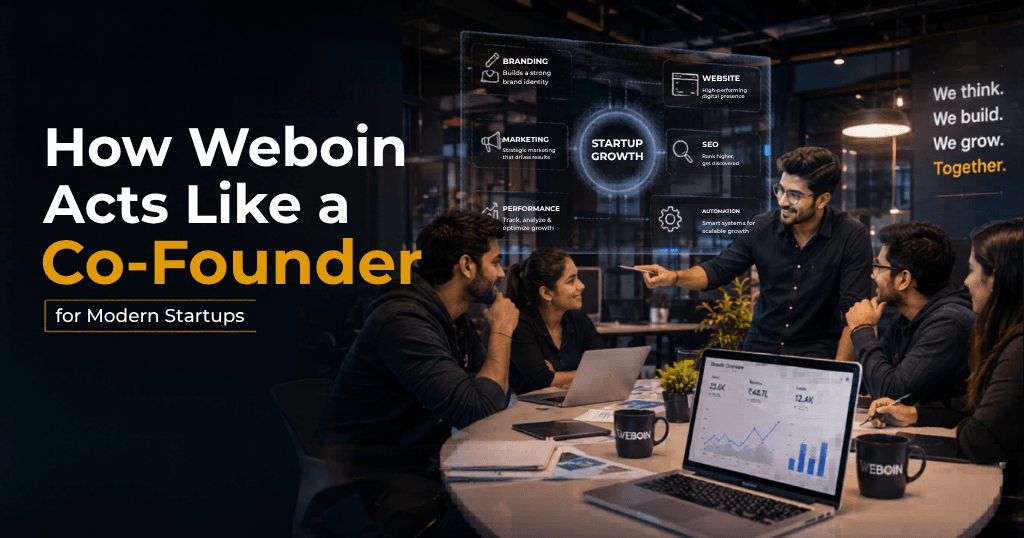
What modern startups actually need is not a vendor. It is a growth partner — an entity that thinks about the business the way a co-founder would, that contributes strategy alongside execution, and that treats the startup’s commercial outcomes as its own success criteria.
This is what Weboin has built its model around. And this guide explains what that model looks like in practice — how it differs from conventional agency relationships, what it delivers across each dimension of startup growth, and why it has become the approach that Chennai’s most ambitious startups are increasingly choosing.
The Startup Reality That Traditional Agencies Are Not Built For
The startup environment is distinct from the established business environment in ways that matter enormously for how marketing and growth strategy should be approached.
Resource constraints are structural, not temporary. Most startups operate with lean budgets that must deliver maximum commercial return. Every rupee invested in marketing must work harder than it would in a company with an established customer base and predictable revenue. There is no room for the exploratory brand campaigns or long-horizon awareness spending that established companies can afford. Every marketing activity must connect to a measurable step in the customer acquisition journey.
Speed matters in ways it doesn’t for established businesses. A startup that takes twelve months to establish its market positioning has potentially given competitors a twelve-month head start. The pace of iteration — testing hypotheses, learning from data, adjusting strategy — needs to be significantly faster than the typical large agency’s approval and execution cycles allow.
Digital foundation decisions made early have long-term compounding effects. The website architecture built in month one creates the technical context in which SEO will operate for years. The brand positioning established in the early months shapes customer perception for the life of the business. The content strategy built in the first year determines topical authority building for the next three. Decisions that seem tactical in the moment are actually strategic, and they are much easier to get right from the start than to correct later.
The channels and strategies that work for established brands often don’t work for startups. A startup competing for the same keywords as an established competitor with five years of domain authority will not win through brute-force SEO spending. It needs a more intelligent approach — identifying the specific search intent angles where it can compete, building topical authority in niches where established players haven’t invested, and converting that niche authority into the domain credibility that allows it to compete more broadly over time.
Traditional agencies are typically not structured to address these realities. Their processes, pricing models, and delivery frameworks are built around established business marketing — executing defined services for clients who already have stable foundations. When a startup engages a conventional digital marketing agency in Chennai for the same services designed for established clients, it pays for a framework that doesn’t fit its actual situation.
Weboin was built around a different starting point: what does a startup actually need to grow, and how should a growth partner be structured to deliver it?
What “Acting Like a Co-Founder” Actually Means in Practice
The phrase “co-founder mindset” is easy to use as marketing language. It is harder to define with the specificity that makes it a meaningful commitment. Here is what it actually means in Weboin’s approach to startup partnerships.
Thinking in Problems, Not Services
A conventional agency receives a brief — “we need social media management” or “we need SEO” — and delivers the specified service. A co-founder partner receives a business challenge — “we’re generating traffic but not converting it into leads” or “we’re invisible in search for the terms our customers are using” — and works backwards to the strategy and execution that solves it.
The distinction is significant. A startup that hires for social media management gets social media management, whether or not social media is actually the constraint limiting their growth. A startup that engages a co-founder partner gets an honest assessment of what is actually limiting growth and a strategy built around that reality.
Taking Responsibility for Business Outcomes, Not Activity Metrics
Co-founders are accountable for whether the business succeeds, not for whether specific tasks were completed on schedule. Weboin applies this accountability structure to its startup relationships — measuring its own performance against qualified lead volume, customer acquisition cost, conversion rates, and organic visibility growth rather than against the activity metrics (posts published, keywords tracked, reports delivered) that conventional agencies use to demonstrate value.
This outcome orientation changes the decision-making calculus at every level. It changes what content gets prioritised (what will generate leads, not what is easiest to produce). It changes how paid campaigns are structured (what conversion outcome are we optimising for, not what reach can we achieve). It changes how website design decisions are made (what layout will convert at the highest rate, not what looks most impressive in a portfolio).
Integrating Across Functions Rather Than Operating in Silos
A startup’s digital growth ecosystem is deeply interconnected. Website performance directly affects SEO rankings, paid ad conversion rates, and user retention. SEO strategy determines what content is worth producing and how it should be structured. Brand positioning shapes the messaging used across all channels and the trust signals that determine conversion probability. Paid media performance is heavily influenced by landing page quality and conversion architecture.
When these functions are managed by separate vendors without coordination, they produce fragmented results — each component optimised independently, none optimised as a system. Weboin’s co-founder model integrates all of these functions into a single strategic framework, managed by a team that understands how each decision affects the others.
The Five Pillars of Weboin’s Startup Growth Model
Pillar 1: Website Development Built for Commercial Performance
Most startup founders make their first major digital mistake when commissioning their website. They evaluate web design firms on portfolio aesthetics and price, and they end up with a website that looks credible but performs poorly — ranking weakly on Google because SEO architecture wasn’t integrated into the development decisions, converting visitors at low rates because UX and conversion psychology weren’t applied to the layout, and loading slowly on mobile because performance engineering wasn’t prioritised.
Weboin’s website development approach treats the website as the startup’s primary commercial asset — the hub that every other marketing activity drives traffic toward, and therefore the asset whose performance most directly determines the return on all marketing investment.
SEO architecture from day one: URL structure, site hierarchy, internal linking architecture, schema markup implementation, content management approach — these decisions are made with SEO requirements as a primary consideration, not as a post-launch retrofit. A website built with the right SEO architecture can begin generating organic visibility from its first days indexed. One built without it requires expensive corrective work before organic growth can begin.
Core Web Vitals engineering: Google’s page experience metrics — Largest Contentful Paint, Interaction to Next Paint, and Cumulative Layout Shift — are direct ranking factors. Weboin engineers these metrics at the code level, not the configuration level. LCP is addressed through server response time, render-blocking resource elimination, and proper image delivery pipelines. CLS is addressed through dimension specification for media, font loading strategy, and dynamic content handling. The result is websites that pass Core Web Vitals thresholds on mobile — where the majority of local search traffic arrives — and benefit from the ranking advantage that compliance provides.
Conversion optimisation as a design principle: The placement of calls to action, the sequence in which information is presented, the friction in contact forms, the trust signals shown at decision-making moments — these are not afterthoughts in Weboin’s development process. They are first principles that shape design decisions before visual choices are made. For startups where each website visit represents real marketing spend, the difference between a 1% and a 3% conversion rate is the difference between a website that pays for itself and one that doesn’t.
AI-search compatibility: Semantic HTML, structured data markup, entity-rich content, and FAQ schema are built into every site Weboin develops — ensuring that AI Overviews and AI-powered search systems can properly access, interpret, and represent the startup’s content in the generated answers where more and more buying decisions begin.
Pillar 2: SEO That Builds a Long-Term Commercial Asset
The most common SEO mistake startups make is treating it as a tactical channel rather than a strategic investment. They allocate a small monthly budget, expect results in sixty days, and abandon the programme when those results don’t materialise — returning instead to paid advertising with its immediate but expensive and non-compounding returns.
Weboin approaches SEO as one of the highest-value long-term investments a startup can make, and as an seo agency in Chennai that has seen this play out across hundreds of client engagements, the evidence for that position is strong. A startup that builds genuine organic authority in its first two years of operation will, in its third and fourth years, be generating leads from organic search at a fraction of the customer acquisition cost of its paid-only competitors — because the asset built by that investment compounds in value while the investment in maintaining it remains relatively stable.
Technical SEO as the foundation: Every Weboin SEO engagement begins with a forensic technical audit — crawlability assessment, Core Web Vitals analysis, indexation health review, schema markup evaluation, site architecture assessment, and JavaScript rendering verification for AI crawler accessibility. Technical issues that limit a site’s ability to rank are the first priority, because they are the leverage point that most directly amplifies the value of every subsequent SEO investment.
Entity-based semantic SEO: Weboin’s content strategy is built around the concept of topical authority — establishing the startup’s domain as a comprehensive, reliable source of information on its core subject areas. This means building topic clusters: a comprehensive pillar page covering a core subject broadly, supported by cluster content that goes deep on specific subtopics. This architecture signals to search engines that the domain is a genuine authority, not just a site with occasional relevant content.
Local SEO for Chennai-based startups: For startups serving the Chennai market, local search visibility — appearing in Google’s Map Pack, ranking for location-specific queries, maintaining a properly optimised Google Business Profile — directly translates to qualified local enquiries. Weboin’s local SEO capability addresses every dimension of local visibility: GBP optimisation, local citation consistency, review generation strategy, and hyperlocal content for specific Chennai districts and neighbourhoods.
AI-search optimisation: As Google’s AI Overviews, Perplexity, and ChatGPT Search capture an increasing proportion of search interactions, Weboin structures startup content to be citable by AI systems — not just rankable in traditional results. This involves answer-structured content that AI systems can directly extract, entity authority building that establishes credibility in AI knowledge bases, and factually dense content with proper attribution that meets the higher evidentiary standard AI systems apply when selecting sources.
Weboin’s standing as a best seo company in Chennai is built on outcomes rather than promises — on the compounding organic authority that its clients’ domains accumulate over time, and on the measurable reduction in customer acquisition cost that follows.
Pillar 3: Branding That Makes Startups Commercially Memorable
A startup without distinctive branding is competing on price and proximity — the weakest possible competitive positions. In crowded digital markets where potential customers encounter multiple alternatives in a single search session, the brands that convert are those that create a specific, memorable identity that stands apart from the generic.
Weboin’s branding work for startups is not primarily about visual design — it is about competitive positioning and market communication strategy. The visual elements (logo, colour system, typography, design language) are important, but they are expressions of the positioning decisions that precede them, not substitutes for them.
Positioning strategy: Before any visual or content decisions, Weboin works with startup founders to establish the core positioning — the specific, defensible claim about what the startup does better or differently than alternatives, and for whom that difference is most valuable. This positioning shapes every subsequent communication decision.
Brand messaging architecture: The language that best communicates the startup’s value to its specific target audience, the tone that builds credibility and connection simultaneously, the specific claims that differentiate without overpromising — these are the messaging decisions that determine whether marketing copy converts or slides past a reader’s attention.
Content identity and consistency: Consistent brand expression across all touchpoints — website, social media, paid ads, email, sales materials — creates the cumulative impression that builds trust over repeated exposures. Weboin’s branding work establishes the standards that ensure this consistency without requiring every content decision to go through a lengthy approval process.
Research from Lucidpress indicates that consistent branding can increase revenue by up to 23% — a figure that reflects the practical commercial impact of building a brand that customers recognise, remember, and trust more readily than alternatives.
Pillar 4: Performance Marketing That Prioritises Revenue Over Metrics
Performance marketing for startups requires a specific discipline that many agencies don’t apply: ruthless prioritisation of the metrics that connect to revenue, and elimination of the metrics that look impressive but don’t.
Impressions and reach are not performance metrics — they are awareness metrics that may or may not contribute to business outcomes. Qualified leads, cost per qualified lead, conversion rate from lead to customer, and revenue attributed to paid channels are performance metrics. Weboin’s paid media work is structured around the second category, not the first.
Funnel-integrated campaign architecture: Paid campaigns at Weboin are designed as integrated funnels, not isolated traffic acquisition activities. The ad, the landing page, the lead capture mechanism, and the follow-up sequence are designed together as a system — with each component optimised for its specific function in moving a potential customer from awareness to conversion.
Platform selection based on audience, not habit: Weboin manages campaigns across Google Ads (Search, Display, Performance Max), Meta Ads (including Advantage+ campaign structures), LinkedIn (for B2B startups), and YouTube. Platform selection for each startup is based on where the target audience actually is and what campaign objectives are most important at the current growth stage — not on which platforms the agency is most comfortable managing.
Performance marketing integrated with SEO: One of the most valuable aspects of Weboin’s co-founder model is the integration of paid and organic strategy. Keyword conversion data from paid search campaigns directly informs organic content priorities. Organic ranking coverage reduces the need for paid bids on terms where organic positions are strong, improving paid budget efficiency. This integration produces better combined search visibility for a given total budget than treating paid and organic as independent programmes.
Landing page optimisation as a core function: A campaign that drives traffic to a poorly converting landing page is burning budget. Weboin treats landing page performance as a core paid media responsibility — not as a separate service — designing, testing, and continuously improving the pages that paid traffic lands on to maximise the commercial return from every rupee of ad spend.
Pillar 5: AI-Search Optimisation for Future-Proof Visibility
The search landscape of 2026 is different in kind, not just degree, from what it was three years ago. AI Overviews now appear at the top of results for a majority of informational queries. Voice search processes queries in conversational, question-shaped language. Perplexity, ChatGPT Search, and Microsoft Copilot are handling queries that previously flowed exclusively to Google.
For startups building their digital presence in this environment, the choice is stark: optimise for the search landscape as it exists in 2026, or optimise for the search landscape as it existed in 2022 and gradually lose visibility as the two diverge.
Weboin’s AI-search optimisation approach addresses this directly through:
Answer engine optimisation: Structuring key pages to provide clear, concise, directly extractable answers to the primary questions they address — the format that AI systems prefer when synthesising responses to user queries.
Entity authority building: Establishing the startup’s presence in Google’s Knowledge Graph and in the citation networks that AI systems draw from — through consistent, authoritative external mentions, comprehensive schema markup, and the kind of well-sourced, expert-attributed content that AI systems recognise as credible.
Semantic content structure: Using semantic HTML, topic cluster architecture, and entity-rich language to communicate to AI systems not just what words appear on a page but what concepts the page is about, and how those concepts relate to each other and to the startup’s domain of expertise.
Voice search compatibility: Ensuring that content addresses the conversational, question-shaped queries that voice search generates — particularly important for local searches where “near me” and question-based queries dominate.
Weboin’s Four-Phase Startup Growth Framework
The practical implementation of the co-founder model follows a structured progression designed to build a durable digital foundation before adding performance marketing acceleration.
Phase One: Foundation Setup
The foundation phase establishes the infrastructure on which all subsequent growth will be built. This includes: comprehensive brand strategy and positioning work; website development with full SEO architecture, Core Web Vitals engineering, and conversion optimisation integrated from the start; analytics and tracking infrastructure (Google Analytics 4 with proper event configuration, Google Search Console integration, conversion goal setup); and initial technical SEO audit and remediation.
The instinct of many founders is to skip or compress this phase in pursuit of faster results. This is almost always a mistake. Structural deficiencies in the foundation compound over time — a website built without proper SEO architecture becomes progressively harder to optimise as content and links accumulate around the wrong structure; brand messaging established without strategic positioning becomes more costly to change as customer associations form.
Phase Two: Visibility Growth
With the foundation properly established, Phase Two focuses on building search and social visibility. This includes: SEO content production following the topic cluster framework; local SEO programme for Chennai-based visibility; social media presence development; and initial AI-search optimisation work to establish the entity authority and content structure that AI systems draw from.
This phase requires patience — SEO authority builds progressively, and the compounding returns that make it the most valuable long-term customer acquisition channel don’t fully manifest in the first few months. Startups that maintain their investment through this phase are the ones that see the dramatic reduction in customer acquisition cost that organic authority enables at scale.
Phase Three: Lead Generation
Once organic foundations are in place, Phase Three activates performance marketing to accelerate lead generation. Paid search and social campaigns are deployed with landing pages designed for the specific conversion objectives of each campaign type. Remarketing systems are activated to recapture visitors who engaged with organic content but didn’t convert on first visit. Lead nurturing sequences are established through email and WhatsApp to develop leads across longer consideration cycles.
The sequencing matters: paid campaigns deployed against well-converting landing pages built on a strong organic foundation produce better results than paid campaigns deployed cold, because the organic authority and brand recognition that Phase Two builds improves quality scores, click-through rates, and conversion rates across paid channels.
Phase Four: Scale and Automation
The Scale phase introduces the systems and automation that allow growth achieved in previous phases to compound without proportional increases in management overhead. Marketing automation workflows reduce the manual effort required for lead nurturing. CRM integration connects marketing activity data to sales pipeline management. Analytics infrastructure evolves to provide the predictive insights that allow resource allocation decisions to be made with increasing confidence.
The goal of this phase is to transform the startup’s digital growth engine from a manually managed system into a more self-sustaining one — where the organic authority, brand recognition, and lead generation infrastructure built in earlier phases generate an increasing return with increasing efficiency.
Industries Where Weboin’s Co-Founder Model Creates the Most Impact
Weboin’s startup growth model has been refined across a range of industries, and its impact is particularly pronounced in several categories:
Healthcare Startups
Healthcare startups face a specific combination of challenges: YMYL (Your Money or Your Life) content requirements that demand the highest E-E-A-T standards; highly competitive local search for specific service types; and patient trust as the primary conversion currency. Weboin’s healthcare startup work integrates clinical content quality with local SEO excellence and conversion architecture calibrated for the trust-intensive healthcare decision journey.
SaaS Startups
SaaS marketing requires understanding of the long B2B sales cycle, the multiple decision-maker personas involved in enterprise purchasing, and the specific metrics (CAC, LTV, churn, expansion revenue) that determine whether a SaaS business is commercially viable. Weboin’s SaaS startup work builds the content infrastructure that nurtures prospects across long consideration cycles — positioning content for early-stage awareness, evaluation content for mid-funnel comparison, and conversion content for bottom-funnel decision support.
Ecommerce Startups
Ecommerce growth is determined by three interdependent metrics: traffic volume, conversion rate, and average order value. Weboin’s ecommerce startup work addresses all three — organic visibility growth through product and category page SEO, conversion rate improvement through product page and checkout flow optimisation, and average order value improvement through cross-sell and upsell architecture.
Real Estate Startups
Real estate digital marketing in Chennai requires expertise in both the hyperlocal search patterns that drive property discovery and the high-consideration conversion journey that turns a property enquiry into a site visit. Weboin’s real estate startup work builds the landing page architecture and lead capture systems that convert high-intent local search traffic into qualified site visits.
Education Startups
Student acquisition for educational startups is dominated by digital channels — search for specific programmes, YouTube for faculty and campus content, and local search for institution discovery. Weboin’s education startup work builds the search visibility and lead capture systems that connect prospective students to the right information at the right stage of their decision journey.
Why Startups in Chennai Are Choosing the Co-Founder Model
Chennai’s startup ecosystem has grown rapidly across SaaS, healthcare, ecommerce, real estate, and education — and the competitive pressure on new entrants has grown proportionally. The digital marketing landscape that Chennai startups navigate in 2026 is characterised by: aggressive competition for search visibility from established players, rising cost-per-click across all paid channels, increasingly sophisticated consumer digital behaviour, and the rapid evolution of search toward AI-driven experiences that reward genuinely authoritative content.
In this environment, startups that engage a conventional digital marketing company in Chennai — one that delivers predefined services without deep investment in the startup’s commercial outcomes — are increasingly at a competitive disadvantage relative to those that engage partners who think and operate with a co-founder orientation.
The difference is most visible over twelve to twenty-four months. In month one, both approaches may look similar. By month twelve, the startup engaged with a co-founder partner has an organic search foundation that is generating leads, a brand that has developed genuine recognition in its target market, a paid media programme that is efficient because it is built on strong conversion infrastructure, and a digital ecosystem where each component reinforces the others. The startup engaged with a conventional vendor has a collection of independently executed services that have not compounded into a coherent growth engine.
This is why Weboin’s positioning as a digital marketing agency in Chennai that functions as an extension of the startup team — rather than an external vendor delivering a defined service package — resonates so strongly with founders who understand what they actually need to scale.
Common Startup Mistakes That the Co-Founder Model Prevents
Investing in paid advertising before establishing organic foundation: Startups that spend on Google Ads and Meta Ads before building SEO infrastructure are renting visibility at market rates without building the owned asset that reduces their long-term customer acquisition cost. Weboin’s framework sequences organic foundation before paid acceleration — using paid media to amplify and accelerate, not to substitute for organic authority.
Building websites for aesthetics rather than performance: Startups that choose web designers on portfolio impressiveness get websites that win compliments but don’t rank, don’t convert, and don’t load fast enough to retain mobile visitors. Weboin’s development-first approach treats commercial performance as the primary design criterion.
Fragmenting marketing across multiple disconnected vendors: Startups managing separate agencies for SEO, web design, social media, and paid advertising pay the coordination overhead of multiple vendor relationships and receive the fragmented results of strategies that don’t reinforce each other. Weboin’s integrated model eliminates this fragmentation.
Measuring success with vanity metrics: Startups that evaluate their digital marketing by traffic volume, social media followers, and keyword rankings are measuring activity rather than commercial outcomes. Weboin’s outcome-oriented reporting framework keeps focus on qualified leads, customer acquisition cost, and revenue attribution.
Abandoning SEO before the compounding effect manifests: The most common and most costly SEO mistake is abandoning a programme in month three because results aren’t dramatic yet. Weboin’s client education and expectation-setting process ensures that founders understand the timeline of organic authority building and make investment decisions with accurate information about when returns will materialise.
Final Thoughts: The Partnership That Scales With You
The startup growth challenges of 2026 — high customer acquisition costs, intense digital competition, AI-driven search evolution, multi-channel consumer behaviour — are not problems that a vendor can solve. They require a partner: an entity with genuine investment in the startup’s commercial outcomes, the integrated capability to address every dimension of digital growth, and the strategic orientation to build systems that compound in value over time rather than deliver reports on a monthly basis.
Weboin’s co-founder model is built on this premise. For startups looking for a digital marketing company in Chennai that treats their growth as a shared objective — that combines the SEO authority building of a best seo company in Chennai with the performance marketing expertise of a full-service growth partner — Weboin’s integrated approach provides the foundation that sustainable startup scaling requires.
The difference between a startup that survives its first three years and one that doesn’t is rarely product quality. It is usually the ability to build and maintain the customer acquisition engine that keeps revenue ahead of costs. The right growth partner — one that thinks like a co-founder rather than a vendor — is how you build that engine.

No comment yet, add your voice below!