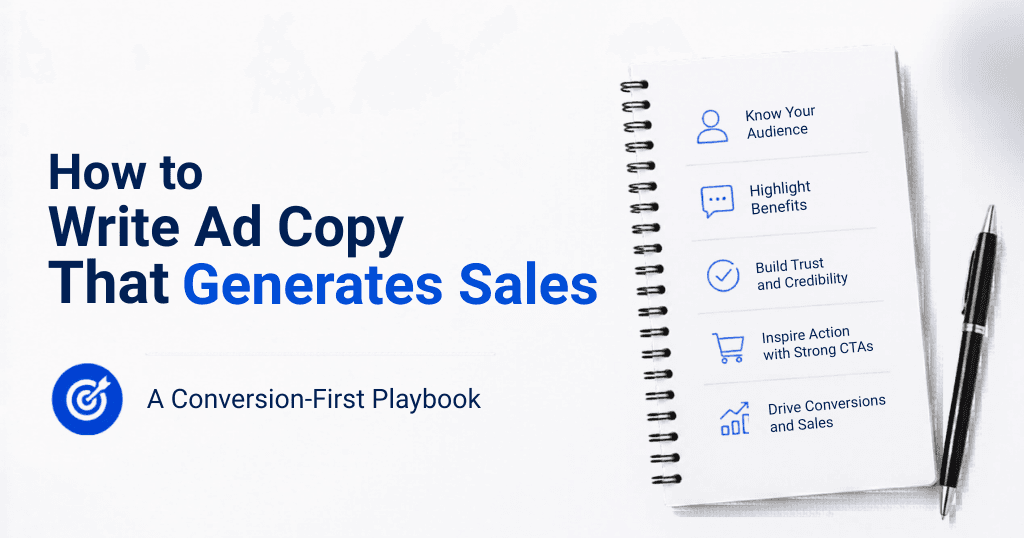
Ad copy that generates sales does one thing above all else: it speaks directly to what the buyer already wants, then makes the next step feel obvious. The difference between copy that converts and copy that burns budget comes down to specificity, intent alignment, and psychological precision — not clever wordplay or louder headlines.
Whether you’re running Google Ads, Meta campaigns, LinkedIn sponsored posts, or display banners, the principles in this guide apply universally. For brands working with a performance marketing agency in Chennai or managing ads in-house, this is the framework that separates campaigns with a 2x ROAS from ones hitting 7x and beyond.
Why Most Ad Copy Fails And What the Data Says
Before diving into what works, it’s worth understanding why most ad copy underperforms. The numbers are sobering: the average click-through rate (CTR) for Google Search Ads across industries is just 6.42% (WordStream, 2024). For display ads, that number drops to 0.46%. The gap between the top 10% of advertisers and the median isn’t budget — it’s copy quality and targeting alignment.
The root causes of underperforming ad copy fall into four buckets:
- Generic messaging — copy that could apply to any brand in the category
- Feature-first writing — leading with what the product does rather than what the buyer gets
- Misaligned intent — showing awareness-stage copy to purchase-ready audiences (or vice versa)
- Weak or absent CTAs — failing to tell the reader exactly what to do next
A Nielsen study found that creative quality accounts for 49% of a campaign’s sales impact — more than targeting, reach, or even brand recognition. In other words, who you show ads to matters, but what those ads say matters more.
This is why businesses that partner with a skilled PPC agency in Chennai don’t just buy media — they invest in message architecture that compounds over every impression.
The Psychology Behind Ad Copy That Converts
Great ad copy isn’t about manipulation. It’s about alignment — connecting what you offer with what the reader already desires. Understanding a few core psychological principles dramatically sharpens your copy.
The 4 Conversion Drivers in Every Buyer’s Mind
Every purchase decision is driven by the same four internal forces. Your copy needs to address all four, in proportion to where the buyer is in their journey:
| Driver | What the Buyer Is Asking | Copy’s Job |
|---|---|---|
| Desire | “Do I want this?” | Paint the outcome, not the product |
| Trust | “Can I believe this?” | Add proof — numbers, testimonials, credibility signals |
| Urgency | “Why now?” | Time, scarcity, or cost of inaction |
| Clarity | “What do I do next?” | One clear, frictionless CTA |
When a campaign underperforms, it’s almost always because one of these four drivers is missing or weak. A digital marketing agency in Chennai running high-volume campaigns audits copy against all four before scaling spend.
Loss Aversion: The Most Underused Copy Lever
Nobel laureate Daniel Kahneman’s research established that humans feel the pain of losing something roughly twice as intensely as the pleasure of gaining something equivalent. This has a direct application in ad copywriting.
Compare these two headlines:
- “Get a Free SEO Audit for Your Website” (gain framing)
- “Stop Losing Customers to Competitors Who Outrank You” (loss framing)
Both offer the same underlying value. The second consistently outperforms in A/B tests because it activates loss aversion. Use it ethically — only when the loss is real and relevant.
Social Proof as a Copy Element
According to BrightLocal’s 2024 Consumer Review Survey, 75% of consumers always or regularly read reviews before making a purchase decision. Social proof isn’t just for landing pages — it belongs in your ad copy itself.
Forms of social proof to embed in ads:
- Specific customer counts (“Trusted by 12,000+ businesses”)
- Star ratings (“⭐ 4.9/5 from 3,200 reviews”)
- Named clients or recognizable logos (where permitted)
- Media mentions (“As seen in Forbes, Economic Times”)
- Specific results (“Helped 400+ brands increase ROAS by 3x”)
The 7 Proven Ad Copywriting Frameworks
Copywriters don’t start with a blank page — they work from frameworks. These structures have been tested across billions of dollars in ad spend and are the backbone of high-converting campaigns run by every serious digital marketing company in Chennai.
Framework 1: PAS — Problem, Agitate, Solution
PAS is the workhorse of direct response copywriting. It works because it meets the buyer where they are — in pain — before offering relief.
Structure:
- Problem — name the specific frustration your audience feels
- Agitate — deepen the emotional weight of that problem
- Solution — present your offer as the clear resolution
Example (for a PPC agency):
“Your Google Ads are running, but the leads aren’t converting. Every click costs money. Every day of wasted spend is revenue your competitor is capturing. Weboin’s PPC management team finds the leaks, fixes them, and scales what’s working — with transparent reporting, weekly.”
PAS is especially effective for search ads where the user has already indicated a problem through their query.
Framework 2: AIDA — Attention, Interest, Desire, Action
AIDA is the oldest framework in advertising, popularized by Elias St. Elmo Lewis in the late 1800s and still the most widely used structure in display and social ads today.
Structure:
- Attention — a headline that interrupts the scroll
- Interest — a fact, stat, or story that earns another second of attention
- Desire — the outcome the reader wants, made vivid
- Action — one CTA that removes friction
Example (for a performance marketing agency):
Headline: “Your Competitors Are Getting 5x ROAS. Here’s Why You’re Not.” Body: Most brands run ads. Few run systems. Weboin builds performance marketing ecosystems — from creative to conversion — that scale profitably. CTA: “Get Your Free Campaign Audit”
Framework 3: FAB — Features, Advantages, Benefits
Most ad writers stop at features. FAB forces you to translate every feature into what it means for the buyer.
| Layer | Question Answered | Example |
|---|---|---|
| Feature | What does it do? | “Real-time bidding optimization” |
| Advantage | How is it better? | “Adjusts bids 24/7 without manual input” |
| Benefit | What does the buyer get? | “You stop overpaying for clicks while you sleep” |
Note: The benefit layer is where the conversion happens. Always end at benefit.
Framework 4: The 4 U’s — Useful, Urgent, Unique, Ultra-specific
Developed by copywriter Michael Masterson, the 4 U’s is a headline evaluation framework. Every headline you write should score at least 3 out of 4.
- Useful: Does it offer clear value to the reader?
- Urgent: Does it create a reason to act now?
- Unique: Does it say something no competitor is saying?
- Ultra-specific: Does it use numbers, names, or precise details?
Weak headline: “Improve Your Ad Performance” Strong headline (4 U’s applied): “Cut Your Cost-Per-Lead by 40% in 30 Days — Without Changing Your Budget”
The strong version is useful (cost reduction), urgent (30 days), unique (without changing budget), and ultra-specific (40%).
Framework 5: Before-After-Bridge (BAB)
BAB is ideal for video scripts, long-form social ads, and email subject lines but applies equally to longer display ad copy.
Structure:
- Before — paint the current painful reality
- After — paint the desirable future state
- Bridge — your product or service is the path from Before to After
Example:
Before: “Spending ₹2 lakhs a month on ads and barely breaking even.” After: “Running the same budget, generating 4x the qualified leads, and scaling confidently.” Bridge: “That’s what a structured performance marketing system delivers. Book a strategy call with Weboin.”
Framework 6: The Specificity Technique
Specificity is not a framework — it’s a principle that makes every other framework more powerful. Vague claims are ignored; specific claims are believed.
Vague: “Our clients see great results.” Specific: “Our average client sees a 3.2x increase in ROAS within the first 90 days.”
Vague: “Fast delivery.” Specific: “Delivered to your door in 24 hours or your next order is free.”
Specificity triggers the analytical part of the brain that evaluates credibility. When a claim is specific enough to be falsifiable, readers instinctively trust it more.
Framework 7: The Curiosity Gap
The curiosity gap is the space between what someone knows and what they want to know. BuzzFeed built a media empire on it. Applied to ad copy, it looks like:
- “The one Google Ads setting most agencies never touch (that doubles CTR)”
- “Why your best-performing ad creative is actually hurting your ROAS”
- “What Chennai’s fastest-growing brands have in common — it’s not their budget”
Use the curiosity gap for top-of-funnel awareness ads where the goal is a click, not an immediate conversion. Don’t use it for retargeting or bottom-of-funnel ads where the buyer needs clarity, not intrigue.
Writing Ad Copy for Each Platform: Specs, Tone, and Tactics
Platform context changes everything. The same message that works on Google Search will feel out of place on Instagram. Here’s how to adapt your copy for each major channel.
Google Search Ads
Context: The user has expressed explicit intent through a search query. They’re in problem-solving mode.
Copy principles:
- Mirror the search query in the headline (Dynamic Keyword Insertion can help)
- Lead with the most important benefit or differentiator
- Include a specific CTA in headline 3 or description
- Use ad extensions (sitelinks, callouts, structured snippets) as secondary copy real estate
- Address price objections, shipping, or guarantees in descriptions
Character limits:
- Headlines: 30 characters each (up to 15 headlines in RSAs)
- Descriptions: 90 characters each (up to 4 descriptions)
High-converting headline formulas for search:
- [Keyword] + [Differentiator] → “PPC Agency Chennai | No Lock-in Contracts”
- [Outcome] in [Timeframe] → “3x Your ROAS in 60 Days”
- [Objection removal] → “No Setup Fees. Full Transparency. Real Results.”
- [Social proof] → “Trusted by 500+ Chennai Brands | 4.9★ Rating”
Meta Ads (Facebook & Instagram)
Context: The user isn’t searching — they’re scrolling. Your ad is an interruption that must earn attention in 1–2 seconds.
Copy principles:
- Lead with the hook (first line must stop the scroll)
- Use conversational, first-person or second-person language
- Short paragraphs — 1–2 sentences max per paragraph
- Emojis are acceptable if they match brand tone
- Test long-form vs. short-form copy — both work in different niches
Character limits (recommended, not enforced):
- Primary text: 125 characters shown before “See More” (put your hook here)
- Headline: 27 characters before truncation
- Description: 27 characters
Hook formulas for Meta:
- The bold statement: “Most businesses waste 60% of their ad budget. Here’s how to find out if you’re one of them.”
- The question: “Why are your competitors paying less per lead than you?”
- The story opener: “Six months ago, this Chennai brand was spending ₹3L/month on ads and getting 12 leads. Today they get 87.”
- The contrarian take: “Boosting posts isn’t advertising. Here’s what actually works.”
LinkedIn Ads
Context: Professional audience, B2B intent, higher cost-per-click (avg. ₹400–800 in India), but significantly higher lead quality for B2B brands.
Copy principles:
- Speak to professional identity and business outcomes
- Use industry-specific language and job title awareness
- Longer copy performs better than on other platforms (LinkedIn users are readers)
- Lead with a stat, case study result, or bold claim
- CTA should be low-friction for cold audiences: “Download,” “Read,” “See How” — not “Buy Now”
Best use cases for LinkedIn ad copy:
- Lead gen forms for B2B services (target: decision-makers)
- Thought leadership content promotion
- Event registrations (webinars, workshops)
- Remarketing to website visitors with bottom-of-funnel offers
YouTube Pre-Roll Ads
Context: The viewer wants to watch something else. You have 5 seconds before they can skip.
The 5-second rule: Your first 5 seconds must create enough curiosity or relevance that the viewer chooses not to skip. The rest of the ad converts.
Proven 5-second openers:
- A counterintuitive statement: “Stop running Google Ads. Seriously.”
- Direct address: “If you’re a business owner in Chennai spending on ads — watch this.”
- A visual hook that can’t be ignored (something unexpected on screen)
- A specific, polarizing question: “Are your ads actually costing you customers?”
After the 5 seconds, deliver on the hook, build desire, and close with a CTA that appears on-screen.
The Anatomy of a High-Converting Ad: Element by Element
Every ad — regardless of platform — is made of the same building blocks. Here’s how to optimize each one.
The Headline: Your One Shot at Attention
The headline is read 5x more than the body copy (David Ogilvy’s research from Confessions of an Advertising Man — still accurate in digital). Spend 50% of your copy time on the headline.
What makes a headline convert:
- It addresses a specific desire or fear
- It’s concrete (numbers, timeframes, names)
- It creates tension that the body copy resolves
- It is written for one specific person, not a general audience
Headline testing approach: Run A/B tests with these variables in isolation:
- Benefit headline vs. curiosity headline
- Question vs. statement
- Number-led vs. no number
- First-person vs. second-person
The Body Copy: Where Trust Is Built
The body copy’s job is to bridge the gap between the headline’s promise and the CTA. It must:
- Validate the headline claim
- Address the one most likely objection
- Add a proof element (stat, testimonial, case study snippet)
- Build emotional momentum toward the CTA
Body copy length guidelines by platform:
| Platform | Recommended Body Copy Length |
|---|---|
| Google Search (description) | 90 characters — every word earns its place |
| Facebook/Instagram | 50–150 words for cold; 20–50 for retargeting |
| 150–300 words for thought leadership | |
| Display/Banner | 10–20 words maximum |
| YouTube (script after 5s) | 30–90 seconds of spoken copy |
The Call-to-Action: Clarity Over Creativity
The CTA is not the place to be clever. Clarity wins. The best CTAs are:
- Specific — not “Click Here,” but “Book a Free 30-Minute Strategy Call”
- Low-friction for cold audiences — “Download Free Guide” > “Buy Now” for first exposure
- Outcome-framed — “Get My Free Audit” > “Submit” (the buyer gets something; they’re not just submitting)
- Matched to funnel stage — see the table below
CTA by funnel stage:
| Funnel Stage | Audience State | Best CTA Type | Example |
|---|---|---|---|
| Top (Awareness) | Doesn’t know you | Content CTA | “Download the Free Guide” |
| Middle (Consideration) | Knows you, evaluating | Soft conversion CTA | “See How It Works” / “Watch Demo” |
| Bottom (Decision) | Ready to act | Direct CTA | “Get a Free Quote” / “Book a Call” |
| Retention (Upsell) | Existing customer | Value CTA | “Upgrade Your Plan” / “Unlock Feature X” |
The Visual-Copy Relationship
In social and display ads, copy and creative work together. The image or video handles attention; the copy handles conversion. When they’re misaligned, both underperform.
Rules for copy-visual alignment:
- The headline should not repeat what the image already shows — it should add a layer
- Use the image to show the outcome; use the copy to explain how to get there
- Contrasting visual-copy combinations (“shocking image + calm, logical copy”) create cognitive engagement
- Never put key copy inside images for Meta ads — text-heavy images reduce delivery
Advanced Tactics to Maximize Ad Copy Performance
Personalization at Scale
Studies show personalized ads generate up to 202% higher conversion rates than generic ones (Instapage, 2023). Personalization in ad copy doesn’t require individual-level customization — it means speaking to a specific segment as if you wrote the ad just for them.
Personalization levers:
- Location: “Chennai’s #1 Rated Digital Marketing Agency” vs. “India’s #1 Rated…”
- Industry: Separate ad sets for healthcare, real estate, e-commerce — each with industry-specific copy
- Behavior: Retargeting copy that references what they viewed (“Still thinking about our PPC services?”)
- Job title: LinkedIn copy that addresses a CFO differently than a Marketing Manager
A professional digital marketing agency in Chennai segments audiences and writes separate copy for each segment — not one message for all.
The Offer Is Part of the Copy
Copywriting legend Gary Halbert said: “The most important element in any advertisement is the offer.” Even the best-written headline can’t save a weak offer. If your copy isn’t converting, examine the offer before rewriting the words.
Offers that consistently outperform:
- Free audit / assessment (low commitment, high perceived value)
- Risk reversal (“Try for 30 days, pay only if you’re satisfied”)
- Bonus stacking (“Get the course + the templates + the 1:1 review call”)
- Limited-time pricing or access
- Free first month / free setup (especially effective for service brands)
When the offer is strong, copy becomes simpler — you just need to communicate it clearly.
Negative Keywords and Copy Alignment
For Google Search specifically, a common reason for low conversion rates isn’t the copy — it’s showing well-written copy to the wrong audience. Negative keyword lists prevent your ads from appearing for irrelevant searches, ensuring your conversion-optimized copy reaches people with genuine intent.
For example, a PPC agency in Chennai running ads for “digital marketing services” might add negatives like “free,” “DIY,” “course,” “tutorial,” or “jobs” to filter out non-buyer traffic before it ever sees the ad.
Ad Copy Testing: The Right Way to A/B Test
Most ad teams test the wrong things. A headline that performs well in one ad account may underperform in another because audience composition differs. Here’s how to test copy scientifically:
Rules for valid A/B copy testing:
- Test one variable at a time (headline OR CTA OR offer — never all three at once)
- Run tests until statistical significance is reached (minimum 95% confidence; use tools like AB Testguide.com)
- Ensure adequate sample size — a minimum of 100 conversions per variant before declaring a winner
- Don’t end tests early due to early trends — early data is often misleading
- Document learnings in a swipe file for future campaigns
What to test (in priority order):
- Headline (highest impact on CTR)
- Offer (highest impact on conversion rate)
- CTA wording
- Body copy length
- Tone (emotional vs. logical)
- Social proof type (number of customers vs. testimonial quote vs. results data)
Seasonal and Contextual Copy
Contextual relevance significantly boosts ad performance. Adapting copy to seasons, events, and cultural moments makes ads feel timely rather than generic.
Seasonal copy calendar for Indian markets:
| Period | Opportunity | Copy Angle |
|---|---|---|
| Diwali (Oct/Nov) | High consumer intent, gifting | Offers, festive urgency, gifting framing |
| Financial Year End (March) | B2B budget decisions | “Maximize your Q4 budget” framing |
| New Year (Jan) | Resolution-driven action | New beginnings, fresh start angles |
| IPL Season (Mar–May) | High digital consumption | Awareness campaigns, reach plays |
| Back to School (June) | Education & EdTech peak | Outcome-focused, parent-targeted copy |
Brands that adapt copy to these windows — rather than running evergreen creative year-round — consistently see 15–30% higher CTRs during peak periods.
Common Ad Copy Mistakes That Waste Budget
A performance marketing agency in Chennai auditing a new client account will almost always find the same recurring copy mistakes. Avoid these:
- Writing for the Product, Not the Buyer The brand is excited about features. The buyer cares about outcomes. “Our platform uses AI-powered bidding” is a feature. “Reduce wasted ad spend by 35% automatically” is a benefit. Always translate.
- One Ad for All Audiences A single ad copy running across cold audiences, warm audiences, and retargeting pools will underperform all three. Each stage needs different messaging.
- Ignoring the Competitor Landscape Your ad doesn’t exist in isolation — it appears next to competitor ads. If every competitor headline says “Best Digital Marketing Agency in Chennai,” saying the same thing is invisible. Study competitor copy and position differently.
- Overloading the Ad with Information An ad is not a landing page. Its job is to earn the click, not close the sale. Keep copy focused on one message, one benefit, one CTA.
- Weak Proof Elements “We have years of experience” is not proof. “We’ve managed ₹15 crore in ad spend for 200+ brands across Chennai” is proof. Be specific enough that a competitor couldn’t copy the claim without lying.
- Neglecting the Description Lines In Google Search Ads, many advertisers put effort into headlines and treat descriptions as an afterthought. Descriptions are prime real estate for objection handling, secondary benefits, and trust signals.
- Not Refreshing Creative Ad fatigue is real. Meta’s own data shows that ad creative loses effectiveness after roughly 5,000–10,000 impressions to the same audience. Build a content refresh cadence — new creative every 3–4 weeks for active campaigns.
How Weboin Builds Ad Copy That Converts
At Weboin, a results-focused digital marketing company in Chennai, ad copy is treated as a strategic asset — not a creative checkbox. Our process ensures every word in every ad is working toward a measurable business outcome.
The Weboin Ad Copy Process:
Step 1: Audience Intelligence Before writing a word, we study the target audience — their language, pain points, objections, and aspirations. We mine reviews, sales call recordings, customer support tickets, and competitor comments to find the exact phrases real buyers use.
Step 2: Intent Mapping We map the buyer journey and assign copy frameworks to each stage. Cold traffic gets curiosity and benefit-led copy. Warm audiences get proof and offer-led copy. Retargeting audiences get urgency and objection-removal copy.
Step 3: Message Architecture We build a messaging hierarchy: primary message (the campaign’s core promise), secondary messages (supporting proof points), and tertiary messages (objection handlers). Every ad draws from this hierarchy — ensuring consistency across channels.
Step 4: Copy Variation Development We write 5–10 headline variations and 3–5 body copy variations per ad set. These are tested systematically using Google’s RSA format and Meta’s A/B testing tool.
Step 5: Performance-Based Iteration Every 2 weeks, we review performance data — CTR, conversion rate, ROAS, and cost-per-acquisition — and iterate copy based on what the data shows, not what we personally prefer.
As a full-service PPC agency in Chennai, Weboin doesn’t just manage bids. We build and continuously improve the message system that makes every rupee of ad spend work harder.
Ad Copy Checklist: Before You Publish Any Ad
Use this checklist to quality-check every ad before it goes live:
Headline:
- Contains the primary keyword or mirrors search intent
- Is specific (includes a number, timeframe, or name)
- Addresses desire or fear of the target audience
- Could stand alone and still convey value
Body Copy:
- Opens with or validates the headline promise
- Includes at least one proof element (stat, testimonial, result)
- Addresses the one most likely objection
- Written in second person (“you,” “your”) where possible
- No jargon the audience wouldn’t use themselves
CTA:
- Tells the reader exactly what to do
- Is framed as what the reader gets, not what they do
- Matches the funnel stage (not too aggressive for cold traffic)
- Creates a reason to act now
Platform Compliance:
- Within character limits for each placement
- No prohibited claims (absolute superlatives, unverified guarantees)
- Visual and copy are aligned (not redundant)
- Mobile preview checked (most traffic is mobile-first)
Tracking:
- UTM parameters added to destination URL
- Conversion tracking verified in platform
- A/B test structure set up correctly (one variable at a time)
Frequently Asked Questions About Ad Copywriting
Ad copy converts when it addresses a specific desire or pain point of a defined audience, builds credibility through proof, creates a reason to act now, and makes the next step frictionless. All four elements must be present.
Length depends on the platform and funnel stage. Google Search descriptions: 90 characters maximum. Facebook cold audience: 50–150 words. LinkedIn B2B: up to 300 words. The rule is: as long as needed to convert, and no longer.
For active campaigns with significant spend, refresh creative every 3–4 weeks or when frequency exceeds 3–4 for the same audience. Monitor CTR trends — a declining CTR with stable targeting is a sign of ad fatigue.
Both. The decision is driven by product type and audience. High-ticket B2B decisions need logical copy with proof. Impulse and lifestyle purchases respond to emotional copy. Most effective campaigns layer both: lead with emotion, support with logic.
Ad copy earns the click; landing page copy closes the conversion. The ad creates a specific expectation — the landing page must fulfill exactly that expectation or conversion rates collapse. This is called "message match" and it's one of the most underrated conversion factors in paid media.
Tools like ChatGPT, Jasper, and Copy.ai can generate first drafts quickly. However, they require expert editing to add specificity, real proof elements, and brand voice. AI tools are strong at volume; human expertise is required for conversion optimization and message strategy. A professional digital marketing agency in Chennai uses AI as a tool, not a replacement for strategic thinking.
The Relationship Between Ad Copy and Landing Page Performance
Writing great ad copy and sending traffic to a mediocre landing page is like running water through a leaking pipe. The copy drives intent; the landing page determines whether that intent converts.
Message match — the most important principle: Every element promised in your ad must appear prominently on your landing page within 3 seconds of arrival. If your ad says “Free PPC Audit for Chennai Businesses,” the landing page headline should not say “Welcome to Weboin.” It should say “Claim Your Free PPC Audit” — immediately.
A study by Unbounce found that message-matched landing pages convert up to 212% better than generic homepages used as ad destinations.
The landing page elements that work with great copy:
- H1 that mirrors the ad headline (message match)
- Subheadline that expands on the specific benefit promised
- Hero image showing the outcome, not the product
- Social proof above the fold (logos, rating, customer count)
- One CTA — not two or three
- Form with minimal required fields (every extra field reduces conversions by ~10%)
Final Thought: Ad Copy Is a Business System, Not a Creative Exercise
The most effective ad copywriters don’t think of themselves as writers. They think of themselves as architects of persuasion systems — each word serves a purpose, each sentence moves the reader one step closer to a decision.
Great copy is researched, tested, iterated, and optimized continuously. It’s informed by data, written with empathy, and measured against revenue — not aesthetics.
For brands serious about growth, ad copy is not a one-time task — it’s an ongoing, compounding asset. Every test teaches you something about your audience. Every winning headline gets added to a swipe file that informs the next campaign. Over time, you build an unfair advantage: a deep, proprietary understanding of exactly what makes your buyers act.
Whether you manage campaigns in-house or partner with a specialist performance marketing agency in Chennai like Weboin, the framework in this guide gives you the foundation to write copy that doesn’t just get clicks — it generates sales, consistently and profitably.
About Weboin: Weboin is a full-service digital marketing company in Chennai offering performance marketing, PPC management, SEO, content strategy, and paid media creative. As a trusted PPC agency in Chennai, Weboin helps brands across industries write, test, and scale ad copy that converts — backed by data, driven by results.

No comment yet, add your voice below!