
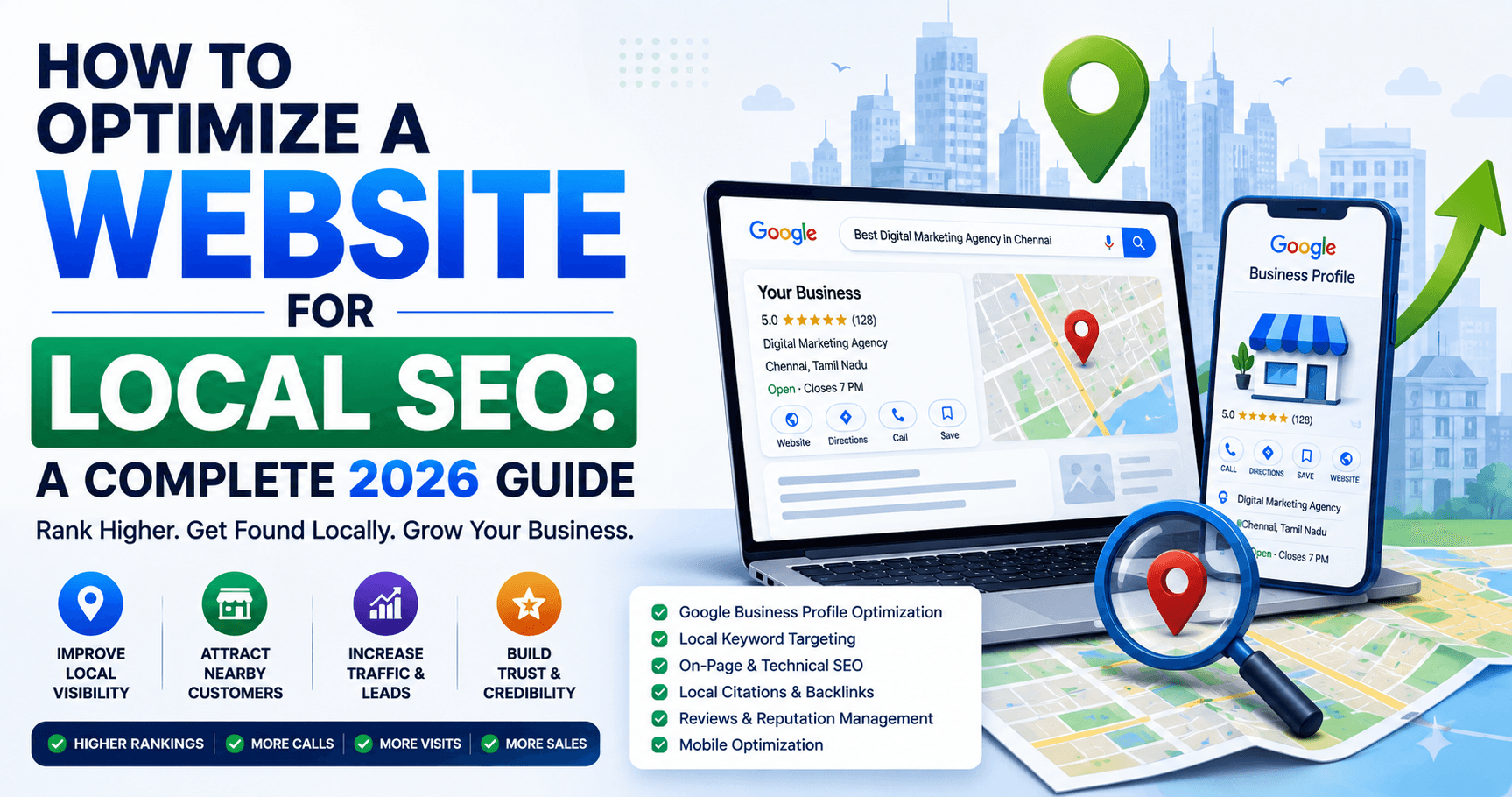
Optimizing a website for local SEO means configuring every element of your digital presence — your Google Business Profile, website structure, on-page content, schema markup, local citations, and review strategy — so that Google surfaces your business when nearby customers search for your services or products. The goal is to appear in three specific places: the Map Pack (the three local business listings at the top of local search results), Google’s organic results for location-specific queries, and AI-generated answers that reference local businesses.
According to Google, 76% of people who search for something nearby on their smartphone visit a business within one day, and 28% of those searches result in a purchase. BrightLocal’s 2025 Local Consumer Review Survey found that 98% of consumers used the internet to find information about local businesses — up from 90% just three years prior. Moz’s Local Search Ranking Factors report identifies Google Business Profile signals as the single most influential factor in local Map Pack rankings, accounting for approximately 36% of local ranking weight. These numbers establish local SEO not as a supplementary marketing tactic but as the primary channel through which local customer decisions are made and influenced.
This guide covers every component of local SEO website optimisation, from the technical foundations to the review strategy that sustains long-term ranking authority.
Understanding Local SEO: How Google Decides Who Ranks Locally
Google evaluates local search ranking using three core signals: Relevance, Distance, and Prominence. Understanding how each works determines where to focus optimisation effort.
The Three Local Ranking Factors
Relevance — How well your business matches the search query
- Determined by your Google Business Profile categories and description
- Determined by keyword signals in your website content
- Determined by schema markup that explicitly defines your business type and services
- Determined by the specific services listed in your GBP
Distance — How close your business is to the searcher (or to the location specified in the query)
- The only ranking factor you cannot directly optimise — it is a function of your physical location
- For multi-location businesses, creating separate location pages and GBP listings for each location is the correct approach
Prominence — How well-known and trusted your business is in its local market
- Determined by review volume, rating, and recency
- Determined by the quality and consistency of external citations (NAP mentions across the web)
- Determined by backlinks from other local and relevant websites
- Determined by the overall domain authority of your website
The optimisation framework in this guide addresses relevance and prominence signals systematically — because these are the signals you can influence, and improving them is how local ranking improvements are earned.
Local Search Results Formats
Understanding the formats in which Google displays local results helps prioritise which optimisation elements to focus on:
| Result Format | Triggered By | Primary Ranking Signals | Optimisation Focus |
|---|---|---|---|
| Map Pack (3 listings) | “near me”, location-intent queries | GBP signals, reviews, citations | GBP optimisation, reviews |
| Organic local results | Location-modified keywords | Website content, domain authority | On-page SEO, location pages |
| Knowledge Panel | Brand searches | GBP data, schema markup | GBP completeness, structured data |
| AI Overviews | Informational + local intent | E-E-A-T content, structured data | FAQ schema, entity clarity |
| Google Maps | Direct Maps searches | GBP completeness, photos, reviews | GBP, photos, engagement |
Appearing in the Map Pack requires a different strategy from appearing in the organic results below it — Map Pack prominence is driven predominantly by GBP signals and reviews, while organic local results require strong on-page SEO and location-specific content. A complete local SEO strategy addresses both.
Step 1: Google Business Profile — Your Most Powerful Local SEO Asset
Google Business Profile (GBP) is the single most important local SEO asset a business can build. It directly powers the Map Pack results, generates branded Knowledge Panels, and enables direct customer actions — calls, directions, website visits, and appointment bookings — without requiring a website click. According to Moz, GBP signals account for approximately 36% of local Pack ranking factors, making it the highest-weight individual signal in local search.
Claiming and Verifying Your GBP Listing
If you have not already claimed your GBP listing, this is your first action:
- Go to business.google.com
- Search for your business name — Google may have already created a basic listing from publicly available data
- If a listing exists, claim it. If not, create a new one
- Complete the verification process (typically by postcard, phone, or email)
- Verification typically takes 5-14 days
Warning: Unverified listings can be claimed by other parties, including competitors. Verify your listing immediately.
The Complete GBP Optimisation Checklist
Business Name Exactly as it appears in the real world. Do not add keywords to your business name (e.g., “Weboin — Best SEO Agency Chennai”) — this violates Google’s guidelines and can result in suspension. If keywords appear naturally in your legal business name, they count. Artificially inserted keywords do not.
Primary Category The most specific category that accurately describes your primary service. This is the highest-weight GBP optimisation signal. Examples:
- Digital marketing agency → “Marketing Agency” or “Internet Marketing Service”
- Restaurant → “Restaurant” (then select cuisine type)
- Dental clinic → “Dentist” (most specific primary category)
Secondary Categories Add every relevant secondary category for additional services you offer. A digital marketing company in Chennai might add: “Search Engine Optimizer,” “Advertising Agency,” “Web Design Company,” “Social Media Marketing Service.”
Business Description (750 characters) Use the full 750 characters. Describe what you do, who you serve, and what makes you different — in language your customers would use. Include your primary service keywords naturally. Do not keyword-stuff.
Physical Address Enter your exact address consistently with how it appears on your website and all external citations. Use the full street address format Google recommends for India.
Service Area For businesses serving customers at their location (plumbers, electricians, delivery services), define your service area by city, district, or pincode. For physical storefronts, this supplements the address.
Phone Number Use a local Chennai number where possible — area code 044 for landline, or a local mobile number. The phone number must match exactly what appears on your website and all citations.
Website URL Link to a specific landing page where relevant, not just the homepage. A plumber with a dedicated “Emergency Plumbing Services” GBP listing might link directly to the emergency services page rather than the homepage.
Hours of Operation Keep these accurate and updated, including special hours for public holidays. Google flags businesses with incorrect hours in reviews (“they were closed when the listing said open”), which damages trust signals.
Services List every service with name and description. Google uses this data to match your business to more specific service queries. A seo agency in Chennai might list: “Technical SEO,” “Local SEO,” “Keyword Research,” “Link Building,” “SEO Audit,” “Google Ads Management.”
Products For businesses selling physical or digital products, list them in the Products section with images, descriptions, and prices where applicable.
Attributes Select all applicable attributes — these are the characteristics Google shows in your listing and uses for filtering (e.g., “Online appointments,” “Free Wi-Fi,” “Women-owned,” “LGBTQ-friendly”). Different categories have different available attributes.
Photos Quantity and recency of photos are positive local ranking signals. Target:
- Minimum 10 photos at listing setup
- Add 1-2 new photos per week ongoing
- Include: exterior, interior, team, work examples, products
Photo best practices:
- Use real photos of your actual premises and team — not stock images
- Name photo files descriptively before uploading (not DSC4721.jpg but weboin-digital-marketing-team-chennai.jpg)
- Maintain photo aspect ratios Google recommends (1.78:1 for interior/exterior photos)
Step 2: NAP Consistency — The Invisible Local Ranking Foundation
NAP stands for Name, Address, and Phone number — the three data points that uniquely identify your business across the internet. Inconsistency in NAP data across different websites and directories creates conflicting signals that reduce Google’s confidence in your business information, directly suppressing local rankings.
According to BrightLocal, 80% of consumers lose trust in a local business if they find incorrect or inconsistent contact information online. The SEO consequence is as significant as the trust consequence.
What NAP Consistency Means in Practice
Every place your business name, address, and phone number appears online must be identical. Not similar — identical.
Common NAP inconsistencies to audit and fix:
| Inconsistency Type | Example Variation | Impact |
|---|---|---|
| Street abbreviation | “MG Road” vs “M.G. Road” vs “Mahatma Gandhi Road” | Medium |
| Suite/Unit format | “#203” vs “Suite 203” vs “203” | Medium |
| Phone format | “044-12345678” vs “+91 44 12345678” vs “04412345678” | Medium |
| Business name variation | “Weboin” vs “Weboin Technologies” vs “Weboin Tech” | High |
| Old address not updated | Address from before relocation still showing on directories | Very High |
How to Audit Your NAP Consistency
- Google your exact business name and look at every result
- Use BrightLocal’s Citation Tracker or Moz Local to scan major directories automatically
- Manually check the most important sources: Google Business Profile, JustDial, Sulekha, IndiaMart, Bing Places, Apple Maps, Facebook Business
- Create a spreadsheet listing every source, the NAP it shows, and whether it matches your primary NAP
Fixing inconsistencies:
- Priority fix: your own website — ensure the NAP in the footer and contact page exactly matches your GBP
- Update Google Business Profile first, as this is the canonical source
- Contact directory platforms to update incorrect listings
- For directories that don’t allow direct editing, use a citation management tool (BrightLocal, Moz Local, Whitespark)
Building New Local Citations
Beyond fixing existing citations, building new citations from authoritative sources strengthens your local prominence signal.
Priority citation sources for India/Chennai businesses:
| Source | Type | Priority |
|---|---|---|
| Google Business Profile | Primary | Essential |
| Bing Places | Primary | Essential |
| Apple Maps | Primary | Essential |
| JustDial | India-specific directory | Very High |
| Sulekha | India-specific directory | Very High |
| IndiaMart | B2B India directory | High |
| Indiacom | India business directory | High |
| Yellow Pages India | Traditional directory | High |
| Facebook Business | Social profile | High |
| LinkedIn Company | Professional | High |
| Industry-specific directories | Vertical | High |
| Local Chamber of Commerce | Local authority | Very High |
| Local business associations | Local authority | High |
Step 3: On-Page Local SEO — Optimising Your Website for Local Queries
On-page local SEO is the set of optimisations applied to your website’s content and structure to signal geographic relevance to search engines. While GBP optimisation is the primary driver of Map Pack rankings, on-page local SEO drives the organic local results that appear below the Map Pack — and these receive a significant share of local search clicks.
BrightLocal’s 2025 data shows that while the Map Pack captures 44% of clicks for local searches, the organic results below it capture 29% — making on-page local SEO the second-largest opportunity in local search.
Title Tag and Meta Description Optimisation for Local Queries
Every page targeting local keywords should include the location in the title tag:
Homepage: Digital Marketing Agency in Chennai | Weboin
Service pages: SEO Services in Chennai | Improve Your Google Rankings | Weboin Google Ads Management Chennai | PPC Agency | Weboin
Meta descriptions should include the location and a compelling benefit: Weboin is Chennai’s leading SEO agency, helping 500+ local businesses rank higher on Google and generate consistent organic leads. Free audit available.
Header Structure for Local Content
Use location-specific language in H1 and H2 headings:
H1 (one per page): “Digital Marketing Services for Chennai Businesses” H2 examples:
- “Why Chennai Businesses Choose Weboin”
- “Our SEO Services in Chennai”
- “Serving Businesses Across Chennai — From Anna Nagar to OMR”
Local Keyword Integration
Integrate local keyword variations naturally throughout page content. For a digital marketing company in Chennai, relevant local keyword patterns include:
| Keyword Pattern | Example |
|---|---|
| [Service] in Chennai | “digital marketing in Chennai” |
| [Service] Chennai | “SEO services Chennai” |
| Chennai [service] | “Chennai digital marketing agency” |
| Best [service] in Chennai | “best SEO company in Chennai” |
| [Service] near me | (geo-resolved by Google to local intent) |
| [Service] + district | “digital marketing agency Anna Nagar” |
Include these variations in:
- Title tags and H1 headings
- First paragraph of page content
- Image alt text
- Internal link anchor text
- Footer contact section
What not to do: Keyword stuffing — repeating “digital marketing agency in Chennai” 15 times in a 500-word page — is detected and penalised by Google’s algorithms. Natural variation and contextual integration is the correct approach.
Contact Page Optimisation
Your contact page is one of the most important local SEO pages on your website. It should include:
- Full business name, address, and phone number (matching GBP exactly)
- Embedded Google Map showing your location
- Business hours
- Links to GBP listing and other social/directory profiles
- Local schema markup (see Step 5)
Many businesses underestimate the contact page’s local SEO value. It is a primary signal for local relevance and NAP consistency — and it is often the page Google’s crawlers visit to verify your location data.
Step 4: Location Pages — Scaling Local SEO Across Multiple Areas
For businesses serving multiple locations or districts, dedicated location pages are the most effective mechanism for capturing local search traffic from each specific area. A single homepage optimised for “digital marketing in Chennai” cannot compete with dedicated pages targeting “digital marketing in Adyar” or “SEO services in OMR” for those specific district-level queries.
When to Create Location Pages
Multi-location businesses: Each physical business location should have its own page, its own GBP listing, and its own local citation set.
Service area businesses: Businesses that serve multiple areas without physical locations in each (plumbers, photographers, consultants) should create service area pages for each primary district or city they serve.
Single-location businesses with broad service areas: A Chennai-based seo company in Chennai serving clients across the city should create pages for its highest-demand service areas — OMR, Adyar, Anna Nagar, T. Nagar, Velachery — targeting the specific local searches from each area.
The Anatomy of a High-Quality Location Page
A location page that ranks for local queries must be substantively unique — not a generic page with the city name swapped. Google’s quality algorithms detect and discount location pages that are thin content with minimal differentiation from each other.
Location page content requirements:
- Unique headline: “Digital Marketing Services in [District], Chennai”
- Location-specific introduction: Reference the specific area, its business environment, and why local businesses in that area need marketing support
- Local business context: Mention specific local landmarks, business districts, or industry clusters relevant to the area
- Services offered in that area: List your specific services with descriptions
- Local case study or client reference: Even a brief anonymised example of work done for a business in that area adds genuine local relevance
- Local team information: If you have team members based in or serving that area
- Local schema markup: LocalBusiness schema with the specific service area address
- Directions: How to reach your office from that area, or your service coverage for that area
- Local contact call-to-action: “Serving businesses in [District] — call us today”
What makes a location page thin (and ineffective):
- Simply replacing the city name in a template while all other content is identical across location pages
- No locally specific information beyond the place name
- Less than 300 words
- No unique images or visuals
- No local schema markup
Location Page URL Structure
Use a clean, consistent URL structure for location pages:
- /services/seo/chennai/anna-nagar/
- /services/digital-marketing/omr-chennai/
- /locations/velachery/
Avoid: /page?location=1042 or /anna-nagar-seo-services-digital-marketing-chennai/ (over-optimised)
Step 5: Local Schema Markup — Speaking Google’s Machine Language
Schema markup is structured data code added to your website that explicitly tells search engines and AI systems what your business is, where it is, and what it offers. For local SEO, schema markup translates your human-readable business information into machine-readable format — improving how Google represents your business in Knowledge Panels, rich results, and AI-generated answers.
According to Search Engine Journal, websites with properly implemented local schema markup are significantly more likely to appear in rich results and Knowledge Panels than those without structured data. In 2026, as AI systems increasingly rely on structured data to generate their responses, schema markup has become essential rather than optional.
The Essential Local Business Schema Types
LocalBusiness Schema (or its specific subtype)
This is the foundational schema for any local business. It should appear on your homepage and contact page, and a variation should appear on each location page.
Minimum required properties:
{
“@context”: “https://schema.org”,
“@type”: “LocalBusiness”,
“name”: “Weboin”,
“url”: “https://weboin.com”,
“telephone”: “+91-44-XXXXXXXX”,
“address”: {
“@type”: “PostalAddress”,
“streetAddress”: “[Your Street Address]”,
“addressLocality”: “Chennai”,
“addressRegion”: “Tamil Nadu”,
“postalCode”: “[Your Pincode]”,
“addressCountry”: “IN”
},
“geo”: {
“@type”: “GeoCoordinates”,
“latitude”: “[Your Latitude]”,
“longitude”: “[Your Longitude]”
},
“openingHoursSpecification”: [
{
“@type”: “OpeningHoursSpecification”,
“dayOfWeek”: [“Monday”,”Tuesday”,”Wednesday”,”Thursday”,”Friday”],
“opens”: “09:00”,
“closes”: “18:00”
}
],
“image”: “[URL to your business logo]”,
“priceRange”: “₹₹”,
“description”: “Chennai’s leading digital marketing agency offering SEO, PPC, and web development services.”
}
Use the most specific @type available: Instead of just “LocalBusiness,” use the most specific subtype: “MarketingAgency,” “Dentist,” “Restaurant,” “LegalService,” etc. Specific types carry more relevance weight.
Service Schema
For each service you offer, implement Service schema to explicitly define what the service is, who provides it, and its availability:
{
“@context”: “https://schema.org”,
“@type”: “Service”,
“name”: “Local SEO Services”,
“provider”: {
“@type”: “LocalBusiness”,
“name”: “Weboin”
},
“areaServed”: {
“@type”: “City”,
“name”: “Chennai”
},
“description”: “Local SEO optimisation for Chennai businesses including GBP management, citation building, and local keyword strategy.”
}
FAQ Schema
FAQ schema marks up question-and-answer content so that AI systems and Google’s featured snippets can directly extract and display answers. For local SEO, FAQ schema on location pages and service pages addresses the questions local searchers commonly ask:
- “What areas in Chennai does Weboin serve?”
- “How long does local SEO take to show results?”
- “How much does local SEO cost in Chennai?”
- “What is included in a local SEO audit?”
Review Schema
If you display customer reviews on your website (not just embedding Google reviews via a widget), mark them up with Review and AggregateRating schema to enable star ratings in organic search results — which improve CTR by 15-30%.
Verifying Schema Implementation
After implementing schema, verify it using:
- Google’s Rich Results Test (search.google.com/test/rich-results): Confirms schema is valid and eligible for rich results
- Schema.org Validator: Checks for technical errors in schema code
- Google Search Console → Enhancements: Shows which pages have structured data detected and any errors
Step 6: Google Reviews Strategy — The Ranking Signal You Cannot Buy
Google reviews are the most significant local ranking signal that businesses consistently underinvest in. According to BrightLocal, businesses in the top three Map Pack positions have an average of 47 Google reviews, while businesses outside the top three average 17. Review quantity, rating average, and recency all contribute to the prominence signal that drives local rankings.
Beyond rankings, reviews influence conversion rates: BrightLocal’s data shows that 87% of consumers read online reviews before visiting a local business, and a business with 50+ reviews generating a 4.7+ star average converts first-time searchers at dramatically higher rates than one with 8 reviews at 4.2 stars.
Building a Systematic Review Generation Programme
Step 1: Identify the right moments to ask
The highest-converting review request moment is immediately after a positive customer experience — when the value delivered is fresh and the customer’s satisfaction is highest. For a digital marketing agency in Chennai, this might be:
- After a campaign achieves a significant milestone (first page-one ranking, CPL improvement)
- After a successful project delivery
- During quarterly client reviews when positive results are being discussed
Step 2: Make the process frictionless
Every additional step between “customer agrees to leave a review” and “review submitted” reduces completion rate. Create a direct link to your Google review form:
- Go to your Google Business Profile
- Click “Get more reviews” → copy the direct link
- Use a URL shortener (bit.ly) to create a clean, shareable version
- Include this link in your review request message
Step 3: Send via the right channel
WhatsApp has 90%+ open rates among Indian consumers — significantly higher than email. For local businesses in Chennai with client WhatsApp relationships, a WhatsApp message with the direct review link outperforms email review requests by 2-3x in response rate.
Review request message template (WhatsApp): “Hi [Name], I hope the [service/project] is delivering the results you were looking for! If you’ve been happy with our work, we’d really appreciate a quick Google review — it genuinely helps other Chennai businesses find us. Here’s the direct link: [review link]. Thank you!”
Step 4: Respond to every review within 24 hours
Google rewards active engagement with your GBP listing, and review responses are a signal of that engagement. More importantly, how you respond to negative reviews is visible to every potential customer reading your listing:
- Positive reviews: Thank the reviewer by name, reference a specific detail from the review to personalise the response, and invite them back
- Negative reviews: Acknowledge the issue without dismissing it, apologise for the experience, offer to resolve it privately (share a contact), keep the response professional and concise
Never argue with negative reviews publicly. A calm, professional response to a negative review often signals better customer service to potential customers than the negative review itself damages your reputation.
Review Velocity and Recency
Google’s local algorithm weighs recent reviews more heavily than older ones. A business that generates 5 reviews per month consistently will outperform one that generated 50 reviews two years ago and has received no new reviews since.
Aim for a minimum of 2-4 new reviews per month. This requires making review requests a systematic business process rather than an occasional activity.
Step 7: Local Link Building — Building Local Authority
Links from other local and relevant websites are one of the strongest signals of local prominence in Google’s algorithm. A link from the Chennai Chamber of Commerce website, a local newspaper article, or a regional industry association carries significant local authority signal — in many cases worth more than links from higher-domain-authority national sites with no geographic relevance.
Local Link Building Strategies
Local business partnerships and supplier links Businesses you work with, supply to, or receive services from often have websites where mutual links are natural. A digital marketing company in Chennai that serves a restaurant might be listed as a “marketing partner” on the restaurant’s website. A law firm using accounting services might be cross-referenced on the accountant’s site.
Local media and press coverage Chennai-based publications — The Hindu, Times of India Chennai edition, Deccan Chronicle, and digital outlets like TNM (The News Minute) — cover local business stories. Developing a press release strategy around genuine business milestones, original research, or community involvement generates authoritative local coverage with high-value backlinks.
Local event sponsorship and participation Sponsoring Chennai business events, startup meetups, professional conferences, or community events typically includes a listing on the event website — a natural, relevant local backlink. Participating as a speaker at industry events generates additional mentions.
Chamber of Commerce and industry associations The Confederation of Indian Industry (CII), FICCI, NASSCOM, and local Chennai business associations often maintain member directories. These are high-authority, locally relevant citation sources that also provide backlinks.
Educational and community content Content that provides genuine value to the local business community — research reports, guides specific to the Chennai market, local data — earns natural links from other local businesses, publications, and organisations that find it valuable.
Local SEO-specific link directories Industry-specific and locally relevant directories that are genuinely used by potential customers provide both citation signals and backlink signals:
- Chennai startup ecosystems directories (for tech companies)
- Healthcare directories (for medical practices)
- Legal directories (for law firms)
- Education portals (for coaching and educational institutions)
Step 8: Technical Local SEO — Site Speed, Mobile, and Core Web Vitals
Technical performance directly affects local SEO rankings because Google uses page experience signals — particularly on mobile — as ranking factors in both organic and local results. Given that over 80% of “near me” searches happen on mobile devices, your site’s mobile performance is not a technical nicety — it is a core local ranking determinant.
Mobile Optimisation for Local Search
Why mobile matters more for local:
- 76% of “near me” mobile searches result in a store visit within 24 hours (Google)
- Mobile users searching locally have higher immediate purchase intent than desktop searchers
- Google uses mobile-first indexing — your mobile site performance determines your ranking
Mobile local SEO checklist:
- Page loads in under 3 seconds on a standard mobile connection (test with Google PageSpeed Insights on the Mobile tab)
- All text is readable without zooming (minimum 16px font size)
- Tap targets (buttons, links, phone numbers) are minimum 48px in size
- No horizontal scrolling required
- Phone number is click-to-call (not just displayed text)
- Address links to Google Maps
- Forms are fillable without a keyboard zoom issue
- No intrusive interstitials or pop-ups that block content on mobile (Google applies ranking penalties for these)
Core Web Vitals for Local Businesses
Core Web Vitals — Google’s page experience metrics — are direct ranking signals that affect local search visibility.
Common CWV issues for local business websites:
| Issue | Metric Affected | Common Cause | Fix |
|---|---|---|---|
| Slow loading hero image | LCP | Uncompressed JPG/PNG | Convert to WebP; add lazy loading |
| Unstable layout as page loads | CLS | Images without specified dimensions | Add width/height to all img tags |
| Slow response to button taps | INP | Heavy JavaScript | Defer non-critical scripts |
| Slow server response | LCP | Cheap shared hosting | Upgrade hosting; add caching |
| Multiple plugin scripts | All metrics | WordPress plugin overload | Audit and remove unnecessary plugins |
Target thresholds:
- LCP: Under 2.5 seconds
- INP: Under 200 milliseconds
- CLS: Under 0.1
Test at: search.google.com/search-console (Core Web Vitals report) and pagespeed.web.dev
HTTPS and Website Security
Your website must be on HTTPS. Non-HTTPS sites are flagged as “Not Secure” by Chrome, which reduces trust with local searchers who see this warning and reduces click-through rates from search results. HTTPS implementation is a Google ranking signal and a basic credibility requirement.
Step 9: Local Content Strategy — Creating Content That Drives Local Visibility
Content marketing for local SEO is not the same as general content marketing. Local content strategy targets the specific questions, problems, and interests of your local audience — producing content that ranks for local-intent queries and that signals geographic expertise to search engines and AI systems.Local Content Types That Drive Rankings
Local service guides “A Guide to Digital Marketing for Chennai Restaurants,” “How Chennai Real Estate Developers Can Use SEO to Generate Leads,” “The Complete Guide to Local SEO for Chennai Healthcare Practices.” These long-form guides target high-intent queries from specific local business segments and build topical + geographic authority simultaneously.Local case studies Documented results achieved for local clients — with permission and specific metrics — are the highest-value local content type for three reasons: they provide genuine social proof, they rank for client industry + location queries, and they are cited by AI systems as examples when answering questions about local service quality.Local market data and research Original research specific to the Chennai market — “How Chennai Businesses Are Investing in Digital Marketing in 2026,” “Local SEO Benchmarks for Chennai SMEs” — generates backlinks from other local sites and establishes the business as a genuine local authority.FAQ content with local context Questions that combine service and location: “How much does local SEO cost in Chennai?” “What is the average Google Ads CPL for healthcare in Chennai?” “How long does it take to rank in the Chennai Map Pack?” These answer the specific questions local searchers ask and are optimised for AI Overview extraction.Local event and news content Coverage of local business events, startup ecosystem news, or local industry developments signals genuine local engagement and can attract backlinks from local news sources and event organisers.The Local Content Calendar
A sustainable local content production cadence for a small business:| Frequency | Content Type | Goal |
|---|---|---|
| Weekly | GBP posts (short) | GBP engagement signal |
| Monthly | 1-2 local blog posts | Local organic rankings |
| Quarterly | 1 local case study | Social proof + authority |
| Bi-annually | 1 local market research report | Backlinks + authority |
Step 10: Local SEO Tracking and Measurement — Knowing What’s Working
Local SEO improvement is only visible when you are measuring the right metrics before and after your optimisation work. The standard website analytics metrics — total organic traffic, bounce rate, average session duration — do not reveal the specific local search performance improvements that local SEO produces.
The Local SEO Metrics That Matter
Map Pack and Local Pack Performance:
- Google Business Profile Insights: Tracks how many people found your listing, what actions they took (calls, direction requests, website visits), and what queries triggered your listing to appear. This is the most direct measure of GBP performance.
- Map Pack Rankings: Use tools like BrightLocal, Semrush Local, or Whitespark Rank Tracker to track your ranking position in the Map Pack for specific keywords across different locations (rankings vary by the searcher’s location within the city)
Organic Local Search Performance:
- Google Search Console: Filter by location-specific queries to see which local keywords are driving impressions and clicks. Compare current performance to the previous period — consistent month-over-month growth in local query clicks indicates effective local SEO
- Keyword rankings: Track target local keywords in Ahrefs, Semrush, or Moz — specifically monitoring position for “[service] in Chennai” and “[service] Chennai” variants
Business Outcome Metrics:
- Phone calls from GBP: Tracked in GBP Insights
- Direction requests: Tracked in GBP Insights
- Website visits from GBP: Tracked in GBP Insights + confirmable in GA4
- Form submissions from local landing pages: Tracked in GA4 with event tracking configured on form confirmation pages
Review metrics:
- Total review count (month-over-month growth target: 2-4 new reviews minimum)
- Average rating (target: maintain above 4.5 for competitive local markets)
- Response rate (target: 100%)
Competitive Local SEO Analysis
Regularly benchmarking your local SEO performance against direct competitors reveals whether your improvements are generating competitive advantage or whether you are improving while competitors are improving faster.
Competitive local SEO audit:
- Search your primary local keywords in Google and identify the top three Map Pack competitors
- Check their GBP: review count, average rating, photo recency, post frequency
- Check their website: do they have location pages? What local keywords are they targeting?
- Use Ahrefs or Semrush to compare referring domain counts and local citation coverage
- Use BrightLocal to compare citation consistency scores
Where a competitor is significantly outperforming you in a specific area — reviews, citations, local content depth — that area is where your next optimisation investment should focus.
Step 11: Local SEO for Voice Search and AI Queries
Voice search and AI assistants are changing the format of local queries. “Near me” voice searches have grown consistently year-over-year, and in 2026, optimising for conversational local queries is no longer a future consideration — it is a present requirement.
According to Google, “near me” searches have grown more than 200% in the past three years. Voice queries are typically longer, more conversational, and more question-shaped than typed queries:
- Typed: “seo agency chennai”
- Voice/conversational: “Which is the best SEO agency in Chennai for small businesses?”
Optimising for Voice and AI Local Queries
Use natural language in headings and content Structure content around how people speak, not just how they type. “What is the best digital marketing service in Chennai for startups?” performs better as a heading for AI extraction than “Digital Marketing Services Chennai.”
Implement comprehensive FAQ schema Voice assistants and AI systems extract answers from FAQ-marked content. Build FAQ sections on local pages addressing the questions people actually ask:
- “How do I find the best SEO company in Chennai?”
- “What does local SEO cost for a small business?”
- “How long does it take to see results from local SEO?”
- “Does my business need local SEO if I’m already on Google Business Profile?”
Structured, direct answers Open each FAQ answer with a direct, complete response in the first sentence — this is what AI systems extract. Expanding detail can follow but the extractable answer should be self-contained in the first 40-60 words.
Step 12: Working With a Local SEO Partner — What to Look For
Local SEO requires consistent, multi-dimensional effort across GBP management, citation building, content production, and review strategy. For many business owners, the combination of operational demands and the technical complexity of local SEO makes a professional partner the most practical approach.
When evaluating a seo company in Chennai or a digital marketing agency in Chennai for local SEO services, assess these specific dimensions:
Local SEO Partner Evaluation Framework
GBP Management Competency Does the agency offer ongoing GBP management — not just initial setup but weekly posts, photo uploads, Q&A management, review response, and monthly GBP Insights reporting? GBP is a dynamic asset that requires consistent attention to maintain its ranking impact.
Citation Management Infrastructure Can the agency audit your current citation profile, identify and fix inconsistencies, and build new citations in relevant Indian and local directories? Ask specifically about their approach to NAP consistency and which citation sources they prioritise for Chennai businesses.
Local Content Production Does the agency produce genuine locally-relevant content — not templated content with the city name inserted? Ask to see examples of location pages and local blog content they have produced for other clients.
Review Strategy Integration Does the agency integrate review generation into their local SEO programme, or is it treated as entirely the client’s responsibility? The most effective local SEO partners help build the systematic process for consistently generating reviews.
Local Rank Tracking Does the agency provide Map Pack rank tracking across different locations within the city? Map Pack rankings vary based on where the searcher is located — a business might rank #1 in the Map Pack for “digital marketing” near its office but #7 for the same search in a different district. Accurate local rank tracking should account for this geographic variability.
Reporting That Connects to Business Outcomes Does the reporting show GBP calls, direction requests, website visits from GBP, and organic leads from local queries — not just keyword positions? The most valuable local SEO partner reports on the business metrics that local SEO should be improving.
Local SEO Checklist: Everything in One Place
Complete local SEO optimisation covers these twelve areas:| Area | Key Actions | Priority |
|---|---|---|
| Google Business Profile | Claim, verify, complete all fields, post weekly, add photos | Essential |
| NAP Consistency | Audit all citations, fix inconsistencies, build new citations | Essential |
| On-Page Local SEO | Title tags, meta descriptions, H1s, content with local keywords | Essential |
| Location Pages | Create dedicated pages for each service area or location | High |
| Local Schema Markup | LocalBusiness, Service, FAQ schema on key pages | High |
| Review Strategy | Systematic generation, 100% response rate | Essential |
| Local Link Building | Press coverage, local partnerships, business associations | High |
| Technical Performance | Core Web Vitals, mobile speed, HTTPS | Essential |
| Local Content | Local guides, case studies, FAQ content | High |
| Voice/AI Optimisation | Conversational FAQs, direct answer structure | Medium-High |
| Competitive Analysis | Monthly competitor benchmarking | Medium |
| Tracking and Reporting | GBP Insights, Search Console, rank tracking | Essential |
Final Thoughts: Local SEO Is a Compound Investment
Every improvement you make to your local SEO compounds with every other improvement. Better GBP completeness improves relevance signals. More reviews improve prominence. Consistent NAP across authoritative directories reinforces trust. Location pages and local schema markup signal geographic expertise to AI systems. Local content earns local backlinks. Mobile performance improvements reduce bounce rates from local searchers and improve ranking directly.
None of these changes produces immediate, dramatic results in isolation. But executed together, consistently, over 6-12 months, they produce the kind of local search dominance that generates a steady, compounding flow of qualified local leads — customers who were actively searching for what you offer, in your city, at the moment of highest purchase intent.
For businesses in Chennai looking to build this local search presence with professional support — working with a digital marketing company in Chennai that understands both the technical and strategic dimensions of local SEO — the framework in this guide is the baseline expectation for any partner you engage. The businesses that dominate Chennai’s local search results in 2026 are those that started building this foundation methodically. The best time to start was last year. The second-best time is now.

No comment yet, add your voice below!