
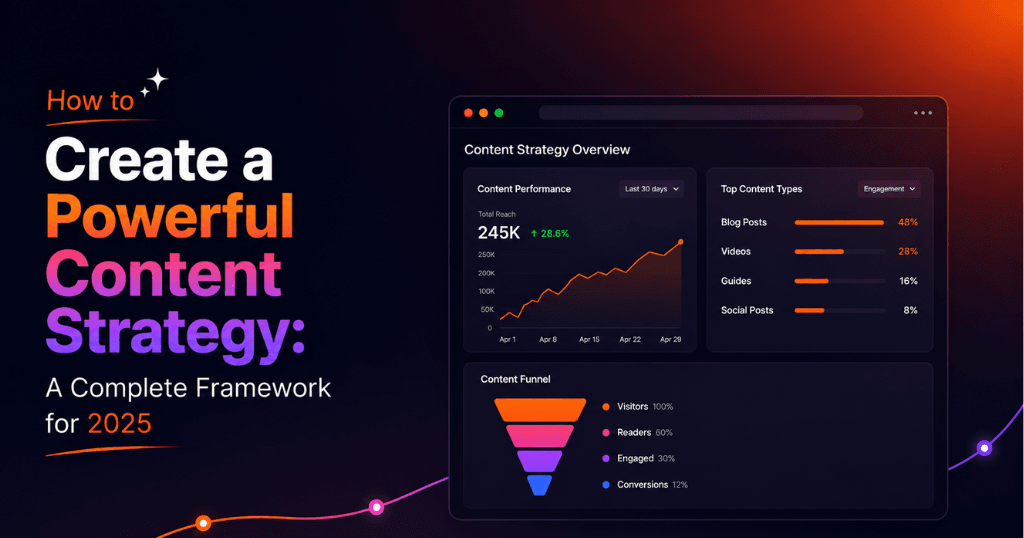
A powerful content strategy is a documented system that defines who you create content for, what problems that content solves, which channels it lives on, and how it connects to specific business outcomes — not just a publishing schedule or a topic list. The brands that consistently grow through content are not the ones publishing the most; they’re the ones publishing with the clearest strategic intent, the deepest audience understanding, and the most rigorous measurement of what actually works.
This guide walks through every component of building a content strategy from scratch — from audience research and content pillar development to distribution, measurement, and iteration. Whether you manage content in-house or partner with a digital marketing agency in Chennai, this is the framework that separates content strategies that compound into competitive advantage from those that produce effort without return.
Why Most Content Strategies Fail Before They Start
The majority of businesses that invest in content marketing don’t get the results they expect — not because content doesn’t work, but because what they’re doing isn’t actually a strategy.
The data on the disconnect between content effort and content outcomes is consistent:
- According to the Content Marketing Institute’s 2024 B2B Report, only 29% of B2B marketers say their content marketing is extremely or very successful — despite 73% having some form of content strategy in place
- HubSpot’s 2024 State of Marketing report found that companies with a documented content strategy are 3x more likely to report success than those with an undocumented one
- A Semrush study found that 55% of content teams have no documented content strategy — meaning the majority of content budgets are being spent without a tested, written plan
- According to Demand Metric, content marketing generates 3x more leads than outbound marketing and costs 62% less — but only when executed with strategic precision
- BrightEdge research confirms that organic search drives 53.3% of all website traffic — making content strategy inseparable from SEO strategy for any business serious about sustainable growth
The failure pattern is predictable: a business starts publishing blog posts, social media content, or videos without a defined audience, without a keyword strategy, without a distribution plan, and without conversion integration. After 6 months and dozens of pieces of content, traffic is flat and no one can explain why.
The solution is not more content — it’s a strategy that makes every piece of content count.
Step 1: Define Your Content Mission Statement
Before researching keywords, building content calendars, or filming videos, every content strategy needs a single, precise mission statement that guides every subsequent decision.
The Content Mission Statement Formula
Developed by content strategist Robert Rose and widely adopted in the content marketing community, the content mission statement follows this structure:
“[Our brand] provides [audience description] with [content type] that helps them [desired outcome or transformation].”
Example for a digital marketing agency:
“Weboin provides Chennai-based business owners and marketing managers with practical digital marketing guides and case studies that help them grow their businesses through measurable online marketing strategies.”
This statement answers four questions that every content decision must be filtered through:
- Who is the content for? (Chennai-based business owners and marketing managers)
- What type of content? (Practical guides and case studies)
- What outcome does it create? (Grow businesses through measurable online marketing)
- Why does this audience need it from you specifically? (Practical, not theoretical — local relevance)
Why this matters in practice: When a content idea is proposed and it doesn’t serve the defined audience or create the defined outcome, the mission statement is the filter that rejects it before resources are wasted. Without this filter, content programs expand in all directions and serve no one particularly well.
Step 2: Build Deep Audience Understanding — Beyond Demographics
Most content strategies define their audience in demographic terms: “businesses with 10–200 employees,” “marketing managers aged 28–45,” “Chennai-based SMBs.” These demographics are necessary but not sufficient. The brands that create content audiences genuinely want to consume understand their audience at a psychological and behavioral level.
The 4 Audience Research Methods That Inform Content Strategy
Method 1: Customer Interviews Direct conversations with existing customers — particularly your best customers — reveal the language, fears, aspirations, and decision-making processes that no analytics platform can surface.
Questions that generate content-strategy-defining answers:
- “What was the specific problem you were trying to solve when you first found us?”
- “What words would you use to describe that problem to a colleague?”
- “What content or resources helped you most during your research phase?”
- “What questions did you have that you couldn’t find good answers to?”
- “What almost stopped you from working with us?”
The answers to these questions become your content topics, your headline vocabulary, your FAQ sections, and your objection-handling content.
Method 2: Sales and Support Conversation Mining Your sales team and customer support channels receive the same questions from prospects and customers repeatedly. These questions are proven content demand — someone is already asking for this information.
Systematic approaches:
- Review the last 30 sales call recordings or transcripts
- Export the last 6 months of customer support tickets and categorize by question type
- Interview the sales team: “What are the top 5 questions prospects ask before deciding to buy?”
Method 3: Community and Forum Research Reddit, Quora, LinkedIn Groups, and niche industry forums are treasure troves of unfiltered audience language. The upvoted questions and comments reveal what your audience genuinely wants to know — without the polishing that happens in formal interviews.
Tools: Reddit search by subreddit, Quora topic searches, SparkToro (audience intelligence tool that shows what your audience reads, follows, and searches for), AnswerThePublic.
Method 4: Competitor Content Audit Analyzing your competitors’ highest-performing content reveals proven demand — someone has already tested what works for your shared audience. Tools: BuzzSumo (shows competitor content sorted by social shares), Ahrefs Content Explorer (shows competitor content sorted by organic traffic), Semrush Topic Research.
What to look for:
- Which competitor articles generate the most organic traffic?
- Which competitor content earns the most backlinks?
- What topics do competitors cover that you don’t?
- Where is the quality gap — where is competitor content shallow or outdated?
Building the Audience Persona for Content Strategy
Synthesize your research into a content-specific audience persona that goes beyond demographics:
| Dimension | What to Define |
|---|---|
| Role and context | Job title, company type, decision-making authority |
| Primary goal | What are they trying to achieve professionally? |
| Primary pain | What problem keeps them up at night? |
| Content consumption habits | Where do they consume content? When? In what format? |
| Knowledge level | Beginner, intermediate, or advanced on your topic? |
| Vocabulary | What words do they use for the problems you solve? |
| Objections | What prevents them from taking action? |
| Aspirational identity | Who do they want to be? What do they want their work to look like? |
Step 3: Define Content Pillars — The Architecture of Topical Authority
Content pillars are the 3–5 broad topic areas where your brand has deep expertise and your audience has consistent, recurring questions. They are the strategic foundation that transforms a collection of individual articles into a coherent content ecosystem.
Why Pillar-Based Content Architecture Matters
Google’s algorithm rewards topical authority — a concept that SEO expert Bruce Clay first described and that became central to Google’s Helpful Content and Core Update guidance. A website that covers one topic deeply and comprehensively ranks more easily for that topic than a website that covers many topics superficially.
HubSpot, which pioneered the topic cluster model as a commercial content strategy, reported a 55% increase in organic traffic after reorganizing their blog from isolated articles into pillar pages and supporting cluster content.
The structure:
- 1 Pillar Page — a comprehensive, long-form guide on a broad topic (e.g., “The Complete Guide to Social Media Marketing for Chennai Businesses”)
- Multiple Cluster Pages — in-depth articles on specific subtopics (e.g., “Instagram Reels Strategy for Local Businesses,” “LinkedIn Marketing for B2B Chennai Brands,” “How to Measure Social Media ROI”)
- Internal links — cluster pages link to the pillar; the pillar links to cluster pages; the whole structure signals topical depth to Google
How to Choose Your Content Pillars
Criteria for a strong content pillar:
- Your brand has genuine, demonstrable expertise in this area
- Your target audience has consistent, recurring questions about this topic
- The topic has sufficient keyword demand to generate organic traffic
- The topic connects directly or indirectly to your product or service
- The topic is defensible — you can cover it more thoroughly than competitors
For a social media agency in Chennai, example content pillars might be:
- Social Media Strategy (platform-specific tactics, content planning, algorithm guides)
- Content Marketing (content creation, copywriting, visual design for social)
- Paid Social Advertising (Meta Ads, LinkedIn Ads, Instagram advertising)
- Brand Building Online (identity, voice, community management)
- Analytics and Measurement (social media ROI, reporting, attribution)
Each pillar generates 15–30 cluster articles, creating a content ecosystem of 75–150 pieces over 12–18 months — building deep topical authority in each area.
Step 4: Keyword Research — The Bridge Between Audience and Algorithm
Content strategy lives at the intersection of what your audience wants and what Google will surface. Keyword research is the discipline that maps your audience’s questions to specific search queries — ensuring your content finds an audience through organic search.The Three Keyword Categories Every Content Strategy Needs
Bottom-of-Funnel (BOFU) Keywords — Start Here These are queries indicating purchase intent — the audience is actively evaluating solutions and may be close to a decision. They convert at the highest rate of any keyword category.Examples: “social media marketing agency Chennai,” “best digital marketing company Chennai,” “hire content strategist Chennai”These keywords should inform service page copy and case study content — pages designed to convert, not just inform.Middle-of-Funnel (MOFU) Keywords — Build Next These queries indicate evaluation — the audience is comparing options, understanding methodologies, and building confidence in a decision.Examples: “how to choose a digital marketing agency,” “social media agency vs. in-house team,” “content marketing results timeline”These keywords should inform comparison guides, methodology articles, and case studies — content that builds trust and pre-sells your approach.Top-of-Funnel (TOFU) Keywords — Scale Last These are informational queries — the audience is learning about a problem or topic, not yet actively seeking a solution.Examples: “how to increase social media engagement,” “what is content marketing,” “social media strategy for small business”These keywords should inform educational blog posts, guides, and how-to articles — content that captures audience at the awareness stage and nurtures them toward consideration.Why this order matters: BOFU content converts readers who are ready to buy. MOFU content builds the case for your approach. TOFU content builds the audience. Building in this sequence ensures every piece of content serves a strategic funnel stage rather than generating traffic that never converts.Keyword Evaluation Criteria
| Metric | What It Tells You | Tool | Target |
|---|---|---|---|
| Monthly Search Volume | Demand level for the keyword | Ahrefs, Semrush, Google Keyword Planner | Relevant to funnel stage |
| Keyword Difficulty (KD) | Competition intensity | Ahrefs KD | Below your domain’s DR |
| Traffic Potential | Actual traffic top-ranking page receives | Ahrefs | More accurate than raw volume |
| Search Intent | What type of content ranks (blog, product, landing page) | Google SERP analysis | Match to your content type |
| CPC | Commercial value (high CPC = high buyer intent) | Google Keyword Planner | Proxy for conversion value |
Step 5: Content Formats — Choosing the Right Vehicle for Each Message
Not every piece of content should be a blog post. The most effective content strategies deploy multiple formats — each suited to different audience behaviors, different stages of the buyer journey, and different distribution channels.
Content Format Selection Matrix
| Format | Awareness | Consideration | Decision | Best Distribution Channel | Production Effort |
|---|---|---|---|---|---|
| Long-form blog post (2000+ words) | Medium | High | High | SEO, email, LinkedIn | Medium |
| Short-form social video (15–60s) | Very High | Medium | Low | Instagram, TikTok, YouTube Shorts | Low-Medium |
| Long-form video (5–20 min) | Medium | High | Medium | YouTube, LinkedIn | High |
| Infographic | High | Medium | Low | Pinterest, LinkedIn, blog embeds | Medium |
| Case study | Low | High | Very High | Website, email, sales collateral | Medium-High |
| Podcast episode | Medium | High | Medium | Spotify, Apple Podcasts, YouTube | Medium |
| Email newsletter | Low | High | High | Email (owned channel) | Low-Medium |
| Webinar / live video | Medium | High | High | LinkedIn Live, YouTube Live | High |
| Original research report | High | High | Medium | PR, website, email, LinkedIn | Very High |
| Interactive tool / calculator | High | High | Medium | Website, social sharing | Very High |
How to choose formats: Match the format to where your audience is in their journey and where they consume content. A Chennai-based startup founder researching “how to build a content strategy” is in awareness/consideration mode — they’re likely reading blog posts and watching YouTube videos, not ready for a sales webinar. A marketing manager actively evaluating agencies is in decision mode — they’re reading case studies, checking references, and comparing approaches.
Step 6: Build the Content Calendar — From Strategy to Execution
A content strategy without an execution system is a document, not a program. The content calendar is the operational infrastructure that transforms strategic decisions into a consistent publishing rhythm.
The Content Calendar Architecture
A complete content calendar tracks more than just publication dates. It is a project management system that ensures every piece of content is strategically justified, properly briefed, produced to standard, and distributed effectively.
What a complete content calendar entry includes:
| Field | Purpose |
|---|---|
| Publication date | Scheduling and deadline tracking |
| Content type and format | Blog post, video, social series, email, etc. |
| Title / working title | Specific enough to brief a writer |
| Target keyword | Primary keyword this content is optimized for |
| Search intent / funnel stage | TOFU / MOFU / BOFU |
| Content pillar | Which of the 3–5 pillars this serves |
| Audience persona | Which audience segment this is for |
| Goal and success metric | What does success look like? (Rankings, leads, traffic) |
| CTA | What action should readers take? |
| Internal links (target) | Which existing pages should this link to? |
| Distribution channels | Where will this be published and promoted? |
| Status | Ideation → Brief → In Production → Review → Published → Promoted |
| Owner | Who is responsible for producing this? |
Calendar planning horizons:
- Monthly: Detailed planning with specific titles, keywords, and owners for each piece
- Quarterly: Topic cluster planning — which pillars are being covered, which gaps are being addressed
- Annual: Strategic planning — which content initiatives, campaigns, and large assets (research reports, tools, major guides) are planned for the year
Tools for content calendar management: Notion (highly customizable, free-tier available), Airtable (database-style, excellent for filtering), CoSchedule (marketing-specific), Trello (simple Kanban boards), Asana (project management with calendar view)
Content Velocity: How Much to Publish
Publishing frequency is one of the most debated questions in content strategy. The data is clear: more high-quality content generates more traffic — but quality cannot be sacrificed for volume.
HubSpot data on content frequency:
- Companies publishing 16+ blog posts per month get 3.5x more traffic than those publishing 0–4 per month
- But: the same research confirms that quality must be maintained — thin, low-effort content at high volume actively harms SEO and brand perception
Realistic publishing frequencies by team size:
| Team Configuration | Realistic Monthly Output | Content Mix |
|---|---|---|
| Solo founder / single writer | 4–6 blog posts + daily social | 4 blog posts + social repurposing |
| Small team (2–3 content people) | 8–12 blog posts + social + email | Blog + social series + newsletter |
| Mid-size team (4–6 people) | 12–16 blog posts + video + email | Full mix across all formats |
| Agency / full content team | 20+ pieces across formats | Pillar content + cluster + video + social + email |
The most important principle: set a sustainable frequency and maintain it without fail. Consistency signals algorithmic reliability to Google, professional credibility to your audience, and operational discipline to your own team.
Step 7: Distribution Strategy — Content Without Distribution Is a Tree Falling in a Forest
Creating great content and publishing it without a distribution strategy is one of the most common and costly content marketing mistakes. According to marketing technologist Rand Fishkin of SparkToro, the most effective content teams spend as much time distributing content as creating it.
The Content Distribution Framework
Tier 1: Owned Channels (Free, Full Control)
These are channels you own and control completely — no algorithm change can take them away:
- Website / blog: The permanent home of long-form content; the foundation of SEO
- Email newsletter: Direct access to your audience without platform intermediaries. Email open rates of 20–40% consistently outperform organic social reach.
- Social media profiles: Your owned presence on each platform
Tier 2: Earned Distribution (Free, No Control)
Distribution that happens because others value your content:
- Backlinks: Other sites linking to your content (drives SEO authority and referral traffic)
- Social shares: Organic sharing by your audience
- Press coverage: Journalists citing your research or expertise
- Guest posts: Publishing on external platforms with links back to your content
Tier 3: Paid Distribution (Cost, Amplification)
Using paid channels to accelerate distribution of proven content:
- Paid social (Meta Ads, LinkedIn Ads): Boost top-performing organic content to broader, targeted audiences
- Content discovery networks (Taboola, Outbrain): Native content amplification to relevant audiences
- Google Discovery Ads: Visual content distribution through Google’s interest-based targeting
The distribution checklist for every content piece:
- [ ] Published to primary platform (website, YouTube, etc.)
- [ ] Shared to all owned social media accounts with platform-specific copy
- [ ] Included in next email newsletter (or sent as standalone if high-value)
- [ ] Repurposed into social-format snippets (quote cards, short videos, carousels)
- [ ] Internal links added to 3–5 existing related pages
- [ ] Outreach to anyone cited in the content (they may share or link)
- [ ] Added to relevant community groups or forums (genuinely, not as spam)
- [ ] Scheduled for resharing in 30 and 90 days (evergreen content)
Step 8: Social Media Content Strategy — Platform-Specific Execution
A content strategy for 2025 cannot treat social media as a simple distribution channel for blog posts. Social media has its own content formats, algorithmic preferences, and audience behaviors — requiring platform-specific strategy within the broader content framework.
Platform Strategy for Content Distribution
LinkedIn: The B2B Content Powerhouse
LinkedIn’s algorithm gives extraordinary distribution to content from individual profiles — particularly content that generates early comments. For a digital marketing company in Chennai targeting business decision-makers, LinkedIn is the highest-ROI social content channel available.
What performs on LinkedIn in 2025:
- Text posts with 3–7 short paragraphs (algorithm favors native text over link posts)
- Document carousels (multi-slide PDF-style posts that keep users on platform)
- Short video (60–90 seconds, subtitled, professional insight-driven)
- Founder-led personal storytelling (“Here’s what I learned after 5 years of…”)
- Data-backed insights with specific numbers and claims
Instagram: Visual Authority and Brand Building
For a social media marketing agency in Chennai or any brand with a visual story to tell, Instagram remains essential for building brand recognition and community.
What performs on Instagram in 2025:
- Reels (15–60 seconds) for reach and new audience acquisition
- Carousels for saves, shares, and engagement
- Stories daily for community presence and brand intimacy
- Educational content repurposed from blog posts into visual formats
YouTube: The Long-Game Content Channel
YouTube is the second-largest search engine — and content published there compounds over years, not weeks. A video that ranks for a relevant keyword can generate consistent leads for 3–5+ years.
Content that performs on YouTube:
- Educational how-to content directly answering audience questions
- Case study walkthroughs with real results
- Tool and platform tutorials (specific, searchable)
- Thought leadership content that builds authority over time
Content Repurposing Hierarchy:
The most efficient content strategy creates one “cornerstone” piece and repurposes it across all channels — extracting maximum value from a single investment of creative effort.
Example repurposing map for one long-form blog post:
| Repurposed Format | Channel | Production Effort |
|---|---|---|
| Short-form video (hook + key point) | Instagram Reels, YouTube Shorts, TikTok | Low |
| LinkedIn text post (key insight) | Very Low | |
| Email newsletter section | Email list | Very Low |
| Instagram carousel (5 key takeaways) | Low | |
| Twitter/X thread (numbered insights) | X (Twitter) | Very Low |
| Pinterest infographic | Medium | |
| Podcast talking point | Podcast | Low |
| YouTube long-form video | YouTube | High |
One blog post, eight content pieces, one investment of research and thinking.
Step 9: Content Measurement — Connecting Content to Business Outcomes
Content measurement is where most content strategies break down. Teams track vanity metrics — pageviews, social followers, video views — without connecting them to the business outcomes that justify the content investment.
The Three-Tier Content Measurement Framework
Tier 1: Business Outcome Metrics (Most Important)
These connect content directly to revenue and pipeline:
| Metric | What It Measures | How to Track |
|---|---|---|
| Content-attributed leads | Leads that first engaged with content before converting | GA4 + CRM source tracking |
| Content-attributed revenue | Revenue from customers who first arrived via content | GA4 multi-touch attribution |
| Organic traffic growth | Compounding content SEO impact | Google Search Console |
| Email list growth rate | Audience building pace | Email service provider |
| Demo / consultation requests from content | Bottom-of-funnel content conversion | GA4 conversion events |
Tier 2: Engagement Metrics (Diagnostic)
These indicate whether content is resonating — leading indicators of Tier 1 outcomes:
| Metric | Target | Tool |
|---|---|---|
| Time on page | Above 3 minutes for long-form | GA4 |
| Scroll depth | Above 60% for blog content | Hotjar / GA4 |
| Social shares | Growing month-on-month | BuzzSumo / native analytics |
| Email open rate | Above 25% | Email service provider |
| Email click rate | Above 3% | Email service provider |
| Backlinks earned | Growing referring domains | Ahrefs |
Tier 3: Vanity Metrics (Context Only)
These have limited strategic value on their own — track only as context:
- Total pageviews (without conversion context)
- Social media followers
- Total impressions
- Total video views (without watch time or conversion data)
The content attribution challenge:
Content marketing often influences purchases without being the last click before conversion. A prospect might read your blog for 6 months, follow you on LinkedIn for 3 months, then search your brand name and convert via direct traffic. Standard last-click attribution would give zero credit to content.
Solutions:
- First-touch attribution: Credits the first content piece that brought a visitor to your site (shows top-of-funnel content value)
- Multi-touch attribution: Credits all content pieces in the conversion path proportionally (most accurate for long-cycle purchases)
- Lead source CRM field: Ask every new lead “How did you first hear about us?” — qualitative data that attribution models miss
Step 10: Content Auditing — The Ongoing System That Compounds Growth
A content strategy is not complete at publication. Content that performed well at launch gradually decays as competitors publish better alternatives, statistics become outdated, and Google’s algorithm evolves.
Backlinko reported that refreshing and updating existing content increased organic traffic by an average of 111.3%. For most businesses, the highest-ROI content activity is not publishing new pieces — it’s improving existing ones.
The Content Audit Process
Step 1: Export performance data Export all published URLs with their performance metrics from GA4 (organic sessions, conversions) and Google Search Console (impressions, clicks, average position). This is the dataset for all audit decisions.
Step 2: Categorize by performance tier
| Tier | Criteria | Action |
|---|---|---|
| Tier 1: Winners | High traffic, good engagement, converting | Protect and amplify (link to from new content, build backlinks) |
| Tier 2: Underperformers | Ranking positions 4–15, declining traffic | Refresh and optimize (update data, add depth, improve structure) |
| Tier 3: Dormant | Minimal traffic, high impressions but low CTR | Update meta title/description, improve on-page optimization |
| Tier 4: Candidates for removal | Zero traffic, no backlinks, thin content | Consolidate, redirect, or remove |
Step 3: Refresh underperformers For Tier 2 content, a structured refresh includes:
- Update all statistics and examples to current year
- Add sections addressing questions the original content missed
- Improve header structure for featured snippet opportunities
- Add internal links to newer related content
- Improve formatting: add tables, bullets, visuals
- Update the “last reviewed” date visibly on the page
- Re-submit in Google Search Console after significant updates
Audit frequency:
- Monthly: Review GSC for significant traffic drops on individual pages; address immediately
- Quarterly: Full performance tier audit; identify Tier 2 refresh candidates
- Annually: Comprehensive audit including removal/consolidation decisions for Tier 4 content
How Weboin Builds Content Strategies for Clients
At Weboin, a full-service digital marketing company in Chennai, content strategy is the strategic foundation that makes every other marketing investment — SEO, social media, paid advertising — more effective and more efficient.
The Weboin Content Strategy Development Process:
Phase 1 — Discovery and Research (Weeks 1–2) We begin with deep audience research: customer interview synthesis, sales conversation analysis, competitor content audit, and keyword landscape mapping. This phase produces the audience personas, content pillar definitions, and keyword priority matrix that underpin every subsequent decision.
Phase 2 — Strategy Documentation (Weeks 2–3) We document the full content strategy: mission statement, audience personas, content pillars with supporting cluster maps, keyword priority list segmented by funnel stage, format strategy by channel, distribution plan, and measurement framework. This is the living document that guides all content decisions.
Phase 3 — Content Calendar Build (Weeks 3–4) We build a 90-day content calendar with specific titles, target keywords, formats, owners, and distribution plans for each piece. Every entry in the calendar is strategically justified against the pillar structure and funnel stage mapping.
Phase 4 — Production and Publishing System We establish the editorial workflow: briefing templates, style guide, review and approval process, SEO checklist, and distribution checklist. This ensures every piece of content meets the strategic and quality standard — regardless of who produces it.
Phase 5 — Measurement and Iteration Monthly performance reviews connect content activity to Tier 1 business outcomes. Quarterly content audits identify refresh opportunities. The strategy evolves based on what the data shows, not what was assumed at the start.
As a specialist social media agency in Chennai, Weboin integrates social media content strategy seamlessly with blog, email, video, and SEO content — ensuring every channel reinforces the same brand narrative and drives toward the same business goals.
Building a Content Team: In-House vs. Agency vs. Hybrid
The right content team structure depends on budget, business stage, and the internal expertise available. There is no universally correct answer — but there are clear trade-offs.
| Model | Advantages | Limitations | Best For |
|---|---|---|---|
| In-house team | Brand knowledge, speed, full integration | Recruiting difficulty, cost, limited expertise breadth | Companies with 2+ dedicated content roles |
| Content agency | Expertise across formats, scalability, no hiring overhead | Less brand intimacy, requires briefing investment | Businesses wanting full-service execution |
| Freelance network | Flexible, cost-effective, specialist skills | Coordination overhead, quality consistency | Specific content types requiring niche expertise |
| Hybrid (in-house strategy + agency execution) | Strategic control with production scale | Requires strong internal content director | Most mid-size businesses |
The hybrid model — where a strong internal content strategist defines the strategy, manages the calendar, and owns the brand voice, while agency or freelance resources handle production volume — is the most effective structure for most businesses with meaningful content ambitions but limited internal team capacity.
Common Content Strategy Mistakes That Prevent Results
Mistake 1: Creating Content Without Documented Strategy Publishing without a documented strategy is the #1 predictor of content marketing failure. The CMI data is clear: documented strategies dramatically outperform undocumented ones. Write it down.
Mistake 2: Optimizing for Traffic Without Conversion Integration Content that generates thousands of pageviews but no leads, no email signups, and no business outcomes is not a content strategy — it’s a publishing hobby. Every piece of content must have a conversion goal and a CTA aligned to it.
Mistake 3: Treating All Channels Identically Repurposing a blog post by copying and pasting it into a LinkedIn post, Instagram caption, and email newsletter is not a distribution strategy. Each channel requires format adaptation, vocabulary adjustment, and audience-specific framing.
Mistake 4: Neglecting Content That’s Already Ranking Existing content that ranks in positions 4–15 is your highest-ROI content investment target. A targeted refresh of a page ranking #8 for a high-value keyword often generates more traffic than publishing 5 new articles targeting the same keyword from scratch.
Mistake 5: Inconsistent Publishing Publishing 8 articles in January and 0 in February, then 12 in March trains neither Google nor your audience to expect consistent value from your brand. Set a frequency you can sustain with quality and maintain it without exception.
Mistake 6: Writing for Search Engines Instead of Humans Google’s Helpful Content system specifically targets and demotes content written primarily to rank rather than to genuinely help the reader. In 2025, the safest SEO strategy and the best content strategy are the same strategy: create genuinely useful, expert content for real people.
Mistake 7: Skipping the Distribution Plan Content that isn’t actively distributed relies entirely on organic discovery — which takes months for new content. A distribution checklist ensures every published piece generates as much immediate value as possible while the long-term SEO results compound.
A 90-Day Content Strategy Launch Roadmap
Days 1–30: Research and Strategy
- Conduct 5–10 customer interviews (or review existing sales recordings)
- Complete competitor content audit using BuzzSumo and Ahrefs
- Define content mission statement
- Build 2–3 audience personas with full psychological depth
- Identify 3–5 content pillars
- Complete keyword research: 50–100 target keywords segmented by funnel stage and pillar
- Document full content strategy (mission, audience, pillars, keywords, formats, distribution, measurement)
Days 31–60: Infrastructure and First Content
- Set up content calendar tool and populate with 90-day schedule
- Publish first pillar page (comprehensive, SEO-optimized, internally linked)
- Publish 4–6 cluster articles supporting the pillar
- Set up email newsletter infrastructure; publish first issue
- Establish social media content templates and visual identity
- Configure GA4 content conversion tracking
- Install Hotjar for content engagement analysis
Days 61–90: Distribution and Measurement
- Activate full distribution checklist for all published content
- Begin backlink outreach for pillar page
- Publish second batch of cluster content
- Review month-1 GSC data: identify early keyword traction
- Review email and social performance: double down on highest-engagement formats
- Begin first content refresh: update any existing content ranking in positions 4–15
- Build Month 4 calendar based on performance learnings
Frequently Asked Questions About Content Strategy
Expect 3–6 months before significant organic search traffic from new content. Email and social media results are more immediate — often within 30–60 days. The compounding nature of content means returns accelerate over time: month 12 typically generates 3–5x the results of month 3, from the same monthly effort.
Three to five content pillars is optimal for most businesses. Fewer than three limits topical coverage; more than five spreads effort too thin to build genuine authority in any area. Choose pillars where you have deep expertise and your audience has deep questions.
Not necessarily — but every business should have some form of owned content that compounds over time. For most businesses, a blog integrated with their website is the most practical vehicle. For some, YouTube or a podcast serves the same function. The channel is less important than the strategic intent and consistent execution.
Connect content activity to revenue through CRM source tracking and GA4 multi-touch attribution. Track: organic traffic growth, content-attributed leads, email list growth, and conversion rates from content landing pages. Combine quantitative attribution with qualitative data ("How did you hear about us?") for the most accurate picture.
Content strategy is the plan — the documented framework defining audience, goals, pillars, formats, distribution, and measurement. Content marketing is the execution — the actual creation, publishing, and distribution of content. Strategy without execution is theoretical; execution without strategy is directionless. Both are required.
A specialist social media marketing agency in Chennai like Weboin provides the strategic architecture (audience research, pillar development, keyword mapping), the production infrastructure (editorial workflows, briefing templates, style guides), and the distribution expertise (platform-specific optimization, community management, paid amplification) that most in-house teams lack capacity to build independently — while keeping the client's brand voice, business context, and conversion goals at the center of every decision.
Final Thought: Content Strategy Is the Infrastructure of Long-Term Growth
Every other marketing channel — paid advertising, SEO, social media, email — performs better when it’s supported by a strong content strategy. Paid ads convert better when the landing page content builds trust and clarity. SEO rankings hold more firmly when content demonstrates genuine expertise. Social media builds stronger communities when content has a consistent voice and strategic purpose.
Content strategy is not a marketing channel. It’s the infrastructure that makes every other channel more effective.
The brands that dominate their categories in 2028 are building that infrastructure today — documenting their strategy, building their pillar content, developing their audience relationships, and accumulating the topical authority that compounds into a competitive advantage no budget alone can replicate.
Whether you’re building your content strategy from scratch or strengthening one that’s already in motion — in-house, with freelancers, or with a specialist digital marketing agency in Chennai like Weboin — the framework in this guide gives you every component of a strategy built to last.
About Weboin: Weboin is a full-service digital marketing company in Chennai specializing in content strategy, social media management, SEO, performance marketing, and brand development. As a trusted social media agency in Chennai, Weboin helps businesses across industries build content strategies that generate compounding organic growth, engaged audiences, and measurable business outcomes — from first strategy session through long-term execution.

No comment yet, add your voice below!