Most startup founders learn the hard way that running ads is not the same as having a marketing strategy.
The pattern plays out with striking consistency. A founder launches a business, allocates a monthly budget to Google Ads or Meta campaigns, watches traffic arrive on the website — and then watches most of that traffic leave without converting. The acquisition cost climbs. The leads that do come in are often low quality. Revenue growth lags well behind traffic growth. The instinct is to spend more on ads, try different targeting, or switch platforms.
The actual problem, almost always, is the absence of a funnel.
A single advertising channel — however well-managed — is not a marketing system. It addresses one moment in a customer’s decision journey while ignoring every other moment that determines whether that customer ultimately buys. In 2026, with customer acquisition costs rising across all digital channels and consumer buying behaviour spanning multiple touchpoints before any single conversion, startups that build complete, integrated marketing funnels consistently outperform those that don’t. HubSpot research shows companies using full funnel strategies achieving up to three times higher conversion rates compared to single-channel approaches. Google’s data shows businesses engaging users across multiple touchpoints experiencing significantly higher brand recall and purchase intent.
This guide explains exactly what a full funnel digital marketing strategy is, how each stage works, what channels and tactics drive the best results at each stage, how to integrate them into a coherent growth engine, and how startup founders in Chennai and across India can implement this framework with the resources available to them.
What Full Funnel Digital Marketing Actually Is
Full funnel digital marketing is the practice of designing and managing marketing activities that correspond to each stage of a customer’s journey from first awareness of your brand to conversion, and beyond into retention and advocacy. It is called a “funnel” because the number of people at each stage narrows progressively — many people become aware of your brand, fewer actively consider it, and a subset of those convert into customers.
The power of the full funnel approach is in its completeness. Rather than concentrating all marketing resources on a single stage of this journey — usually the conversion stage, through paid advertising — a full funnel strategy applies appropriate strategies to every stage, ensuring that potential customers are guided progressively toward a purchase decision rather than encountered cold at the moment they’re expected to buy.
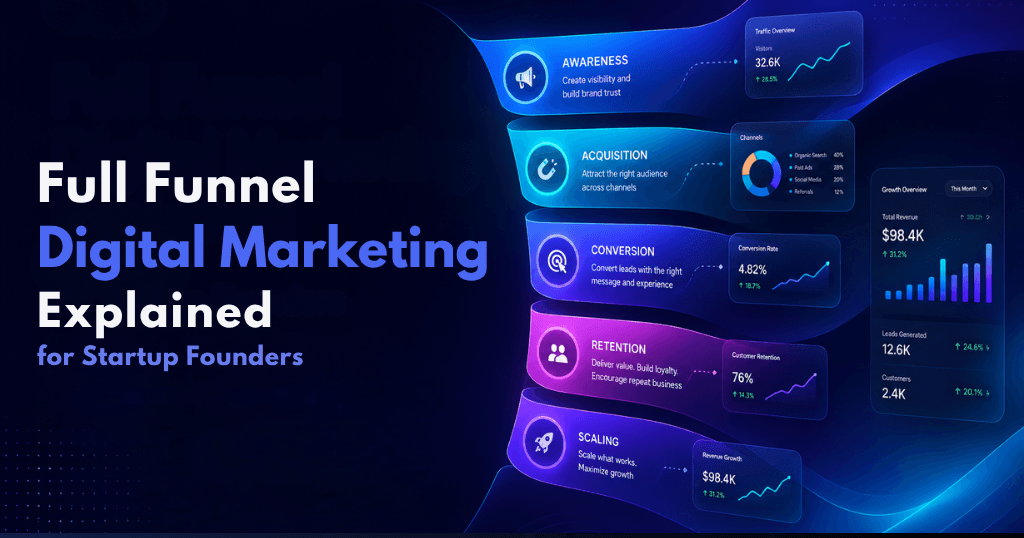
The three primary funnel stages, and a critical fourth that most startups neglect, are:
| Funnel Stage | Customer State | Primary Goal | Example Channels |
|---|---|---|---|
| Top of Funnel (TOFU) | Unaware or curious | Build awareness and generate discovery | SEO, social media, content, YouTube |
| Middle of Funnel (MOFU) | Aware and evaluating | Build trust and maintain consideration | Email, retargeting, case studies, webinars |
| Bottom of Funnel (BOFU) | Ready to decide | Drive conversion to lead or purchase | PPC, landing pages, demos, sales funnels |
| Post-Funnel (Retention) | Existing customer | Increase LTV and generate referrals | Email automation, CRM, community, upselling |
Each stage requires different content, different channels, and different success metrics. A strategy that excels at one stage while neglecting others will underperform relative to its potential — which is exactly the situation most startups find themselves in when they invest heavily in bottom-of-funnel paid advertising without building the awareness and consideration infrastructure that makes those ads more effective.
Why Startups Specifically Need a Full Funnel Approach in 2026
The full funnel argument is compelling for any business, but it is particularly urgent for startups — and for reasons specific to the startup context.
Customer Acquisition Costs Are Rising
The cost of reaching potential customers through paid channels has increased consistently year-on-year across Google Ads, Meta Ads, and virtually every other paid digital channel. This is a structural market dynamic: more businesses competing for the same advertising inventory drives prices up. Startups that rely primarily or exclusively on paid acquisition are experiencing direct margin pressure from this trend, and it will not reverse.
The countermeasure is building organic acquisition channels — particularly SEO — that provide durable, compounding visibility without per-click costs. A startup that builds strong organic search presence in its first two years will, in years three and four, be generating leads from organic search at a fraction of the customer acquisition cost of its paid-only competitors.
First Impressions Are No Longer Enough to Convert
Modern consumers — particularly in B2B and considered consumer purchases — rarely convert on first contact. Research consistently shows that most buying decisions involve multiple touchpoints across multiple channels over a period that can extend from days to months depending on purchase complexity. A startup that only invests in channels that capture first-contact purchase intent is invisible during the extended consideration process that precedes most conversions.
The middle of the funnel — the consideration stage — is where most purchase decisions are actually made, and it is the stage most consistently underinvested by startups. Email nurture sequences, retargeting campaigns, case studies, and educational content that maintains presence during the consideration window are what convert aware prospects into paying customers. Without them, startups pay to generate awareness and then lose the prospect to a competitor who has built consideration-stage presence.
Competition for Attention Has Never Been Higher
In 2026, every potential customer in Chennai’s growing startup ecosystem is simultaneously being reached by multiple competitors through digital channels. The noise level is extraordinary. Startups that invest only in interruption-based advertising — reaching people whether they want to be reached or not — are fighting for attention against enormous competition. Startups that build genuine pull-based marketing — content that people actively seek out, SEO that appears when people search for solutions, social media presence that people choose to follow — build attention assets that compound over time rather than requiring perpetual budget to maintain.
The Search Landscape Has Changed Fundamentally
For any seo agency in Chennai working with startups in 2026, the full funnel approach has taken on additional importance because of structural changes in how search works. Google’s AI Overviews now synthesise answers from multiple sources at the top of results for a majority of informational queries. This changes the nature of top-of-funnel search visibility — appearing in AI-generated answers requires content that is genuinely authoritative, factually dense, and properly structured for AI extraction. The startups building this type of content for their TOFU strategy are gaining an AI visibility layer that functions as a second search presence on top of traditional organic rankings.
Stage One: Top of Funnel — Building Awareness at Scale
The awareness stage is where the customer journey begins. At this point, a potential customer may not yet know your brand exists — or may have a vague awareness but no specific knowledge of your product or service. Your goal at this stage is not to sell; it is to be found, to educate, and to create the first impression that will anchor all subsequent touchpoints.
Search Engine Optimisation: The Compounding Awareness Channel
SEO is the awareness channel with the best long-term economics. Unlike paid advertising, where visibility exists only as long as the budget flows, content that ranks organically continues driving awareness indefinitely with maintenance investment but without ongoing per-click cost.
For startups, SEO should be approached as a long-term asset-building programme — not as a short-term traffic tactic. The topic cluster model is the most effective SEO framework for startups: build comprehensive pillar pages that cover core subject areas at depth, supported by cluster content that goes deep on specific subtopics. This architecture builds the topical authority that search engines and AI systems reward.
The content produced within this framework needs to meet 2026’s E-E-A-T (Experience, Expertise, Authoritativeness, and Trustworthiness) standards. Content that is generic, superficial, or written without genuine subject matter expertise does not rank. Content that demonstrates real expertise, cites verifiable data, and provides genuine information gain — insights or analysis not freely available elsewhere — builds domain authority that compounds over time.
Technical SEO as the foundation: Before content can work, the technical infrastructure must be sound. Core Web Vitals performance (page load speed, interactivity, layout stability), mobile optimisation, schema markup implementation, crawlability, and indexation health are the prerequisites for content visibility. Startups working with a capable seo agency in Chennai should expect the technical audit and remediation to happen before content production is prioritised.
Local SEO for Chennai-based startups: For startups serving the Chennai market specifically, local search visibility is a high-value awareness channel. Google Business Profile optimisation, local citation consistency, and hyperlocal content targeting specific Chennai districts — OMR, T. Nagar, Anna Nagar, Velachery, Adyar, Sholinganallur — direct relevant local traffic with specific geographic intent.
Social Media: Organic Discovery and Brand Personality
Social media at the awareness stage is primarily a discovery channel — the place where potential customers first encounter your brand, often without having actively searched for it. The most effective organic social strategy for startups is platform-specific and audience-specific: the content that builds awareness among B2B SaaS buyers on LinkedIn is fundamentally different from the content that reaches direct consumers on Instagram.
Consistency matters more than frequency at this stage. A regular cadence of genuinely useful, personality-expressing content builds the brand associations that make subsequent conversion-stage encounters more effective. Potential customers who have seen your brand’s perspective expressed coherently and consistently over time are significantly more likely to convert than those encountering you for the first time at the purchase stage.
Content Marketing: Long-Form Authority Building
Long-form content — comprehensive guides, original research, detailed how-to resources, industry analysis — serves awareness functions that short-form content cannot. It ranks for complex, high-intent search queries. It is the content most likely to earn natural backlinks from other sites, building domain authority. It provides the information depth that AI systems draw from when generating search overviews. And it positions the startup as a genuine authority in its space — not just a brand with a presence, but a source of expertise that people trust.
For startups in Chennai’s high-growth sectors — SaaS, healthcare, ecommerce, education, real estate — building a library of authoritative long-form content in the first year creates an awareness infrastructure that delivers compounding returns for years.
YouTube and Video: Discovery Through the World’s Second Search Engine
YouTube is the world’s second-largest search engine, and short-form video on YouTube Shorts and Instagram Reels represents the primary discovery channel for significant demographic segments — particularly those under 35. For startups whose target audience includes these segments, video content strategy is not supplementary to awareness marketing; it is central to it.
Effective awareness-stage video content is educational or entertaining — content that provides genuine value to the viewer without requiring them to already be interested in your specific product. Tutorials, industry explainers, founder perspectives, behind-the-scenes brand stories, and customer-focused insights all create the awareness associations that later convert to consideration.
Stage Two: Middle of Funnel — Building Trust During the Consideration Window
The consideration stage is where purchase decisions are actually made — and where most startups invest the least. A potential customer who has discovered your brand is now comparing it against alternatives, weighing evidence, looking for reasons to trust or distrust, and determining whether your offering genuinely addresses their specific situation.
Your goal at this stage is not to sell harder — it is to be present with relevant, trust-building information while the prospect goes through their evaluation process.
Email Marketing: The Highest-ROI Consideration Channel
Email remains one of the most effective channels for nurturing prospects through the consideration stage — because it reaches people in a direct, non-competitive environment (their inbox, not a public feed) at a moment of their choosing (when they open it, not when an algorithm serves it). A prospect who has subscribed to your email list has self-selected as interested — they have given you permission to continue the relationship.
Effective email nurture sequences for startups are designed around the specific questions and objections that prospects have during consideration. What does a potential customer need to understand to trust your product? What social proof do they need to see? What objection are they most likely holding that needs to be addressed? Each email in a nurture sequence should have a specific job related to one of these questions.
The sequence is typically triggered by a specific action — downloading a lead magnet, signing up for a webinar, requesting a demo — and unfolds over a defined period that corresponds to the typical length of your decision cycle. A SaaS product with a long evaluation period might run a twelve-email sequence over six weeks. A direct-to-consumer product with a shorter decision cycle might run a four-email sequence over two weeks.
Retargeting: Staying Present Without Being Intrusive
Most potential customers who encounter your brand at the awareness stage will not immediately move to purchase intent. They’ll visit your website, read some content, and leave — returning to their daily lives while your brand sits in the back of their minds during an evaluation process that might last days or weeks.
Retargeting campaigns — ads served specifically to people who have previously visited your website or engaged with your content — maintain your presence during this evaluation window without the cost of reaching cold audiences. Because retargeting audiences are warm — these people have already expressed interest by engaging with your brand — retargeting ads consistently achieve better conversion rates and lower cost-per-conversion than prospecting campaigns.
Effective retargeting strategy segments audiences by their level of engagement: someone who visited the pricing page is much closer to conversion than someone who read a single blog post, and the retargeting message should reflect that difference. A pricing page visitor might receive a direct conversion offer. A blog reader might receive a case study or comparison content that moves them deeper into the consideration stage.
Case Studies and Social Proof: Evidence for the Risk-Averse Evaluator
Human beings are risk-averse, and purchases involve risk. A potential customer evaluating your startup is fundamentally asking: can I trust that this product will work for me, and can I trust that this company will deliver what it promises? Case studies and testimonials answer these questions with evidence rather than claims.
Effective case studies for startup marketing are specific and quantified: they name the client (or describe them specifically enough to be recognisable), explain the challenge they faced before working with you, describe the solution you provided, and quantify the outcome with actual metrics. “A Chennai-based SaaS startup reduced their customer acquisition cost by 43% in eight months by implementing our platform” is a compelling case study. “We helped a tech company improve their marketing” is not.
Case studies also serve an important AI-search function in 2026. AI systems that generate answers to queries like “is [your product type] effective for [your target use case]” will draw from case studies and third-party validations when they exist. Startups with documented, outcome-specific case studies are more likely to be cited in these AI-generated evaluations than those relying on product descriptions alone.
Webinars and Live Events: High-Trust Consideration Content
Webinars and live online events create a level of trust that passive content cannot replicate. The live format signals confidence — you are willing to show up in real time and answer questions without a script. The duration of engagement (typically 45-90 minutes) creates a relationship depth that a blog post or social media post cannot. And the specific, practical value that a well-designed webinar delivers positions the startup as a genuine source of expertise rather than just a vendor.
For B2B startups in particular, webinars are one of the highest-converting consideration-stage content formats. Attendees who have invested an hour of their time with your content have demonstrated a level of interest that significantly predicts conversion.
Stage Three: Bottom of Funnel — Converting Intent Into Revenue
The bottom of the funnel is where the prospect is ready to make a decision. The awareness and trust built in previous stages have done their work; now the goal is to make conversion as frictionless, compelling, and urgent as possible.
PPC Advertising: Capturing Ready-to-Buy Intent
Pay-per-click advertising is the most effective bottom-of-funnel channel because it captures people at the precise moment of active purchase intent. When someone searches “best CRM for small businesses Chennai” or “digital marketing services for healthcare startups,” they are already deep into the buying process. A well-placed, well-crafted paid ad at this moment can capture a lead that is very close to conversion.
For startups working with a ppc agency in Chennai, the key principle for bottom-of-funnel PPC is alignment between the search intent, the ad message, and the landing page experience. The person who searched “digital marketing services for healthcare startups” should see an ad that speaks specifically to healthcare startup marketing, and should land on a page that immediately confirms they are in the right place with relevant evidence (case studies from healthcare startups, specific services for their context, and a clear, low-friction conversion action).
Google Ads campaign structure for conversion-focused startups should prioritise Search campaigns for high-intent keyword targeting, Performance Max campaigns for broad coverage across Google’s network with AI optimisation, and remarketing lists for search ads (RLSA) that bid more aggressively on previous visitors who return with purchase intent.
Meta Ads at the bottom of the funnel serve a complementary purpose: retargeting campaigns that reach website visitors with conversion-focused creative, and lookalike audiences built from existing customers that reach new prospects with similar profiles.
Landing page quality as the primary conversion lever: The single highest-impact improvement most startups can make to their bottom-of-funnel performance is improving landing page quality. A well-structured landing page built on conversion principles — clear headline that matches the ad promise, specific benefit articulation, social proof relevant to the target audience, minimal form friction, single clear call-to-action — consistently outperforms a generic homepage or service page as a paid traffic destination. For startups managing limited ad budgets, landing page optimisation often delivers more improvement in lead volume than any increase in ad spend.
SEO at the Conversion Stage
Not all bottom-of-funnel traffic comes from paid advertising. Commercial-intent search queries — terms like “best [product type] for [use case],” “[your brand] reviews,” or “[your product] vs [competitor]” — represent organic search traffic that is at or near conversion intent. Ranking for these terms delivers high-quality organic conversions without per-click cost.
Conversion-intent SEO content includes: comparison pages (“Weboin vs [competitor]: which digital marketing agency is right for your startup?”), best-of lists in your category, review aggregation pages, and specific service or product pages optimised for bottom-of-funnel queries. This content type is often neglected by startups focused on top-of-funnel SEO, representing a significant organic conversion opportunity.
Sales Funnels and Conversion Sequences
For startups with higher-value products or services — particularly B2B SaaS, professional services, and considered consumer purchases — a structured sales funnel provides the sequence of micro-commitments that moves a prospect from interest to purchase without requiring them to take a large leap of faith in a single step.
A typical sales funnel for a B2B startup might sequence: free resource download → email nurture sequence → webinar or demo invite → demo or discovery call → proposal → close. Each step is a smaller commitment than the final purchase, and successful completion of each step increases the probability of the next. This staged conversion process is significantly more effective for complex purchases than a direct “contact us” call-to-action, because it matches the decision-making process that buyers actually follow.
Stage Four: Retention and Advocacy — The Growth Multiplier Most Startups Ignore
The fourth funnel stage is the one most consistently neglected by startups, and the neglect is expensive. The economics are stark: acquiring a new customer costs five to seven times more than retaining an existing one. Increasing customer retention by 5% can increase profitability by 25-95%. And retained customers who become advocates — who refer friends and colleagues, who write positive reviews, who share their experience publicly — are a customer acquisition channel with essentially zero marginal cost.
Email Automation for Customer Success
The customer relationship doesn’t end at the point of sale — it begins there. A well-designed onboarding email sequence ensures that new customers successfully activate your product or service, understand its full value, and experience the early wins that create emotional investment. Customers who experience early success with your product are dramatically less likely to churn than those who struggle through onboarding alone.
Post-onboarding email automation maintains the relationship through regular value delivery — product updates, educational content relevant to how the customer is using your product, usage tips and best practices, and periodic check-ins that signal that the company genuinely cares about their success rather than just their renewal.
CRM Integration for Systematic Relationship Management
A CRM (Customer Relationship Management) system is the infrastructure that transforms customer relationship management from an art (reliant on individual account managers remembering details) into a system (reliant on documented processes that are reproducible at scale). For startups that anticipate growth, implementing CRM early — before the customer base is large enough to make it a crisis — is significantly less costly than implementing it reactively.
CRM integration with marketing automation creates the feedback loops that improve customer acquisition over time: understanding which acquisition channels produce the highest-LTV customers, which content in the nurture sequence predicts the best-retained customers, and which customer characteristics correlate with expansion revenue — these insights feed directly back into top-of-funnel targeting and content strategy.
Community Building and Brand Advocacy
The most cost-effective form of customer acquisition is referral — a satisfied customer recommending your product to someone in their network. This is not a passive process that happens automatically for good products; it is an outcome that can be systematically encouraged through community building, referral programmes, and the deliberate cultivation of customer relationships that inspire advocacy.
Startups that build genuine communities around their products — whether through LinkedIn groups, WhatsApp communities, user conferences, or online forums — create network effects that compound their growth: each new community member brings their network’s awareness and potential referrals into the community.
Integrating the Full Funnel: Why Each Stage Must Support the Others
The full funnel is only as powerful as the integration between its stages. A startup that builds an excellent awareness programme without a consideration-stage nurture system loses the leads it generates. One that excels at conversion without retention loses the compounding value of customer lifetime value. The commercial power of the full funnel approach comes from the entire system working together.
For startups working with a digital marketing agency in Chennai that provides integrated full-funnel management, the key integration points are:
Awareness to consideration handoff: How is organic traffic converted into email subscribers or retargeting audiences? The answer determines whether awareness investment compounds into consideration-stage assets. Lead magnets — free resources that earn an email address — are the primary mechanism. A startup whose SEO strategy drives traffic to blog posts without any mechanism to capture that traffic into a nurture system is building awareness without building a funnel.
Consideration to conversion alignment: Do the messages in consideration-stage nurture sequences align with the conversion offers at the bottom of the funnel? A prospect who has been nurtured with messaging about one specific benefit should encounter that same benefit framing in the conversion-stage landing page. Misalignment between consideration-stage messaging and conversion-stage offers is a common cause of funnel drop-off.
Paid and organic integration: Bottom-of-funnel PPC campaigns built on top of an established organic presence consistently outperform those deployed cold, because the organic brand recognition improves quality scores, click-through rates, and landing page conversion rates. A digital marketing company in Chennai managing both organic and paid strategy together can exploit this integration; one managing them separately cannot.
Retention data informing acquisition: Which customers stay longest, expand their usage, and refer others? What acquisition channel did they come from? What content did they engage with during consideration? These questions, answered through CRM data, allow startups to progressively optimise their top-of-funnel targeting and content toward the customer profiles that are most valuable over the long term.
The Technology Stack for Full Funnel Execution
Running a full funnel marketing programme requires a coordinated technology infrastructure. For startups, the goal is to build a stack that is functional and integrated without being unnecessarily complex or expensive.
| Tool | Funnel Stage | Purpose |
|---|---|---|
| Google Analytics 4 | All stages | Traffic, behaviour, and conversion tracking |
| Google Search Console | TOFU | SEO performance monitoring and indexation management |
| SEMrush / Ahrefs | TOFU | Keyword research and competitive SEO analysis |
| Hotjar / Microsoft Clarity | MOFU / BOFU | User behaviour analysis and heatmapping |
| Mailchimp / HubSpot | MOFU | Email marketing and marketing automation |
| Zoho CRM / HubSpot CRM | BOFU / Retention | Lead management and customer relationship tracking |
| Google Ads | BOFU | Paid search campaign management |
| Meta Ads Manager | TOFU / BOFU | Paid social and retargeting campaign management |
| Canva / Figma | All stages | Visual content creation and UI design |
| Google Looker Studio | All stages | Integrated reporting and performance dashboards |
The specific tools matter less than how well they are integrated — whether data flows between platforms to create a coherent picture of the customer journey, whether attribution is tracked across the full funnel rather than just at the conversion stage, and whether the reporting infrastructure connects activity metrics to the commercial outcomes that determine whether the programme is working.
Full Funnel Marketing Strategy Framework: Step-by-Step
For startup founders ready to build their full funnel approach, this five-step framework provides a sequenced implementation path:
Step 1: Build the Technical Foundation
Before any content or campaign work begins, ensure the infrastructure is in place. This means: a website that is technically sound (Core Web Vitals passing, mobile-optimised, properly indexed), analytics tracking that captures the full customer journey (GA4 with conversion events, Search Console integrated, UTM parameters on all campaign links), and CRM software configured to receive and manage leads.
A seo company in Chennai beginning a full-funnel engagement should prioritise this foundation work in the first four to six weeks. Campaigns and content built on a broken foundation produce inaccurate data and underperform against their potential.
Step 2: Build Awareness Infrastructure
With the foundation established, build the awareness channels that will drive sustained organic traffic over time. This means: developing the SEO topic cluster architecture appropriate for your industry and audience, beginning a consistent publishing cadence for pillar and cluster content, optimising Google Business Profile for local awareness, and establishing the social media presence appropriate for your audience channels.
Awareness infrastructure takes time to build momentum — organic search authority typically shows meaningful results in three to six months and full compounding effect in twelve to eighteen months. Starting early is the only way to have organic awareness infrastructure at the scale your business needs when it needs it.
Step 3: Build Consideration Capture and Nurture
Simultaneously with awareness building, establish the systems that capture awareness-stage traffic into consideration-stage assets. This means: developing lead magnets that are genuinely valuable enough to earn email addresses, building the landing pages that capture those leads, and creating the email nurture sequences that maintain presence and build trust through the consideration window.
Retargeting campaigns should be activated as soon as retargeting audiences are large enough (typically 1,000+ website visitors) to make campaign delivery efficient. Early retargeting is inexpensive because audiences are small; building the infrastructure before audiences are large ensures you’re ready to deploy at scale when they are.
Step 4: Activate Conversion Channels
With awareness and consideration infrastructure in place, activate bottom-of-funnel conversion channels. PPC campaigns deployed against an established organic presence convert more efficiently than those deployed cold — and the landing pages built for PPC should reflect the E-E-A-T and conversion optimisation principles that make both organic and paid content perform.
For startups working with a ppc agency in Chennai, the sequencing matters: the PPC agency should have access to conversion data from organic traffic and the nurture sequence to understand which messaging converts best before campaign copy is written.
Step 5: Implement Retention Systems
As conversion volume grows, implement the retention infrastructure that transforms customer acquisition into customer lifetime value growth. Onboarding email sequences, CRM management, community building, and systematic review and referral generation should be operational before the customer base is large enough that managing them manually becomes impossible.
Common Mistakes Startup Founders Make With Full Funnel Marketing
Investing in paid advertising without organic foundation: Startups that allocate their entire marketing budget to PPC before building any organic infrastructure are creating perpetual dependency on advertising spend. Every month they aren’t building SEO is a month of compounding organic advantage they are conceding to competitors who are.
Building awareness without consideration infrastructure: Driving traffic to a website with no lead capture mechanism, no email nurture sequence, and no retargeting pixel is paying for attention that immediately disappears. Every visit should have a next step — a way to capture the visitor’s contact information or add them to a retargeting audience.
Treating landing pages as interchangeable with homepages: A homepage is for exploration; a landing page is for conversion. Sending paid traffic to a homepage is sending conversion-ready visitors into an environment designed for discovery, which reduces conversion rates significantly. Every paid campaign should have a dedicated landing page optimised for the specific intent of that campaign.
Neglecting post-conversion retention: Startups that achieve strong conversion rates but weak retention are running a leaky bucket — filling it from the top while it drains from the bottom. Retention investment is the most capital-efficient growth lever available to a startup with a functioning acquisition engine.
Measuring success with activity metrics rather than business outcomes: Page views, social media followers, keyword rankings, and ad impressions are activity metrics — they can look impressive without generating commercial value. The metrics that reveal whether a full funnel is working are qualified lead volume, cost per qualified lead, lead-to-customer conversion rate, customer acquisition cost by channel, and customer lifetime value.
How Weboin Builds Full Funnel Systems for Chennai Startups
For startups in Chennai seeking a growth partner rather than a service vendor, Weboin’s full-funnel approach addresses each stage of the customer journey as a component of an integrated commercial system rather than as isolated services.
At the awareness stage, Weboin builds the organic foundation through technical SEO, topic cluster content architecture, and local search optimisation — while simultaneously establishing the social media and content marketing presence that drives non-search discovery. The content produced meets 2026’s E-E-A-T standards and is structured for AI Overview citability, giving clients visibility in both traditional organic results and AI-generated search answers.
At the consideration stage, Weboin builds the lead capture infrastructure — lead magnets, landing pages, email sequences — and activates retargeting campaigns that maintain presence during the consideration window. Case study development and social proof generation are treated as active marketing investments, not passive documentation.
At the conversion stage, Weboin deploys PPC campaigns — across Google Ads and Meta Ads — that are integrated with the organic presence and conversion infrastructure built in earlier stages. Landing pages are designed with conversion optimisation principles embedded from the start, and post-launch A/B testing continuously improves conversion performance.
At the retention stage, Weboin implements automation workflows, CRM integration, and customer engagement programmes that increase customer lifetime value and systematically generate the referrals and reviews that reduce future acquisition costs.
This integrated approach is why startups searching for a digital marketing agency in Chennai that can function as a genuine growth partner consistently find Weboin’s model — which treats the business outcome as the primary measure of success — more aligned with their actual needs than conventional agencies delivering predefined service packages.
For founders looking for a digital marketing company in Chennai that understands the full commercial system — not just individual channels — the full funnel framework is the right starting point for every strategic conversation.
Full Funnel Marketing Trends for 2026 and Beyond
AI-Driven Personalisation
Marketing personalisation is moving beyond list segmentation to dynamic content that adapts in real time based on individual user behaviour signals. AI systems that predict which content, offer, and message a specific visitor is most likely to respond to — and serve it automatically — are improving conversion rates across the funnel for startups that have the data infrastructure to enable them.
Voice and Conversational Search
Voice search queries are longer, more conversational, and more question-shaped than typed queries. Full-funnel content strategies that include FAQ schema, long-tail conversational keyword optimisation, and question-answer content formats are better positioned for voice search visibility than those optimised only for short-form typed queries.
Video Dominance Across All Funnel Stages
Video content is no longer just a top-of-funnel awareness tool. Case study videos serve consideration-stage functions. Product demo videos serve conversion-stage functions. Customer success story videos serve retention and advocacy functions. Startups that develop video content capabilities across all funnel stages have a meaningful competitive advantage over those treating video as purely an awareness channel.
First-Party Data as Competitive Infrastructure
With third-party cookies largely deprecated and privacy regulation strengthening, businesses with large, rich first-party data assets — email lists, CRM databases, behavioural data from owned channels — have a structural targeting advantage over those dependent on third-party data. Full funnel marketing, by design, generates first-party data at every stage through email capture, lead magnet downloads, event registrations, and purchase history. This data accumulation is itself a competitive asset that compounds over time.
Omnichannel Consistency as the New Table Stakes
In 2026, the buying journey for most products and services involves six to eight touchpoints across multiple channels before conversion. Startups whose brand, messaging, and value proposition appear consistently across search, social, email, and paid channels create stronger conversion rates than those with strong presence in one channel and weak or inconsistent presence in others.
Final Thoughts: Building the System That Scales Your Startup
Full funnel digital marketing is not a campaign strategy — it is a business growth infrastructure. When built correctly, it is a system that generates awareness continuously through organic channels, nurtures that awareness into consideration through trust-building content, converts consideration into revenue through optimised landing pages and well-managed paid campaigns, and retains customers through systematic relationship management that compounds lifetime value.
The startups that build this system early — investing in organic infrastructure before the returns are visible, building consideration nurture before the awareness scale justifies it, implementing retention systems before the customer base makes it urgent — are the ones that arrive at scale with the lowest customer acquisition costs, the highest conversion rates, and the most defensible competitive positions.
For startup founders in Chennai looking for a partner capable of building this system rather than just managing individual channels, working with an experienced seo company in Chennai that also delivers full-funnel strategy and execution — a digital marketing agency in Chennai like Weboin that treats your commercial outcomes as its own success criteria — is the highest-leverage decision available for sustainable growth in 2026’s competitive digital landscape.
The funnel is not a metaphor. It is the architecture of your customer acquisition engine. Build it deliberately, and it will scale your business. Leave it to chance, and you will spend indefinitely on channels that don’t compound.

No comment yet, add your voice below!