
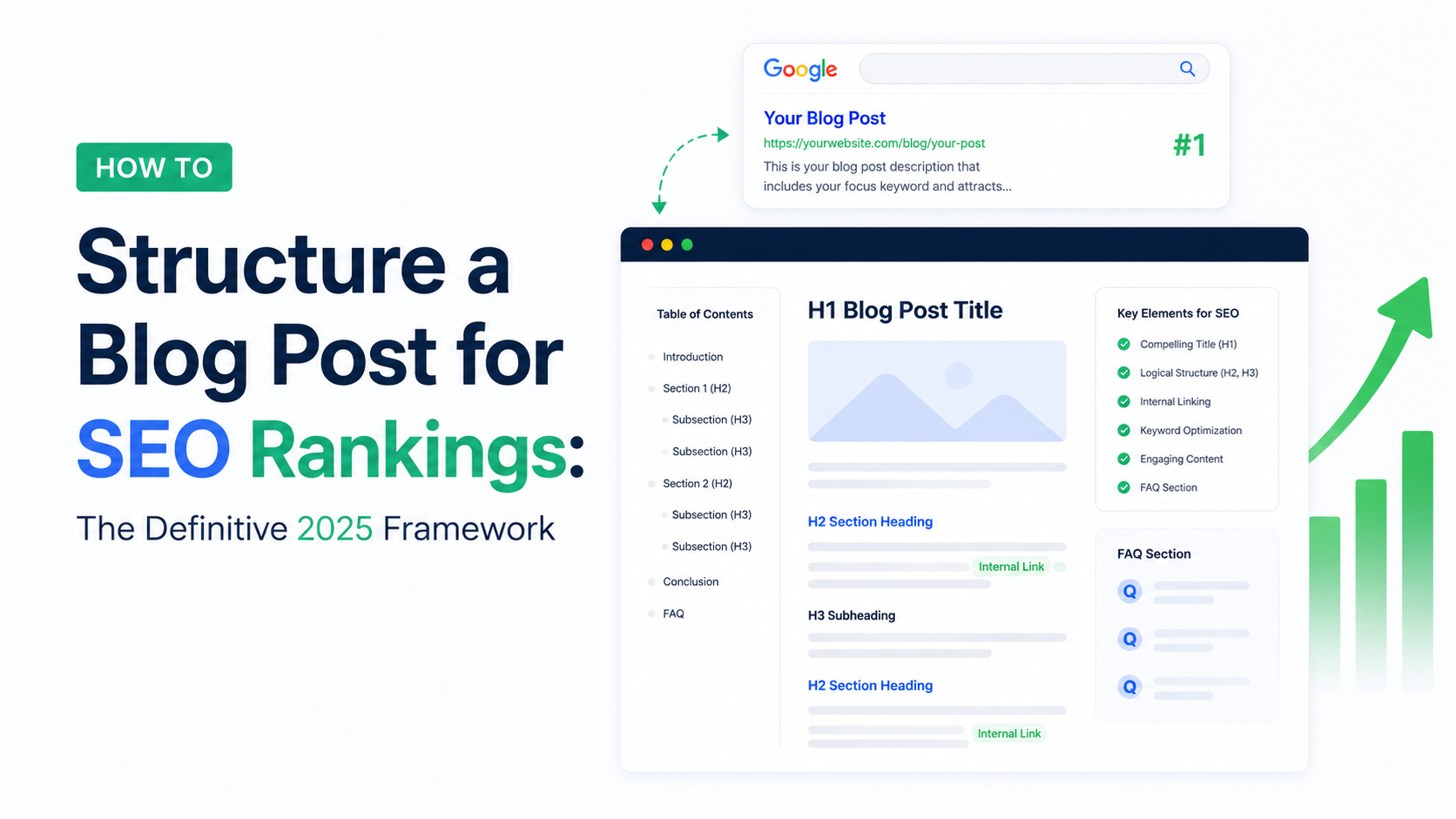
Structuring a blog post for SEO rankings means organizing your content so Google’s algorithm can immediately understand the topic, assess the depth of coverage, and determine relevance to specific search queries — while simultaneously making the content so easy to read and navigate that human visitors stay long enough to signal quality to the algorithm. These two goals — machine readability and human readability — are not competing priorities; they’re the same priority expressed in different dimensions, and the structural decisions that serve one almost always serve the other.
This guide takes a different approach from most SEO writing guides. Instead of listing individual tips, it presents a complete structural system — built on information architecture principles, behavioral psychology, and documented algorithm signals — that you can apply to every blog post you publish. Whether your content program is managed internally or supported by a digital marketing agency in Chennai, this system turns blog structure from an afterthought into a measurable ranking advantage.
The Real Reason Blog Structure Affects Rankings (Most People Get This Wrong)
Most explanations of blog structure for SEO focus on the mechanics — put the keyword in the H1, use H2s for sections, add bullet points. These mechanics matter, but they’re downstream of the actual reason structure affects rankings. Understanding the root cause makes every structural decision clearer.
Google’s algorithm is fundamentally a relevance and quality prediction system. It’s trying to answer two questions for every piece of content it crawls:
- Relevance: Is this content about what the search query is asking about?
- Quality: Does this content serve the reader better than the alternatives?
Structure answers both questions more efficiently than any other content attribute.
For relevance: Structured content — with logical headers, clearly delineated sections, and keyword placement at the beginning of sections — communicates topic focus with a clarity that body text alone cannot achieve. Google’s Natural Language Processing (NLP) models, including BERT and the more recent MUM (Multitask Unified Model), parse document structure as part of understanding a page’s topical coverage. A page without structural hierarchy is significantly harder for NLP systems to parse accurately.
For quality: Structured content signals quality through behavioral outcomes. Readers who find a well-organized post with clear navigation stay longer, scroll deeper, and are less likely to return to Google immediately (known as “pogo-sticking” — one of the clearest negative quality signals in Google’s behavioral data). According to Google’s internal research published in their Think with Google platform, pages that load fast and provide a good user experience — which structural clarity is a major component of — are 20–30% more likely to be revisited, a strong quality signal.
The practical takeaway: stop thinking of structure as a formatting preference and start treating it as an algorithm communication system.
The 7-Layer Blog Post Architecture Model
A fully SEO-optimized blog post is built across seven distinct structural layers. Most blogs address 2–3 of these layers. Posts that address all seven are structurally positioned to outrank competitors targeting the same keywords.
| Layer | Element | Primary Function | Algorithm Signal |
|---|---|---|---|
| Layer 1 | URL and slug | Keyword signal, crawl efficiency | Relevance |
| Layer 2 | Title tag and meta description | SERP click-through, first relevance signal | CTR + Relevance |
| Layer 3 | H1 and opening section | Primary topic declaration, snippet eligibility | Relevance + Quality |
| Layer 4 | H2/H3 header hierarchy | Topical depth, PAA coverage, crawl structure | Depth + Relevance |
| Layer 5 | Body content formatting | Readability, dwell time, engagement quality | Quality |
| Layer 6 | Internal link architecture | PageRank distribution, topical clustering | Authority + Depth |
| Layer 7 | Schema and structured data | Explicit semantic signals, rich result eligibility | Enhanced Relevance |
The key insight: most content optimization efforts focus almost entirely on Layer 5 (body content) while the other six layers — which contribute equally or more to ranking performance — receive minimal attention. This is why well-researched, well-written posts frequently underperform structurally simpler posts on the same topic.
Layer 1: URL and Slug Architecture
The URL slug is the shortest keyword signal on the page — and the first one that Google’s crawler reads when it follows a link to your content. A well-constructed slug communicates the post’s primary topic in 3–5 words, sets a crawl-efficient path through your site’s content structure, and serves as the permanent address that all future backlinks will point to.
URL Slug Best Practices for Blog SEO
Structure: yourdomain.com/blog/primary-keyword-phrase
The 6 Slug Rules
- Short and specific: Keep slugs to 3–6 words maximum. Longer slugs reduce readability in SERPs and are often truncated in search results.
- Keyword-first: Place the primary keyword phrase at the beginning of the slug whenever possible.
- Hyphens only: Use hyphens between words — never underscores. Google treats underscores as joining words rather than separating them.
- Lowercase exclusively: Mixed-case URLs can create duplicate content risks and inconsistency.
- No dates in slugs: URLs such as
/blog/2025/how-to-structure-blogbecome outdated, while evergreen URLs remain relevant over time. - No stop words unless essential: Articles, prepositions, and conjunctions add length without providing meaningful SEO value.
Good Slug Examples
/blog/blog-structure-seo-rankings/blog/how-to-structure-blog-for-seo/blog/blog-seo-structure-guide
Problematic Slug Examples
/blog/2025/04/12/how-to-structure-a-blog-post-for-better-seo-rankings-in-2025-complete-guide/
Too long, dated, and redundant./blog/?p=4521
No keyword information./blog/How-To-Structure-A-Blog
Mixed case and contains unnecessary stop words.
The Permanent Nature of Slugs
Once a post is published and indexed, changing the URL requires a permanent 301 redirect from the old URL to the new one. Even when implemented correctly, some link equity can be lost during the transition.
Choose your URL slug carefully before publishing and treat it as a permanent asset. A well-structured slug improves crawlability, strengthens keyword relevance, and preserves the long-term value of backlinks pointing to the page.
Layer 2: Title Tag and Meta Description — The SERP Click Architecture
The title tag and meta description are the first impression your content makes on a potential reader in Google’s search results. They don’t directly determine your ranking — but they determine whether a ranked position translates into traffic, which is both the purpose of ranking and an indirect signal back to Google about content quality.
Title Tag Construction for Maximum CTR and Relevance
The title tag is constrained to approximately 60 characters before Google truncates it in search results on desktop (slightly less on mobile). Every character is load-bearing.
The Proven Title Tag Formula for SEO Blog Posts
Formula 1:
[Primary Keyword] — [Specific Benefit or Year] | [Brand]
Formula 2:
How to [Primary Keyword Outcome]: [Differentiator] | [Brand]
What Makes a Title Tag Work for Both Rankings and CTR?
- Keyword Placement: Place the primary keyword as close to the beginning of the title as possible. Google bolds matching terms in search results, increasing visual prominence.
- Specificity Signal: Numbers, years, and specific outcomes such as “in 60 Days,” “in 2025,” or “for Beginners” increase CTR by setting precise expectations.
- Curiosity Gap or Authority Signal: Phrases like “The Complete Guide,” “Expert Framework,” or “What Most Guides Miss” create a compelling reason to click your result instead of competing listings.
- Brand Inclusion: Adding your brand name (where character space allows) builds recognition over time and improves trust-based click-through rates.
A/B Testing Title Tags
Google Search Console’s Search Analytics report provides CTR data by page and query, making it possible to identify underperforming title tags.
Pages with high impressions but low CTR typically have a title tag problem rather than a ranking problem. Updating the title structure, specificity, or value proposition can often increase traffic without improving rankings.
Meta Description as a Conversion Tool
At 150–160 characters, the meta description must convert a searcher who has already decided your result may be relevant into a visitor who clicks through.
The Three-Part Meta Description Structure
- Restate the Primary Benefit
Use the first 50 characters to reinforce the main value proposition. Matching keywords are often bolded in search snippets, increasing visibility. - Add a Specificity Signal
Explain what makes your content different, more useful, more current, or more comprehensive than competing results. - Include a Call to Action
Encourage engagement with phrases such as:- Learn how
- Discover the framework
- See the complete checklist
- Get the step-by-step guide
Meta Description Best Practices
- Keep descriptions between 150–160 characters.
- Include the primary keyword naturally.
- Focus on benefits rather than features.
- Write for humans first, search engines second.
- Avoid keyword stuffing or repetitive phrasing.
- Ensure the description accurately reflects the page content.
Layer 3: H1 and Opening Section — The Topic Declaration System
The H1 and the first 200 words of a blog post perform the most important structural function in the entire document: they tell both Google and the reader exactly what the post is about, what they’ll get from reading it, and whether this is the right content for their specific query.
H1 Optimization: More Than Just a Headline
The H1 tag is the primary topic declaration for Google’s crawlers and the primary relevance signal for the human reader scanning search results. It must accomplish three things simultaneously:
- Keyword inclusion: The primary target keyword should appear in the H1, positioned as early as natural readability allows. “How to Structure a Blog Post for SEO Rankings” places the keyword at the beginning; “The SEO Guide You Need for Blog Post Structure” buries it.
- Intent match: The H1 must match the intent of the searcher — not just the keyword. An H1 that says “Blog Post Structure: A Complete Analysis” serves informational/academic intent but may not match the practical, how-to intent of a searcher who typed “how to structure a blog for SEO.” The how-to format signals immediate practicality.
- Promise establishment: The H1 creates an implicit promise. Every section of the content that follows either fulfills that promise or breaks it. An H1 that promises “The Complete Framework” must deliver a systematic framework — not a list of disconnected tips.
The Opening Section: Google’s Featured Snippet Decision Window
The opening section — the first 200 words after the H1 — is where Google decides whether this content qualifies as a featured snippet candidate, and where human readers decide whether to continue reading or hit the back button.
The Opening Section Architecture:
PARAGRAPH 1 (Featured Snippet Target — 40-70 words):
Direct answer to the primary query. Complete sentence.
Standalone useful. No “In this article, I will…”
PARAGRAPH 2 (Context and Credibility — 60-100 words):
Why this topic matters. Specific data point or statistic.
Establishes the stakes of getting it right/wrong.
PARAGRAPH 3 (Promise and Navigation — 40-60 words):
What this guide covers. What the reader will be able to
do after reading. Creates forward pull without being a
table of contents.
What the opening section must NOT contain:
- “In this article, we will explore…” (classic AI padding that adds no value)
- Generic context about how important SEO is before actually addressing the topic
- A table of contents (unless the post is 5,000+ words — use jump links in those cases)
- Your company’s history or credentials (belongs on About pages, not blog posts)
The reader has one question when they arrive: “Did I find what I was looking for?” The opening section answers that question in the first 10 seconds. If the answer is ambiguous, the reader leaves.
Layer 4: Header Hierarchy — The Topical Depth Architecture
The H2/H3 hierarchy is the most complex structural layer in a blog post — and the one with the most direct impact on both topical authority signals and featured snippet eligibility. Each header creates a distinct, crawlable content unit that Google evaluates both independently and as part of the whole.
How Google Uses Headers to Assess Topical Depth
Google’s Natural Language Understanding (NLU) systems evaluate header text as primary signals of a page’s topical coverage. A page where the headers, taken together, cover the major dimensions of the topic comprehensively signals higher topical authority than a page where the headers are vague, repetitive, or narrowly focused.
This is the practical basis for topical authority — the concept that sites covering a topic comprehensively across multiple pages and internal links rank more easily than sites with shallow coverage. At the individual post level, header comprehensiveness is the primary mechanism through which topical depth is communicated.
The Header Comprehensiveness Test: Extract only the headers (H1, H2s, H3s) from your post as a list. Read them as an outline. Does this outline, on its own, tell someone what the complete answer to the topic question is? Could someone read only the headers and walk away with a complete map of the subject? If yes, the header structure signals comprehensive coverage. If the headers are vague (“Introduction,” “Main Points,” “Conclusion”), they communicate nothing to the algorithm.
H2 Optimization: The Primary Topical Division
Each H2 should:
Be a distinct, non-overlapping subtopic — the MECE principle applied to headers. If two H2s substantially cover the same aspect of the topic, merge them or choose one.
Include a keyword, secondary keyword, or semantic term — naturally, without forcing. A good H2 keyword strategy across a post:
| H2 Position | Keyword Strategy | Example |
|---|---|---|
| First H2 | Primary keyword variation | “Why Blog Structure Matters for SEO Rankings” |
| Second H2 | Secondary keyword or semantic term | “The URL and Header Hierarchy System” |
| Third H2 | Long-tail variation | “How to Structure Opening Sections for Featured Snippets” |
| Fourth H2 | PAA-format question | “How Many H2s Should a Blog Post Have for SEO?” |
| Fifth H2 | Related semantic concept | “Internal Linking Architecture Within Blog Posts” |
| Remaining H2s | Topic coverage focus, natural language | Varies by topic |
Be formatted as a question where PAA-alignment is possible — “People Also Ask” questions from the SERP for your target keyword are high-priority H2 candidates because:
- They represent confirmed audience demand (Google surfaces them because many people ask them)
- Google’s algorithm already associates these questions with your target topic
- Answer-formatted H2s are prime featured snippet candidates for list and paragraph snippets
H3 Optimization: The Depth Proof Layer
H3 headers exist to prove that your coverage of each H2 topic is genuinely deep. They demonstrate sub-topic expertise — the kind of specificity that signals first-hand knowledge rather than surface-level overview.
H3 best practices:
- 2–4 H3s per H2 for most topics (fewer signals shallowness; more creates navigation fatigue)
- H3s can be more specific and technical than H2s — this is where you demonstrate genuine expertise
- H3 content typically runs 150–350 words before the next H3
- H3s often contain the specific examples, data points, and case studies that make the H2’s claim credible
Layer 5: Body Content Formatting — The Human Retention System
Body content formatting is what turns a structurally sound document into a genuinely readable one. The structural decisions in Layers 1–4 serve the algorithm’s understanding of the content; Layer 5 serves the human reader’s experience — and human experience generates the behavioral signals (dwell time, scroll depth, low pogo-stick rate) that the algorithm interprets as quality.
The Paragraph Architecture Rules
Maximum 4 sentences per paragraph: Web reading is fundamentally different from reading a printed book. Eye-tracking research from Jakob Nielsen’s landmark NN Group studies (conducted since 1997 and consistently replicated) shows that web readers scan rather than read — processing the first word or two of each line before deciding whether to engage more deeply with that sentence. Long paragraphs are skipped entirely by scanners, resulting in content that was written but not read.
One idea per paragraph: Each paragraph should advance a single argument or concept. The moment a paragraph introduces a second idea, it should be split. This discipline forces clarity — writing one idea per paragraph makes both the writing and the reading more direct.
Sentence length variation: Monotonous sentences kill reading momentum. Vary between short punchy sentences (5–8 words) and longer explanatory ones (20–30 words). Short sentences create emphasis. Longer sentences build context, add nuance, and create the explanatory depth that signals genuine expertise.
Lists: When to Use Them and When Not To
Lists are frequently overused in SEO content — applied indiscriminately to content that would be better expressed in prose. The result is content that feels fragmented and shallow, despite potentially having good underlying ideas.
Use ordered lists (numbered) for:
- Sequential processes where order matters (step 1 must come before step 2)
- Rankings or prioritized recommendations
- How-to instructions
Use unordered lists (bulleted) for:
- Non-sequential collections (tools, resources, examples)
- Features or attributes of something
- Quick-reference items that don’t flow naturally as prose
Use prose instead of lists for:
- Explanations of why something works
- Arguments building to a conclusion
- Nuanced comparisons between options
- Anything that requires contextual connection between ideas
The rule: if the items could be reordered without loss of meaning and are essentially equal in weight, a list is appropriate. If the items have a logical progression or if their relationship to each other matters, prose serves better.
Tables: The Underused Formatting Power Tool
HTML tables are among the most algorithmically valuable formatting elements in blog content — for three distinct reasons:
- Featured snippet eligibility: Table-format featured snippets (“featured table snippets”) appear for comparison and data queries. An HTML table is prerequisite to winning these snippets.
- Information density: Tables convey comparative information at significantly higher density than prose or lists — a 6-row, 4-column table communicates what would take 500 words of prose to express equivalently.
- Time-on-page: Tables are studied carefully by readers — they generate significant dwell time relative to their word count.
Table structure rules for SEO:
- Use actual HTML <table> elements — not images of tables or CSS-styled div grids (Google cannot extract data from table images)
- Include <th> header tags with descriptive column names
- Keep tables to 3–8 rows for optimal snippet extraction (larger tables are truncated)
- Use a table caption (the <caption> element) to provide context that helps Google categorize the table’s content
Layer 6: Internal Link Architecture — The Authority Distribution System
Internal linking is the structural mechanism by which ranking authority (PageRank) flows between pages on your website. Every link from one page to another passes a portion of that page’s authority to the linked page — which means your internal linking structure is a direct determinant of which pages on your site rank most effectively.
This is why Ahrefs research consistently shows that pages with more internal links from high-authority pages rank better than equivalent pages with fewer internal links — regardless of their backlink profiles.
The Strategic Internal Linking Framework
The Authority Pyramid: Most websites have an implicit authority pyramid where the homepage has the most authority, major service/product pages have medium authority, and blog posts have varying authority depending on their backlink profiles. Strategic internal linking ensures that high-authority pages distribute their authority downward to pages that need ranking help.
For a digital marketing company in Chennai running a content program, this means:
- Homepage and main service pages should link to relevant blog posts (passing authority down)
- Blog posts should link to other blog posts in the same topic cluster (distributing and equalizing authority within the cluster)
- Blog posts should link back to relevant service pages (directing warm traffic to conversion pages and passing authority upward)
The Anchor Text Specificity Rule:
| Anchor Text Type | Example | SEO Value |
|---|---|---|
| Exact match | “SEO agency in Chennai” | High, but use sparingly (5–10% of anchors) |
| Partial match | “our SEO services in Chennai” | High, natural-feeling |
| Descriptive | “how to build backlinks safely” | High — tells Google what the linked page covers |
| Branded | “Weboin’s SEO framework” | Medium — signals brand relationship |
| Generic | “click here,” “read more,” “this article” | Very Low — communicates nothing |
The most effective internal link anchor texts are descriptive and specific — they describe what the linked page is about, which reinforces that page’s keyword signals in Google’s index.
The 3-2-1 Internal Linking Rule for New Blog Posts:
- Link out to at least 3 relevant internal pages (cluster members, pillar page, service page)
- Update 2 existing related posts to link back to the new post
- Ensure at least 1 high-authority page (high-traffic existing post or main service page) links to the new post
This ensures every new post is immediately integrated into the site’s authority distribution network — not left as an isolated island waiting for Google to assess its standalone value.
Layer 7: Schema and Structured Data — Explicit Semantic Communication
Schema markup is the most direct form of communication available between your content and Google’s algorithms. Where all other structural signals require Google to infer meaning (this looks like a step-by-step process; this appears to be a comparison table), schema markup states meaning explicitly in machine-readable JSON-LD code.
The Blog Post Schema Implementation Priority
Priority 1: Article Schema The foundational schema for all blog content. Declares the content as an article, specifies the author, publication date, modification date, and headline — enabling potential enhancements in how the article appears in Google News, Discover, and rich results.
Priority 2: FAQ Schema The highest-impact schema for standard blog posts, because FAQ schema enables the most visible SERP enhancement available to organic content: expandable Q&A sections appearing directly below your search result, taking up significant additional SERP real estate.
Implementation requirement: the post must include a clearly marked FAQ section with at least 3 question-answer pairs. The schema then maps each question and answer in the code. Validation via Google’s Rich Results Test confirms eligibility before publishing.
Priority 3: HowTo Schema For tutorial and process-based blog posts, HowTo schema enables step-by-step instructions to appear as rich results in desktop search — potentially with images and time estimates for each step. This is particularly valuable for “how to” keyword targets where visual step display increases CTR.
Priority 4: BreadcrumbList Schema Enables breadcrumb navigation to appear in search results below the title — communicating site hierarchy and content categorization to both users and Google.
Implementing Schema Without Developer Resources
For most WordPress-based sites, schema implementation requires no custom coding:
- Rank Math SEO (free): Includes FAQ, HowTo, Article, and BreadcrumbList schema generation with visual interfaces
- Yoast SEO Premium: Similar schema types with different UI
- Schema Pro: Dedicated schema plugin with extensive type support
- JSON-LD Generator tools: Web-based tools like TechnicalSEO.com/tools/schema-markup-generator allow manual schema creation for copy-pasting into page <head> sections
After implementation, validate every schema type with Google’s Rich Results Test (search.google.com/test/rich-results) before considering it live. Invalid schema provides no benefit and can generate Search Console warnings.
The Behavioral Signal Layer: How Humans Reading Your Post Affect Rankings
Blog structure affects rankings not only through the direct signals covered in Layers 1–7, but through the behavioral data it generates. How human readers interact with your content — and what those interactions signal to Google — is increasingly a differentiating factor in competitive keyword rankings.
The 4 Behavioral Signals That Structure Directly Influences
Signal 1: Time on Page / Dwell Time The time a visitor spends on your page before returning to Google is one of the strongest available quality signals. Well-structured content — with clear navigation, scannable sections, and logical information flow — keeps readers engaged significantly longer than poorly structured content on the same topic.
Structure’s impact on dwell time:
- Clear H2/H3 navigation enables readers to jump to the specific section they want (increasing time spent on relevant sections)
- Short paragraphs and visual breaks prevent “wall of text abandonment” — one of the most common reasons for early exits
- Internal links to related content extend sessions beyond the initial page
Signal 2: Scroll Depth Google’s Chrome browser (used by the majority of searchers) reports scroll depth data back to Google’s quality systems. Content that readers scroll through to the bottom signals that the structure was engaging enough to keep them reading. Content where 90% of readers exit in the top 20% of the page signals structural or relevance failure.
Signal 3: Click-Through Rate (CTR) As covered in Layer 2, CTR from search results is a behavioral signal. But CTR is also influenced by how previous readers responded to the content — pages that generate shares, links, and repeat visits signal quality that the algorithm amplifies with improved positioning.
Signal 4: Pogo-Sticking Pogo-sticking occurs when a searcher clicks your result, quickly decides the content isn’t what they wanted, returns to Google, and clicks a competing result. Google interprets this sequence as a negative relevance and quality signal.
Structure prevents pogo-sticking through:
- Answer-first opening (immediate relevance confirmation)
- H2 headers that match PAA questions (confirms topical breadth)
- Above-the-fold credibility signals (trust markers that reduce immediate skepticism)
Practical Application: Structuring a Blog Post from Scratch in 60 Minutes
This workflow takes a topic from blank page to fully structured draft in a focused 60-minute session:
Minutes 1–10: SERP Research
- Search the target keyword in incognito mode
- Note the format of top 5 results (guide, list, how-to, comparison?)
- Extract all “People Also Ask” questions — these become H2 candidates
- Note the approximate content depth of the #1 result
Minutes 11–20: Keyword and Semantic Research
- Identify 3–5 secondary keywords (Ahrefs “Also ranks for” or Semrush related keywords)
- Find 10–15 LSI/semantic terms (Google autocomplete, “Searches related to,” Surfer SEO)
- Identify the featured snippet format for the query (paragraph, list, table?)
Minutes 21–30: Structural Outline
- Write H1 (primary keyword, specific, promise-making)
- Write opening paragraph (featured snippet target — 40–70 words answering the primary query)
- List all H2s (using PAA questions, secondary keywords, MECE principles)
- For each H2, list 2–3 H3 subtopics
- Identify where tables, numbered lists, and visual elements belong
Minutes 31–45: URL, Title, Meta Description
- Finalize slug (3–5 words, keyword-first, no dates)
- Write title tag (primary keyword + specific differentiator, under 60 characters)
- Write meta description (keyword + benefit + CTA, under 160 characters)
Minutes 46–60: Schema and Internal Linking Plan
- Identify which schema types to implement (Article always; FAQ if FAQ section planned; HowTo if step-by-step)
- List 3–5 internal pages this post should link to (with planned anchor text)
- Identify 2–3 existing posts to update with a link back to this post after publishing
At this point, the complete structural scaffold exists. Writing the content becomes significantly faster because the architecture is already defined — each section has a specific purpose, a keyword target, and a content format specification.
How Weboin’s SEO Content Process Uses This Framework
At Weboin, a specialist SEO company in Chennai managing content programs for clients across industries, every blog post goes through all seven structural layers before a single word of body content is written.
Our content team uses a proprietary briefing template that captures:
- Layer 1–2 decisions (slug, title tag, meta description) — finalized before writing begins
- Layer 3 specifications (H1 variant, opening paragraph target, featured snippet format)
- Layer 4 outline (complete H2/H3 structure with keyword assignments and PAA alignment)
- Layer 5 formatting guidelines (specific sections where tables, numbered lists, or images are required)
- Layer 6 internal linking plan (specific pages to link to and from, with anchor text)
- Layer 7 schema specification (types to implement, FAQ question targets)
This brief is delivered to writers alongside a content depth specification — the LSI terms that must appear, the external sources that should be cited, and the E-E-A-T signals that need to be included (author credentials, original examples, specific data points).
The result is content that is structurally sound before it’s creative — which is the sequence that consistently produces the highest-ranking output.
As a full-service digital marketing company in Chennai, Weboin applies this framework to blog content for clients across e-commerce, B2B SaaS, professional services, real estate, and healthcare — consistently producing content that earns first-page rankings within 60–90 days on achievable keyword targets.
Common Blog Structure Mistakes That Kill Rankings
Mistake 1: Treating All Headers as Decorative Headers chosen for visual organization rather than keyword alignment and topical depth signaling waste the most valuable on-page SEO real estate available. Every H2 should have a deliberate keyword or semantic justification.
Mistake 2: The “Wall of Text” Opening A long, dense opening paragraph — no matter how well-researched — fails both the featured snippet test (too long to extract) and the reader retention test (too much cognitive effort before value is delivered). The first paragraph must deliver the answer, not build up to it.
Mistake 3: Orphaned Posts With No Internal Links Pointing to Them A post with zero internal links pointing to it is invisible to Google’s PageRank distribution system. No matter how well-structured the post is, without internal link equity flowing to it, it starts from zero authority with every ranking cycle.
Mistake 4: Using Images of Tables Instead of HTML Tables Google cannot read the content of an image. A table in image format is invisible to the algorithm — and ineligible for table-format featured snippets. Always use HTML tables, not screenshots or images of tabular data.
Mistake 5: Schema Declared but Not Validated Invalid schema — schema code that doesn’t match the actual page content, or that contains syntax errors — generates Search Console warnings without providing any rich result benefit. Validate every schema implementation before publishing with Google’s Rich Results Test.
Mistake 6: Generic, Non-Descriptive Internal Anchor Text “Click here to read more” tells Google nothing about the linked page. Descriptive anchor text is one of the most direct ways to reinforce the keyword relevance of internal pages — and most sites consistently leave this value unrealized.
Mistake 7: Keyword Stuffing in Headers Including the exact same keyword phrase in every H2 header triggers quality assessment flags for keyword manipulation. The algorithm is sophisticated enough to understand semantic variation — use it.
Frequently Asked Questions About Blog Post Structure for SEO
There is no universal ideal — only the appropriate depth for your specific keyword and competition. For most informational keywords, 1,500–2,500 words ranks well. For "complete guide" or "ultimate guide" topics in competitive niches, 3,000–5,000+ words is often necessary. The diagnostic: check the average word count of the current top 5 results for your specific keyword and target approximately 20–30% more comprehensive coverage — not just more words, but more depth and question coverage.
Yes — Google's algorithms give additional weight to text in header tags relative to body text, because headers serve as explicit topic declarations. The same keyword in an H2 carries more relevance signal than the same keyword in a body paragraph. This is why keyword placement in headers (rather than just in body text) is a distinct and important optimization.
Search your primary keyword in Google and screenshot the full "People Also Ask" section. Click on each PAA question — Google will expand additional related questions each time you click. This cascade reveals the full semantic network of questions associated with your target topic. Prioritize the 3–5 PAA questions most directly related to your content angle as H2 candidates.
Use a linked table of contents for posts exceeding approximately 2,500 words — particularly those with 7+ H2 sections. For shorter posts, the table of contents adds navigation overhead without meaningful benefit. When used, a table of contents generates "jump-link" elements that sometimes appear as site links beneath the main result in Google's SERP, which increases result real estate and CTR.
Technical structural changes (URL optimization, schema implementation, header keyword alignment) that don't require significant content changes typically see ranking response within 2–4 weeks as Google recrawls and re-evaluates the page. Content depth improvements (adding H2 sections, expanding coverage, adding tables and lists) typically take 4–8 weeks to reflect in rankings. Internal linking additions to existing posts often show effect within 1–3 weeks as the new link signals are incorporated into PageRank calculations.
A specialist digital marketing agency in Chennai like Weboin applies a systematic, pre-publication structural framework to every piece of content — with SERP research, keyword mapping, schema specification, and internal linking plans completed before writing begins. Most in-house teams lack the time, the tools, or the workflow discipline to consistently apply all seven structural layers to every post. The difference compounds over a content program: an agency applying the complete framework to 20 posts per month produces structurally superior content at every volume than a team applying partial structure inconsistently.
Final Thought: Structure Is the SEO Advantage That Doesn’t Require More Budget
Almost every other SEO improvement — more backlinks, more content, better tools, faster hosting — requires increased investment. Structural improvement requires only a change in process. You can write the same number of posts, on the same topics, with the same quality of research — and dramatically improve their ranking performance simply by applying the seven-layer structural framework consistently.
This is the underutilized insight in most SEO content programs. Teams that are frustrated with content that doesn’t rank often assume the solution is more content, better keywords, or stronger backlinks. Frequently, the actual solution is better structure — because structure is what enables all the other investments (research, writing quality, backlink acquisition) to achieve their potential.
The 7-layer model in this guide — from slug construction to schema implementation — gives you a complete, systematic approach to blog structure that every post you publish can benefit from. Apply it once, refine it through testing, and it compounds silently across every piece of content your brand produces.
Whether you build this structural discipline into your in-house content process or partner with an experienced SEO agency in Chennai like Weboin to implement it at scale, the framework is the same — and so are the results.
About Weboin: Weboin is a full-service digital marketing agency in Chennai specializing in SEO content strategy, technical blog architecture, schema implementation, internal linking systems, and performance marketing. As a trusted SEO company in Chennai, Weboin has helped brands across industries build structurally superior content programs that consistently earn first-page rankings, featured snippet positions, and compounding organic traffic growth.

No comment yet, add your voice below!