
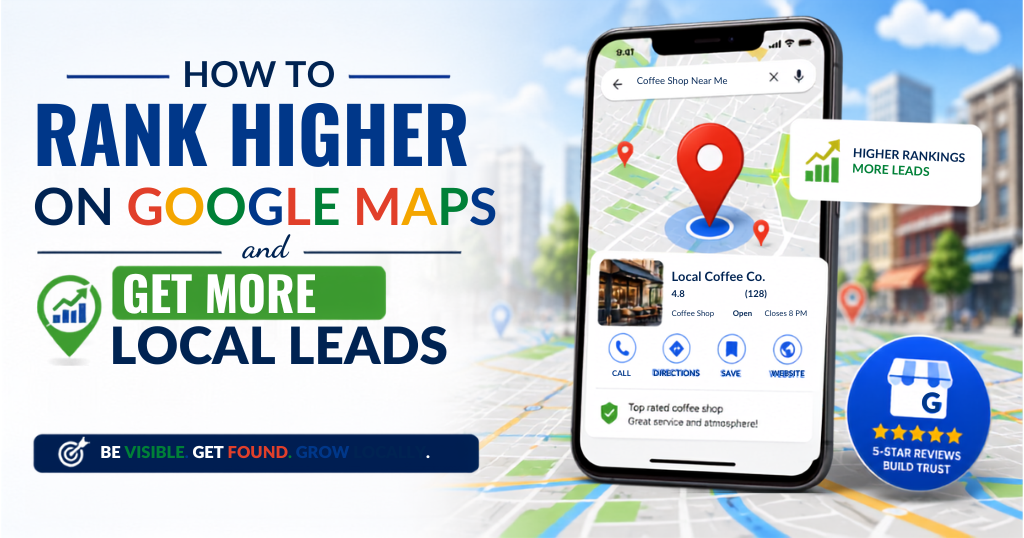
Ranking higher on Google Maps requires optimizing your Google Business Profile with complete, accurate, and frequently updated information — then supporting it with consistent NAP citations, a strong review velocity, locally optimized website pages, and the behavioral signals that Google interprets as proof of a legitimate, active, and trusted local business. The businesses dominating Google Maps in their category are not necessarily the largest or oldest — they’re the ones whose local SEO signals are strongest across every dimension Google’s local algorithm evaluates.
This guide covers the complete Google Maps ranking system: how the local algorithm works, what specific signals drive 3-pack visibility, the advanced GBP optimization tactics that most competitors miss, and the full local SEO ecosystem that makes Map ranking sustainable rather than short-lived. Whether you manage local SEO yourself or work with a local SEO services provider, this is the operational playbook.
Why Google Maps Rankings Directly Generate Business Revenue
Before covering the how, it’s worth establishing why Google Maps rankings deserve serious marketing investment — because the commercial case is stronger than most business owners realize.
The data is definitive:
- According to Google’s own research, 28% of local searches result in a purchase within 24 hours — making Google Maps one of the highest-intent commercial surfaces available to any local business
- The Google Local 3-Pack (the top three businesses shown in map results) captures 44% of all clicks on local search result pages, according to Search Engine Land’s research — significantly more than any individual organic position
- BrightLocal’s 2024 Local Consumer Review Survey found that 98% of consumers read online reviews before visiting a local business, and 87% specifically use Google to evaluate local businesses — making Google Maps the primary business evaluation platform for most consumers
- According to Google’s local business data, businesses with complete GBP listings receive 7x more clicks and 70% more location visits than businesses with incomplete listings
- Moz’s Local Search Ranking Factors survey confirms that Google Business Profile signals are the #1 local pack ranking factor, accounting for approximately 36% of local pack rankings
For any business serving a specific geographic area — from a digital marketing agency in Chennai to a restaurant, clinic, law firm, or retail store — Google Maps visibility is not a marketing channel among many. It’s the channel where the highest-intent local buyers are actively looking for exactly what you offer.
How Google’s Local Algorithm Works: The 3 Ranking Factors
Google’s local algorithm evaluates businesses across three primary dimensions. Understanding each dimension is the prerequisite for knowing where to invest optimization effort.
Factor 1: Relevance
Relevance measures how well your business matches the searcher’s query. Google determines relevance through:
- Primary and secondary GBP categories — the most direct relevance signal available
- Business description and service listings — keyword presence in GBP-managed text
- Website content — the local relevance of pages Google associates with your GBP
- Review content — keywords appearing in customer reviews influence topic relevance
- Q&A content — questions and answers in your GBP that contain relevant terms
Optimization principle: The more completely and specifically you describe what your business does — through every text surface available — the more queries your profile is relevant for.
Factor 2: Distance
Distance measures how physically close the business is to the searcher’s location (or the location specified in the search query). Distance is a largely fixed factor — you can’t change your physical location.
What you can control:
- Service area configuration: For service-area businesses, define your service areas precisely in GBP — this affects which location-based queries you’re eligible to appear for
- Local citation consistency: Consistent NAP data helps Google confirm your location with confidence, which reduces the “uncertainty penalty” that affects businesses with inconsistent location data
Factor 3: Prominence
Prominence measures how well-known and trusted your business is — both online and in the physical world. This is the most actionable factor for most businesses because it can be continuously improved through deliberate effort.
Prominence signals Google uses:
- Review count and rating (Google reviews specifically)
- Backlinks to your website from local and relevant external sources
- Local citation presence across directories and platforms
- Website authority (domain authority and page authority)
- Online mentions of your business name
- Google Business Profile completeness and activity (post frequency, photo volume, Q&A engagement)
- Behavioral signals (how users interact with your listing — clicks, calls, direction requests, website visits)
The relevance-distance-prominence framework is not a checklist; it’s a system. Every optimization action either adds a signal in one dimension or removes a negative signal. The businesses at position 1 in the local 3-pack are those whose combined signal strength across all three dimensions is highest for a specific query-location combination.
The Complete Google Business Profile Optimization System
Google Business Profile (GBP) is the primary instrument through which Google Maps rankings are built. Every element of the profile is a ranking signal — and the businesses winning in local search have optimized every element, not just the basics.
Step 1: Category Selection — The Most Underestimated Ranking Lever
Your primary category is Google’s most direct relevance signal for local queries. Choosing a category that is one level too broad — “Marketing Agency” instead of “Internet Marketing Service” — can reduce visibility for the specific queries your business should rank for.
Primary category selection process:
- Search your top 2–3 target keywords in Google Maps
- Click the top 5 ranked competitors and identify their primary category
- Use PlePer.com or Whitespark’s GBP Category Tool to explore the full category list
- Select the most specific, accurate category that describes your primary service
Secondary categories: Add secondary categories for each distinct service line. For a digital marketing company in Chennai, secondary categories might include: “Advertising Agency,” “SEO Agency,” “Social Media Marketing Service,” “Web Designer.” Each secondary category increases the query footprint your profile is eligible for.
Important: Categories must accurately describe your business. Selecting categories for keyword inclusion without genuine service relevance violates Google’s guidelines and risks suspension.
Step 2: Business Description — The AI-Extracted Content Surface
The 750-character business description is indexed by Google and increasingly extracted by Google’s local AI summaries. It must accomplish two objectives simultaneously: communicate to human readers who you are and what you do, and signal to Google’s algorithm which queries your business is relevant for.
High-performing business description structure:
[Opening: What you do + who you do it for — 100 characters]
[Service details: Core services with natural keyword inclusion — 200 characters]
[Differentiators: What makes you different — 100 characters]
[Geography: Service area with location keywords — 100 characters]
[CTA: What should they do next — 100 characters]
Example for an SEO company:
“Weboin is a Chennai-based digital marketing and SEO agency helping businesses across Tamil Nadu achieve first-page Google rankings and generate more qualified leads. We provide local SEO services, Google Ads management, content marketing, and technical SEO audits — with transparent monthly reporting and no lock-in contracts. Trusted by 200+ businesses since [year]. Call us to schedule a free SEO consultation.”
This description contains: primary keywords (digital marketing, SEO, local SEO services), geographic signal (Chennai, Tamil Nadu), service list, social proof, differentiators, and a CTA — all within 750 characters.
Step 3: Services Section — The Overlooked Ranking Amplifier
The Services section allows you to list individual services with names, descriptions (up to 300 words each), and pricing. These service descriptions are indexed, appear in Maps search results, and are increasingly extracted by Google’s AI local summaries.
Services section optimization:
- List every distinct service as a separate entry
- Write service descriptions of 150–300 words for each major service
- Include specific keywords naturally: “local SEO services for Chennai businesses,” “Google Ads management,” “technical SEO audit”
- Add pricing ranges where possible — visible pricing is surfaced in local results and reduces friction for qualified leads
Step 4: Photos — The Trust and Engagement Multiplier
According to Google’s own data, businesses with photos receive 42% more requests for directions and 35% more website clicks than businesses without photos. Photo quantity and quality are both GBP ranking signals.
The complete photo optimization framework:
| Photo Category | Recommended Quantity | Key Optimization |
|---|---|---|
| Cover photo | 1 (updated quarterly) | On-brand, high resolution, 16:9 |
| Profile/logo | 1 (current version) | Square format, clear on white background |
| Exterior | 3–5 (different angles/times) | Helps customers identify location |
| Interior | 5–10 | Builds trust through transparency |
| Team | 1 per key team member | Humanizes the brand |
| Work samples / service evidence | 10+ | Shows actual deliverables |
| Video | 1–3 (30 seconds each) | Highest engagement format |
Geotagging photos before upload: Embed GPS coordinates in photo EXIF data using GeoImgr or Lightroom before uploading. This reinforces your physical location to Google’s local algorithm — particularly valuable for service-area businesses where location confirmation matters.
Step 5: Posts — The Freshness Signal That Most Competitors Ignore
Google Business Profile posts are among the most consistently underused features in local SEO — despite being one of the clearest freshness signals that tell Google your business is actively operating.
| Post Type | Frequency | Optimization Focus |
|---|---|---|
| What’s New | 2–3x per week | First 100 characters must include primary keyword |
| Offer | Per campaign | Include specific value, CTA, and expiry date |
| Event | Per event | Include date, time, and registration link |
| Product | 2–4x per month | Service/product name, description, and price range |
The freshness algorithm effect: Consistent posting (2–3 times per week) signals active business operation. Google’s local algorithm treats posting history as a proxy for business health — which affects map ranking calculations particularly for businesses in categories with high closure rates.
Step 6: Q&A — The Pre-Emptive Content Strategy
The Questions & Answers section is fully indexed by Google and increasingly extracted by AI local summaries. Yet the majority of local businesses either ignore this feature entirely or fail to notice when questions are asked without any business response.
The proactive Q&A strategy:
You can ask questions on your own GBP profile using a different Google account than your GBP manager account, then answer them from the business account. Seed 8–12 frequently asked questions covering:
- “What services do you offer?” → Comprehensive service list with keywords
- “What areas do you serve?” → Geographic service area with location keywords
- “How much do your services cost?” → Pricing transparency builds trust
- “What makes you different from other [category]?” → Unique differentiators
- “Do you offer free consultations?” → Lead generation offer details
- “How long have you been in business?” → Establishment credibility
- “Are you Google certified / accredited?” → Trust signal questions
These seeded Q&As provide structured content for AI local summaries and serve as 24/7 answer resources for potential customers evaluating your business.
The Review System: Building the Velocity and Quality That Drives Local Rankings
Google reviews are simultaneously a ranking factor (volume and recency), a conversion factor (rating and content), and an AI summary signal (review text keywords). A strategic review program addresses all three dimensions.
The 4 Review Dimensions That Affect Google Maps Rankings
- Review Count More reviews signal more customer interactions — which Google interprets as higher business activity and prominence. The baseline for competitive visibility in most categories is 50+ Google reviews; the threshold for category leadership in competitive markets is 200+.
- Average Rating The 4.0 threshold is significant — profiles below 4.0 receive reduced local pack visibility in Google’s algorithm. The 4.5+ range is competitive; the 4.8–5.0 range with 100+ reviews is category-leading for most markets.
- Review Recency and Velocity A business with 300 reviews earned over 5 years typically ranks below a business with 100 reviews earned consistently over the past 12 months — because recent review velocity signals current active operation. Target: 4–8+ new reviews per month for most local businesses; 10–15+/month for competitive categories.
- Review Content (Keywords and Topics) Google’s algorithm reads review text. Reviews containing specific service mentions (“they helped us with our local SEO campaign,” “our Google Ads cost per lead dropped by half”) contribute to keyword relevance for related queries. This happens naturally when customers describe specific services — the proactive review request strategy below helps elicit more specific review content.
The Ethical Review Generation System
The optimal review request moment: Immediately after a customer achieves a meaningful outcome — a project completed, a result delivered, a problem solved. Enthusiasm peaks at this moment; the request feels natural rather than transactional.
The 3-step review request process:
- Personal ask: “We’d love to hear your feedback — would you be willing to share a Google review? It helps other businesses find us.”
- Frictionless link: Send a direct link to your Google Business Profile review form (access through GBP Dashboard → Get More Reviews → Share review form)
- Brief guidance: “If you’d like guidance on what to include, mentioning the specific service we provided and the result you experienced helps future customers understand what to expect.”
What NOT to do (Google policy violations that risk suspension):
- Never offer incentives for reviews (discounts, free services, gifts)
- Never create reviews using staff accounts or fake identities
- Never use “review gating” — screening customers for positive sentiment before sending the review link
The Review Response Strategy for Rankings
Review responses are indexed content — and responding to reviews is a confirmed signal that Google uses to assess business activity and customer engagement.
Response framework:
- Positive reviews: Thank by name, reiterate the specific service mentioned, include a natural keyword (“We’re glad our local SEO services delivered the visibility you needed”), invite them to refer others
- Negative reviews: Respond within 24 hours, acknowledge professionally, take offline (“Please contact us directly at [email]”), never be defensive, follow up publicly if resolved positively
Local Citation Building: The Foundation of NAP Authority
Local citations are mentions of your business’s Name, Address, and Phone number (NAP) across the web — on directories, platforms, social networks, and industry sites. Consistent NAP data across these citations is a core local prominence signal.
Why NAP Consistency Matters for Google Maps Rankings
Google cross-references your business information across hundreds of data sources to verify your business entity. When your business name appears as “Weboin” on your GBP, “Weboin Digital Marketing” on Justdial, and “Weboin Technologies” on Sulekha — these inconsistencies create entity uncertainty that Google penalizes in local rankings.
The NAP documentation rule: Define your canonical NAP format before building any citations. Document it and apply it consistently everywhere:
Business Name: [Exact legal name — no keyword additions]
Address: [Full address with consistent abbreviations]
Phone: [+91 format consistently — or local format consistently]
Website: [With or without www — choose one, use it everywhere]
| Directory | Domain Authority | Monthly Traffic | Business Type |
|---|---|---|---|
| Google Business Profile | N/A — primary | Billions | All |
| Justdial | 68 | 120M+ | Local Indian |
| Sulekha | 64 | 40M+ | Service businesses |
| IndiaMart | 72 | 100M+ | B2B |
| Bing Places | 92 | — | All |
| Apple Maps Connect | 100 | 500M+ device-side | All |
| Facebook Business | 100 | 2B+ | All |
| Clutch | 78 | High-intent B2B | Agencies/services |
| G2 | 90 | High-intent SaaS | Software/services |
| Yellow Pages India | 55 | Moderate | General |
| TradeIndia | 58 | B2B focused | B2B |
The Citation Audit and Cleanup Process
Step 1: Discover existing citations Use BrightLocal’s Citation Finder, Semrush’s Listing Management, or Moz Local to find all existing web mentions of your business.
Step 2: Identify inconsistencies Compare each citation against your canonical NAP. Flag any with incorrect name variations, address abbreviations, old phone numbers, or closed location addresses.
Step 3: Correct inconsistencies Most directories allow direct editing. For directories that require verification or slow response, use aggregator services (Yext, BrightLocal’s citation building service) to push corrections at scale.
Step 4: Build new citations on priority platforms After cleaning existing citations, build new ones on the priority platforms listed above. Focus on complete profiles — not just NAP, but all available fields (business description, categories, photos, website URL, hours).
Local Link Building: The Underused Prominence Driver
Backlinks to your website from locally relevant domains are one of the highest-impact local SEO signals — yet most local businesses focus entirely on GBP optimization and neglect the website authority component that supports their map rankings.
The local link building opportunity stack:
Tier 1 — Local business associations and chambers:
- Chennai Chamber of Commerce
- CII Tamil Nadu (Confederation of Indian Industry)
- NASSCOM Chennai chapter
- Industry-specific associations (e.g., advertising industry bodies, healthcare associations)
Membership typically includes a directory listing with a backlink — and these .org and institutional links carry high local relevance weight.
Tier 2 — Local media and press: Reach out to Chennai-based media (The Hindu, Deccan Chronicle, Times of India Chennai edition, YourStory, Inc42) with genuine news angles — company milestones, original research, community initiatives, or expert commentary on local business topics.
Tier 3 — Locally relevant guest contributions: Write for local business blogs, industry publications with Chennai readership, or partner businesses in complementary categories. Each earned link strengthens the local authority signal that supports map rankings.
Tier 4 — Local sponsorships and events: Sponsoring local startup events, educational programs, or community initiatives typically generates a backlink from the event website. These backlinks are often from trusted, non-commercial domains with high local relevance.
Tier 5 — Customer/partner reciprocal links (with caution): Links from satisfied customers who mention your services on their website, or from vendor/partner “trusted partners” pages. These are legitimate editorial links — not exchange schemes. The distinction matters: genuine editorial mentions from real business relationships are valuable local signals.
Local Landing Pages: The Website Signal That Connects GBP to Rankings
Google’s local algorithm evaluates the website associated with your GBP as a supporting signal for your profile’s relevance and authority. A website that clearly serves the geographic area your GBP covers, with local keyword optimization and location-specific content, strengthens the combined local signal.
The Local Service Page Architecture
Every location you serve and every primary service category you offer is a potential local landing page. These pages serve dual functions: SEO (ranking for local search queries) and conversion (converting visitors from Google Maps who click through to your website).
Anatomy of a high-performing local service page:
H1: [Primary Service] in [Location] — [Benefit Statement]
Example: “SEO Services in Chennai — First-Page Rankings for Local Businesses”
Opening paragraph: Direct answer to the service query with primary keyword
[100–150 words]
Local context section: Why this service matters for businesses in Chennai/Tamil Nadu
[200–300 words with local references]
Service details: What the service includes, the process, deliverables
[400–600 words]
Local social proof: Client testimonials from Chennai businesses with names and results
[2–3 specific testimonials]
FAQ section: 4–6 questions about the service with answers (FAQ schema eligible)
[Using local keywords in questions and answers]
CTA: Location-specific conversion action
[“Get a Free SEO Consultation for Your Chennai Business”]
Local Schema Markup for Website Pages
For local businesses, the website’s structured data must align with and reinforce the GBP data:
- LocalBusiness schema on the homepage with exact NAP matching the GBP
- Service schema on each service page
- BreadcrumbList schema site-wide
- FAQPage schema on any page with FAQ sections
- AggregateRating schema on pages displaying customer testimonials
The consistency between GBP data and website schema data is itself a trust signal — Google compares these sources to confirm the entity is legitimate and accurately described.
Behavioral Signals: The Advanced Local Ranking Factor
Beyond the technical optimization of GBP and website, Google uses behavioral signals — how users actually interact with your listing and website — as quality signals for local rankings. These signals are harder to manipulate than static content signals, which is why Google weights them more heavily in competitive markets.
The Key Behavioral Signals for Local SEO
Click-through rate from local results: How often searchers click your listing compared to competitors in the same query. A listing with a compelling name, strong review rating, and relevant category earns higher CTR — which positively influences rankings in a feedback loop.
Directions requests: The volume of “Get Directions” requests to your location from Google Maps is a behavioral signal that Google uses to assess physical business activity. For businesses with walk-in customers, this is one of the strongest local prominence signals available.
Phone call clicks: Click-to-call interactions from your GBP are tracked by Google. Higher call volumes signal higher customer interest and active business operation.
Photo views: Profile photos that earn high view counts signal that the visual presentation of the business creates engagement — a positive behavioral quality signal.
Website visits from GBP: The volume of website visits generated from your GBP listing signals that your profile content is compelling enough to earn click-throughs — a positive engagement signal.
How to Improve Behavioral Signals Legitimately
- Improve listing visual appeal: Higher quality cover photos and a complete photo library directly improve the visual first impression that drives CTR
- Optimize your review rating prominently: A higher rating earns more clicks in competitive local search results
- Update hours accurately: Listings with accurate hours (especially holiday hours) earn higher CTR because users trust them to be open
- Use offer posts for seasonal CTR boosts: Active offers in GBP posts increase CTR from local results during promotional periods
What never to do: Never use fake clicks, artificial direction requests, or any form of click manipulation. Google’s systems detect artificial behavioral patterns — and the consequences range from ranking penalties to complete profile suspension.
The Local Content Marketing Strategy for Google Maps Rankings
Beyond GBP optimization and website technical work, local content marketing builds the topical authority and local relevance signals that sustain and improve Google Maps rankings over time.
Local Content Types That Support Map Rankings
Locally-specific blog content: Blog posts targeting local keyword combinations (“best digital marketing practices for Chennai retailers,” “how Chennai startups can use SEO to compete nationally”) create local topical authority signals that reinforce GBP relevance.
Local case studies: Detailed case studies featuring named local clients, specific results, and Chennai-based context serve triple duty: local content SEO, social proof for conversion, and E-E-A-T signals for AI search citation.
Local resource pages: “The Complete Guide to Digital Marketing for Tamil Nadu Businesses,” or “How to Choose an SEO Agency in Chennai” — these comprehensive local resources earn backlinks from local audiences and establish topical authority for local queries.
Neighborhood and area-specific pages: For businesses serving multiple areas within Chennai (Anna Nagar, T. Nagar, OMR, Velachery, Adyar), dedicated area-specific pages with genuine local content (not just keyword-swapped duplicates) expand your local search footprint.
How Weboin Delivers Local SEO Services for Chennai Businesses
At Weboin, a specialist digital marketing agency in Chennai providing comprehensive local SEO services, Google Maps ranking optimization is one of our highest-demand service areas — because for service businesses and local enterprises, Google Maps visibility is the most direct line between marketing investment and revenue generation.
Our local SEO service delivery:
Month 1 — Local SEO Audit: We conduct a full audit covering GBP completeness, NAP consistency across 50+ citation sources, website local optimization (schema, local pages, Core Web Vitals), competitive positioning (who’s outranking the client and why), and review profile health. Every audit produces a prioritized action plan with expected impact for each item.
Month 2 — GBP and Technical Foundation: We implement the complete GBP optimization stack — category refinement, description rewrite, services section build-out, photo optimization, Q&A seeding — alongside the website technical work: schema implementation, local page creation or optimization, and NAP correction across priority citation sources.
Month 3+ — Ongoing Signal Building: We manage weekly GBP post publishing (2–3 posts per week), review response (within 24 hours of every review), citation monitoring and new citation building on emerging platforms, local link building campaigns, and monthly performance reporting with Maps visibility, direction requests, call clicks, and website visits from GBP all tracked.
As a full-service SEO company in Chennai, Weboin’s local SEO engagements consistently produce measurable improvements in local 3-pack visibility within 60–90 days of full implementation — with compound improvements continuing over 6–12 months as citations, reviews, and content signals accumulate.
Google Maps Ranking Checklist: 50 Points for Local SEO Success
Google Business Profile:
- [ ] Claimed and verified with Google
- [ ] Primary category is the most specific, accurate available
- [ ] 5+ secondary categories covering all service lines
- [ ] Business description is 750 characters, keyword-optimized, with CTA
- [ ] All services listed with 150+ word descriptions
- [ ] Cover photo updated within last 3 months
- [ ] 10+ photos across all categories
- [ ] 1+ video published
- [ ] Posts published in last 7 days
- [ ] 5+ seeded Q&As answered from business account
- [ ] Monitoring enabled for new Q&A questions
Reviews:
- [ ] 50+ Google reviews
- [ ] Average rating 4.0+
- [ ] Active review generation process (2+ new reviews/month)
- [ ] Every review has a response
- [ ] No fake reviews or review gating
NAP and Citations:
- [ ] Canonical NAP format documented
- [ ] NAP on website matches GBP exactly
- [ ] Top 20 citation sources verified and accurate
- [ ] Justdial, Sulekha, IndiaMart profiles complete
- [ ] Clutch or G2 profile for service businesses
Website Local SEO:
- [ ] LocalBusiness schema on homepage matching GBP NAP
- [ ] Local service pages for each major service + location combination
- [ ] Location-specific FAQ sections with FAQ schema
- [ ] City/area-specific content on relevant pages
- [ ] Core Web Vitals passing (LCP under 2.5s)
- [ ] HTTPS enabled
- [ ] Mobile-optimized (tested on actual devices)
Local Links:
- [ ] Business association or chamber membership with directory listing
- [ ] 3+ locally relevant backlinks from media or community sites
- [ ] Vendor/partner link opportunities explored
Behavioral Signals:
- [ ] Cover photo and listing visuals optimized for CTR
- [ ] Hours accurate and updated for holidays
- [ ] Phone number click-to-call works on mobile
- [ ] All CTA features in GBP enabled (Booking, Messaging, etc.)
Frequently Asked Questions About Ranking on Google Maps
Ranking higher on Google Maps requires optimizing across three factors: relevance (accurate categories, keyword-rich GBP content, local website pages), distance (accurate address and service area configuration), and prominence (review volume and velocity, local citations, backlinks, and behavioral signals). The GBP optimization system, consistent NAP citations, and a strong review program collectively drive the most significant ranking improvements for most local businesses.
Basic GBP optimization improvements (completing incomplete sections, fixing category errors, adding photos) typically improve local pack visibility within 2–6 weeks. Building review velocity and citation consistency produces measurable improvements over 3–6 months. Competitive market leadership — consistently appearing in position 1–3 for category queries — is typically achieved within 6–12 months of sustained local SEO effort.
Yes — Google reviews are one of the most significant local ranking factors. Review count (how many reviews you have), rating (your average score), recency (how recently reviews were received), and review content (keywords mentioned by reviewers) all contribute to local rankings. A business with 150 recent reviews averaging 4.8 stars will consistently outrank a competitor with 20 old reviews averaging 4.2 stars, all else being equal.
Local SEO is the practice of optimizing a business's online presence to appear in geographically relevant search results — primarily Google Maps (local pack results) and organic search results with local intent. It differs from regular SEO in that it prioritizes Google Business Profile optimization, NAP citation building, local backlinks, and review management alongside traditional SEO factors. Local SEO is specifically valuable for businesses serving a defined geographic area.
Google Business Profile is the most important single asset in local SEO — it's the primary mechanism through which Google Maps rankings are established. According to Moz's research, GBP signals account for approximately 36% of local pack ranking factors. A fully optimized, actively managed GBP profile with strong reviews is the foundation that all other local SEO activity supports.
Final Thought: Google Maps Rankings Are Won Through Systematic Signal Building
The businesses at position 1 in Google Maps for their category did not get there by accident, by having the best product, or by spending the most on advertising. They got there by consistently building every signal that Google’s local algorithm uses to assess relevance, distance, and prominence — across their GBP profile, their website, their review ecosystem, and their citation network.
The good news is that this is a winnable game for any local business that approaches it systematically. The barrier to entry is not budget — it’s execution. The majority of your local competitors have incomplete GBP profiles, inconsistent NAP data, infrequent posting schedules, and minimal review programs. Executing the full system in this guide places you ahead of most of them within 90 days.
The businesses that sustain position 1 are those that maintain the system over months and years — treating local SEO not as a campaign with an end date but as a permanent operational function that continuously builds the signals that protect and grow local visibility.
Whether you build and manage this system internally or with a specialist digital marketing company in Chennai providing local SEO services like Weboin, the 50-point checklist and complete strategy in this guide give you everything you need to build Google Maps visibility that generates more local leads, consistently and sustainably.
About Weboin: Weboin is a full-service digital marketing agency in Chennai offering local SEO services, Google Business Profile management, technical SEO, performance marketing, and content strategy. As a trusted SEO agency in Chennai and SEO company in Chennai, Weboin helps businesses across Tamil Nadu dominate Google Maps and local search results — through systematic local SEO programs that generate measurable local lead flow.

No comment yet, add your voice below!