
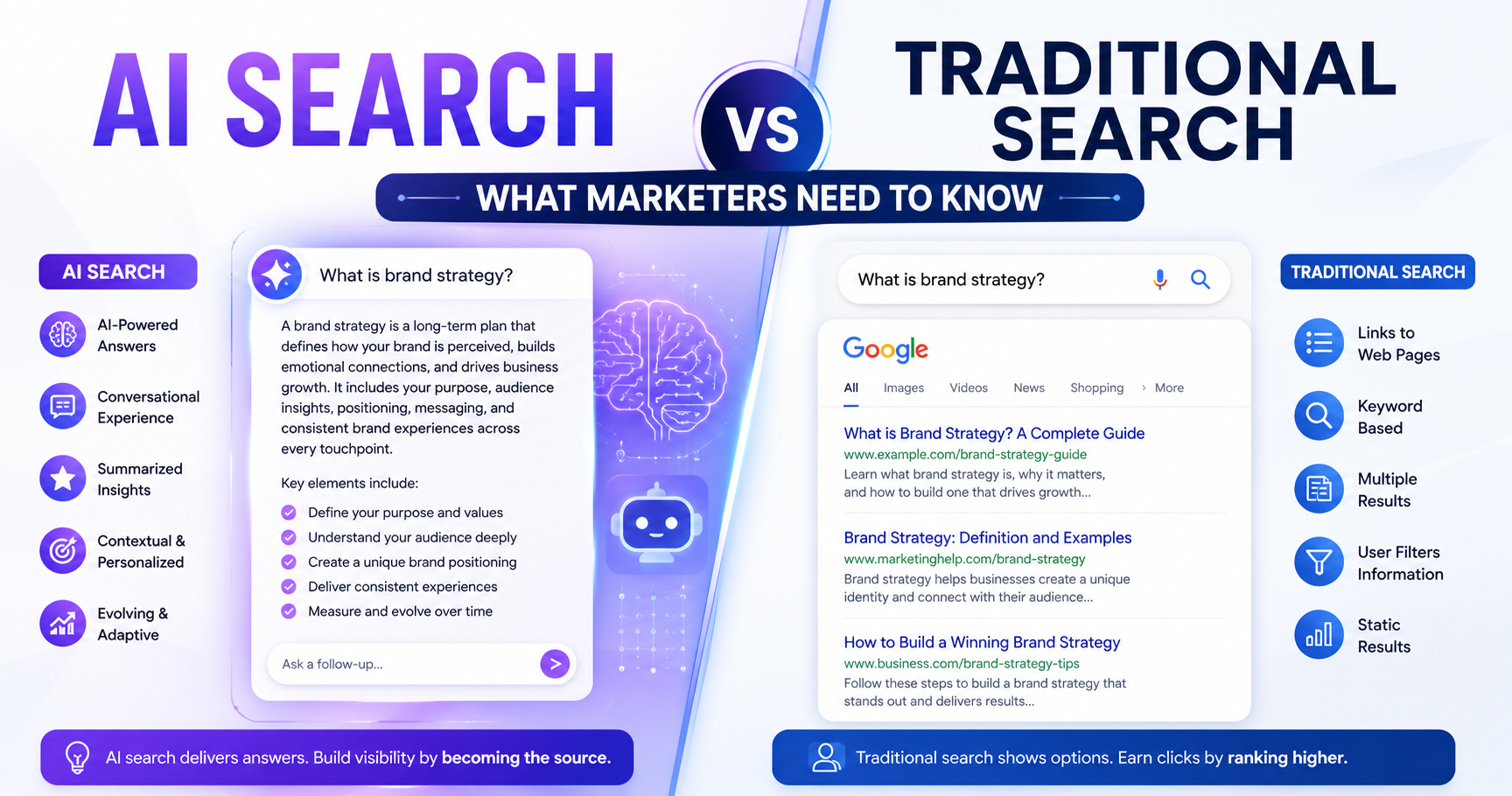
AI Search vs Traditional Search: What Marketers Need to Know
AI search synthesizes information from multiple sources to generate a direct answer, while traditional search returns a ranked list of links for the user to evaluate — and this fundamental difference in how answers are delivered is reshaping which content earns visibility, which metrics matter, and what SEO strategy looks like in 2025 and beyond. Marketers who understand this distinction and adapt their content and technical strategy accordingly will capture traffic that others lose; those who don’t will see organic traffic patterns shift in ways they can’t explain with traditional reporting.
This guide covers everything marketers need to understand about the AI search transition: how each type of search works, where they’re converging and where they differ, what the data shows about traffic impact, and the specific strategic adaptations that protect and grow organic visibility in the AI search era. Whether you manage SEO in-house or work with an SEO agency in Chennai, this is the briefing that changes how you think about search marketing in 2025.
The Two Search Paradigms: How Each Works
To understand what’s changing and why, you need a clear model of how traditional and AI search actually work — not at a surface level but at the level of mechanism, because the mechanism determines what content wins.
How Traditional Search Works
Traditional search — the system Google has operated since 1998 and which remains the dominant form of web search — follows a three-stage process:
Stage 1: Crawling Google’s crawler (Googlebot) continuously visits web pages, following links from page to page and downloading content to Google’s servers.
Stage 2: Indexing Downloaded pages are analyzed and stored in Google’s Search Index — a vast database of pages, their content, their structure, and the relationships between them. Google’s natural language processing systems (BERT, MUM) analyze content meaning during indexing.
Stage 3: Ranking When a user types a query, Google’s ranking algorithm evaluates hundreds of factors — keyword relevance, page authority, user experience signals, E-E-A-T signals — and returns a ranked list of the most relevant pages.
The user’s role: In traditional search, the user receives a list of options and must click through to individual pages to find their answer. The search engine’s job is to surface good options; the user’s job is to evaluate them.
How AI Search Works
AI search — represented by Google’s AI Overviews, Microsoft’s Copilot in Bing, Perplexity AI, ChatGPT with web browsing, and Gemini Advanced — follows a fundamentally different process:
Stage 1: Query Understanding The AI system interprets the query not just as keywords but as a complete intent — understanding what the user ultimately wants to accomplish, what follow-up questions they might have, and what context is needed for a complete answer.
Stage 2: Multi-Source Synthesis Rather than returning a list of documents, the AI system retrieves information from multiple sources simultaneously — using retrieval-augmented generation (RAG) — and synthesizes them into a single coherent response.
Stage 3: Generated Answer with Citations The AI produces a direct answer in natural language, with some sources cited. The user receives the answer immediately rather than having to click through to find it.
The user’s role: In AI search, the user receives the answer directly. Clicking through to source pages becomes optional rather than necessary — which is the core mechanism of AI search’s traffic impact.
The Scale of the AI Search Transition in 2025
AI search is not a future event. It’s a current reality with measurable market presence and documented impact on organic search traffic patterns.The data on AI search adoption and impact:- Google’s AI Overviews appear in an estimated 25–35% of all search queries as of late 2025, according to BrightEdge’s 2025 AI Search Impact Study — with significantly higher prevalence for informational, how-to, comparison, and research-intent queries
- Perplexity AI reached 15 million daily active users as of mid-2025 (TechCrunch, 2025), representing a significant and growing share of information-seeking behavior
- According to Semrush’s 2025 SERP Analysis, queries that trigger AI Overviews show an average 23% reduction in organic click-through rate for positions 1–5 that are not cited in the AI Overview — while pages cited within AI Overviews receive 3x more traffic than their position would normally generate
- SparkToro’s research found that zero-click searches — queries where users don’t click any result — now represent approximately 60% of all Google searches, a trend AI Overviews accelerate
- According to Gartner’s 2024 Technology Predictions, by 2026, organic search traffic will decrease by 25% for brands that don’t adapt to AI-powered search interfaces, while brands that optimize for AI citation will see traffic advantages over the same period
AI Search vs. Traditional Search: Side-by-Side Comparison
| Dimension | Traditional Search | AI Search |
|---|---|---|
| Result format | Ranked list of links | Generated answer with citations |
| User behavior | Click through to find answer | Read answer in-page; click only for depth |
| Traffic distribution | Distributed across top 10 results | Concentrated in cited sources + commercial queries |
| Content that wins | Keyword-optimized, high-authority pages | Authoritative, structured, entity-rich content |
| Query type prevalence | All query types | Strongest for informational; weakest for transactional |
| Key ranking signals | Backlinks, keyword relevance, technical SEO | E-E-A-T, entity authority, content structure, schema |
| Click-through rate | Predictable by position | Highly variable; cited pages win, uncited lose |
| Voice/conversational | Limited (keyword-focused) | Native (designed for conversational queries) |
| Personalization | Limited (location, search history) | Strong (session context, preference learning) |
| Primary platforms | Google Search, Bing | Google AI Overviews, Perplexity, Copilot, ChatGPT |
What Changes for Marketers: The 7 Key Shifts
Understanding what changed is useful. Understanding how to adapt is essential. These seven shifts describe exactly how marketing strategy must evolve in response to AI search.
Shift 1: From Keyword Rankings to Citation Visibility
In traditional SEO, success is measured by ranking position — position 1 for a target keyword is the objective. In AI search, citation in the AI Overview is the new position 1 — and it’s determined by content authority, structure, and E-E-A-T signals rather than simply keyword density and backlinks.
What this means in practice:
- Tracking keyword rankings remains necessary but insufficient
- Add AI Overview monitoring: track which queries in your category produce AI Overviews and whether your content is cited
- Optimize content specifically for citation eligibility (answer-first structure, FAQ schema, entity authority)
- Track impressions vs. clicks separately — a page with high impressions but declining clicks may be losing traffic to an AI Overview it’s not cited in
Tools for AI Overview monitoring:
- Semrush AI Toolkit: Tracks AI Overview presence and citation status for target keywords
- BrightEdge: Enterprise-level AI Overview tracking
- Google Search Console: Compare impression vs. CTR trends pre and post AI Overview adoption
Shift 2: From Traffic Volume to Traffic Quality
As AI Overviews capture zero-click informational queries, the traffic that does reach your website will increasingly be higher-intent — users who clicked through specifically to get more depth than the AI Overview provided.
The strategic implication: Optimize for converting this higher-intent traffic, not just attracting more of it. A 15% reduction in organic traffic with a 40% improvement in conversion rate produces more business outcomes than identical traffic volume.
Tactical responses:
- Improve landing page conversion rate optimization for organic traffic (forms, CTAs, social proof, page speed)
- Create “depth content” — comprehensive resources that provide substantially more value than what an AI Overview summarizes
- Focus organic traffic measurement on conversion rate, lead quality, and revenue attribution rather than raw session volume
Shift 3: From Content Volume to Content Depth and Authority
The content quantity strategy — publishing many short articles targeting many keywords — loses effectiveness as AI Overviews compress informational content into a single synthesized answer. What wins in AI search is depth: content so comprehensive, authoritative, and specifically useful that it can’t be fully replaced by a generated summary.
Content depth signals that earn AI citation:
- Original research and proprietary data (something no AI can fabricate)
- First-hand expert accounts (something only someone who has done the work can provide)
- Comprehensive coverage of a topic from every relevant angle (pillar content + topic clusters)
- Named expert authors with verifiable credentials (author entity establishment)
The quality threshold has risen: A 600-word article targeting a single keyword earned traffic in 2020. In 2025, it earns an AI Overview that absorbs the query and returns nothing to your site. The minimum viable content depth for organic traffic has increased substantially.
Shift 4: From Generic Content to Entity-Based Authority
Traditional SEO treated content as pages optimized for keywords. AI search treats content as entities — people, organizations, products, places, and concepts — with verifiable relationships between them.
What entity-based authority means:
- Google recognizes your organization as a trusted source for specific topics
- Your authors are recognized entities with documented expertise in their fields
- Your content covers topic clusters that collectively establish your domain as authoritative
How to build entity authority:
- Implement Organization and Person schema markup throughout your site
- Build author pages with credentials, external publication links, and social profiles
- Create a Knowledge Graph footprint: Wikipedia mentions, Wikidata entries, authoritative citations from trusted domains
- Develop topic cluster architecture that demonstrates comprehensive domain coverage
For any SEO company in Chennai building entity authority for clients, this represents a shift from purely technical and link-based SEO toward brand-and-expertise-based SEO — building the signals that tell Google’s AI systems “this source is verifiably credible on this topic.”
Shift 5: From Meta Description Optimization to Answer-First Structure
In traditional search, meta descriptions drive CTR from the SERP. In AI search, the opening paragraph of each content section drives whether that section gets cited in an AI Overview.
The answer-first content principle for AI search:
Every H2 section should open with a direct, complete, 40–70 word answer to the question the H2 implies. This paragraph becomes the AI Overview citation candidate — it must be:
- Complete without context: The answer must make sense if extracted from the surrounding article
- Declarative, not hedging: “Schema markup is structured data code that…” not “Schema markup could be described as…”
- Specific: Numbers, timeframes, specific examples where relevant
- Under 80 words: AI systems extract concise answers; verbose openings reduce citation probability
The format matters for the type of citation:
- Paragraph for definitions and explanations
- Numbered list for processes and steps
- Comparison table for “X vs Y” queries
- Bulleted list for “best practices” and “types of” queries
Shift 6: From Backlink Volume to Trust Signal Diversity
Traditional SEO placed heavy emphasis on acquiring backlinks as the primary authority signal. AI search weights a broader set of trust signals — of which backlinks are one component.
The expanded trust signal set in AI search:
| Trust Signal | Traditional SEO Weight | AI Search Weight |
|---|---|---|
| Backlinks (quantity) | Very High | Medium |
| Backlinks (domain relevance) | High | High |
| E-E-A-T signals | Medium | Very High |
| Schema markup | Low | High |
| Author entity recognition | Low | High |
| Brand entity recognition (Knowledge Graph) | Low | High |
| Content freshness | Medium | High (for current topics) |
| Topical authority depth | Medium | Very High |
| User engagement signals | Medium | High |
The practical strategy shift: Continue building high-quality, relevant backlinks — they remain important. But supplement with investment in E-E-A-T signals, schema implementation, author entity development, and topical depth that were less critical in traditional SEO.
Shift 7: From SEO and Content as Separate Disciplines to Unified Content Authority
In traditional SEO, content teams and SEO teams frequently operated semi-independently — SEO teams handled technical optimization and keyword strategy; content teams wrote articles. The gap between them produced content that was either keyword-focused without genuine expertise or expert-quality without search visibility.
AI search collapses this gap because the signals that earn AI citation — genuine expertise, structured information, verifiable authority — require both strategic SEO thinking and genuine subject matter expertise simultaneously.
The unified content authority requirement:
- SEO strategy must inform every content brief (structure, question coverage, semantic terms)
- Subject matter expertise must appear in every piece of content (first-hand examples, original analysis, expert citations)
- Technical SEO must support every page (schema, page speed, crawlability)
- Brand authority must be built across the full content ecosystem (topic clusters, author entities, consistent voice)
Where AI Search and Traditional Search Coexist: The Query Intent Map
Understanding which types of queries AI search dominates — and which traditional search still serves — is essential for prioritizing your content and SEO investment.
The AI Search Prevalence by Query Type
| Query Type | AI Overview Prevalence | Traditional SEO Value | Marketing Priority |
|---|---|---|---|
| Informational (“what is X,” “how does X work”) | Very High (40–60%) | Declining | Optimize for citation, not click-through |
| How-to (“how to do X”) | High (30–50%) | Declining for simple tasks | Create depth content that earns citation |
| Comparison (“X vs Y”) | High (25–40%) | Medium | Tables and comparison structure |
| Research (“best X for Y”) | Medium (20–30%) | Medium | Commercial intent content |
| Commercial (“buy X,” “hire X”) | Low (5–15%) | High | Traditional SEO + PPC still dominant |
| Transactional (“X near me,” “X in Chennai”) | Very Low (under 10%) | Very High | Local SEO remains critical |
| Navigational (“company name”) | Very Low (5%) | High | Brand SEO and GBP optimization |
The strategic insight from this map: Informational and how-to content faces the highest AI search disruption. Commercial and transactional content retains strong traditional SEO value. This suggests a portfolio rebalancing: reduce investment in informational content that generates clicks but doesn’t convert, and increase investment in commercial and transactional content that retains direct traffic value.
The Platforms of AI Search: What Marketers Need to Track
AI search is not a single platform but an ecosystem of AI-powered search experiences with different audiences, capabilities, and citation behaviors.
Google AI Overviews
Audience: Google’s 8.5 billion daily searches — the largest existing search audience AI mechanism: Powered by Gemini, Google’s large language model; integrated into standard Google search results Content sourcing: Draws primarily from Google’s existing search index — pages that rank well in traditional search are more likely to be cited Citation behavior: Links 3–8 sources at the bottom of the AI Overview; cited pages receive significantly higher CTR than uncited pages at equivalent positions
Marketing relevance: Highest priority for all marketers — this is the AI search experience that affects the most traffic for the most businesses.
Microsoft Copilot in Bing
Audience: Bing’s approximately 1 billion monthly active users; growing through Microsoft 365 and Windows integration AI mechanism: Powered by GPT-4o through Microsoft’s partnership with OpenAI Content sourcing: Sources from Bing’s index; displays citations prominently in all responses Citation behavior: More citation-heavy than Google AI Overviews; typically cites 5–10 sources per response
Marketing relevance: Important for B2B marketers (enterprise Microsoft 365 integration), older demographics (Windows default browser), and markets where Bing has stronger penetration.
Perplexity AI
Audience: 15 million+ daily active users (growing rapidly); skews toward tech-savvy, research-oriented users AI mechanism: Multiple LLM options with real-time web search integration Citation behavior: Very transparent — cites sources prominently and allows users to explore cited pages easily Content sourcing: Actively crawls the web; respects robots.txt
Marketing relevance: Growing rapidly in the research and B2B decision-making contexts. Perplexity citations can generate meaningful referral traffic — monitor in GA4 under “perplexity.ai” referral source.
ChatGPT with Web Search
Audience: 200 million+ weekly users (OpenAI, 2025) AI mechanism: GPT-4 with web search capability through Bing integration and ChatGPT Plugins Content sourcing: Bing search index for web-connected responses Citation behavior: Cites sources when web search is activated; less systematic than Perplexity
Marketing relevance: Massive user base creates significant brand exposure opportunity; content that earns citations in ChatGPT responses reaches a highly engaged audience.
Optimizing for AI Citation: The Technical Framework
Understanding the shift is one thing. Implementing the technical framework that actually earns AI citations is another. This section covers the specific technical and content practices that increase AI citation probability across platforms.
The AI Citation Optimization Stack
Foundation Layer — Technical SEO:
- Fast page load (LCP under 2.5 seconds) — AI systems crawl and index efficiently
- Clean HTML structure with semantic elements (<article>, <section>, <aside>)
- HTTPS and security
- Correct robots.txt (AI crawlers respect Googlebot rules for Google AI Overviews; Perplexity, ChatGPT use separate bots that also respect robots.txt)
Schema Layer — Structured Data:
- Article schema with dateModified for freshness signal
- FAQ schema for Q&A content (directly feeds AI answer formats)
- Organization + Person schema for entity establishment
- Speakable schema for sections optimized for voice/AI extraction
Content Layer — Answer Architecture:
- Answer-first opening paragraph (40–70 words) for each major section
- H2 headers phrased as questions (mirrors query formats AI systems see)
- Tables for comparative data
- Numbered lists for sequential processes
- Bulleted lists for collections of items
Authority Layer — E-E-A-T:
- Named author with credentials and bio
- External citations with links to primary sources
- Original data, examples, or first-hand accounts
- Regular content updates with visible date modification
Distribution Layer — Cross-Platform Presence: Cited in multiple authoritative sources (Wikipedia, industry publications, recognized media) creates the entity recognition that AI systems use to identify credible sources. Content amplification through PR, guest contributions, and partnership content increases cross-platform citation probability.
The Impact on PPC and Paid Search
AI search primarily disrupts organic search — but its effects on paid search are also significant and in some ways surprising.
Where AI Search Increases PPC Importance
For queries where AI Overviews reduce organic click-through rates, paid search maintains its position above the AI Overview. A Google Ad appearing at position 1 above an AI Overview captures intent that would otherwise be absorbed by the AI-generated answer.
This dynamic has increased the commercial value of high-intent search queries for PPC — because those queries retain more of their click value when AI Overviews don’t appear (as they rarely do for transactional intent).
The PPC opportunity in the AI search era:
- Commercial and transactional queries are less disrupted by AI Overviews
- High-intent queries (near me, buy, hire, contact) retain strong PPC value
- Branded queries (competitor names, category names with commercial intent) are worth protecting with PPC
- Local queries remain primarily traditional-search-driven with minimal AI Overview impact
For businesses working with a digital marketing company in Chennai on both SEO and PPC, the channel balance may shift: less investment in informational SEO content (which AI Overviews are absorbing) and more in commercial SEO content + PPC for high-intent queries.
The Google Ads Landscape in AI Search
Google has integrated AI into its advertising products simultaneously with AI Overviews:
- Performance Max campaigns use AI to optimize across all Google inventory (Search, Display, YouTube, Gmail, Shopping, Maps)
- Demand Gen campaigns use AI creative and targeting for awareness objectives
- Responsive Search Ads (RSAs) use AI to assemble the best headline-description combinations
The shared theme: AI is increasingly making tactical PPC decisions (bid adjustments, asset combinations, audience targeting) that human managers previously made manually. The human role in PPC management shifts toward strategic objectives, audience definition, offer design, and creative quality — while AI handles the tactical execution.
Measuring SEO Performance in the AI Search Era
The metrics that defined SEO success in the traditional search era are becoming less reliable in the AI search era. New measurement frameworks are needed.
The Expanded SEO Measurement Framework for 2025
Traditional metrics to maintain:
- Keyword rankings (still useful for competitive benchmarking)
- Organic sessions and pageviews (still core traffic metrics)
- Domain authority and backlink profile health
New metrics for AI search:
- AI Overview citation rate: % of tracked target queries where your content is cited in an AI Overview
- AI Overview impression share: How often your brand/content appears in AI-generated answers (trackable through emerging tools like Semrush AI Toolkit)
- Search impression vs. click ratio by query: Queries with high impressions but declining CTR are candidates for AI Overview displacement diagnosis
- Zero-click query identification: Identify which of your high-ranking keywords are generating impressions but no clicks (potential AI Overview absorption)
- Branded search volume trend: Growing branded search volume signals that AI search exposure is building brand recognition even without direct clicks
- Referral traffic from AI platforms: Track perplexity.ai, bing.com/chat, and other AI platform referral sources separately in GA4
The Search Console Analysis for AI Overview Impact
Google Search Console doesn’t yet explicitly label AI Overview impressions and clicks — but you can infer AI Overview impact through pattern analysis:
- Export queries with 500+ monthly impressions
- Sort by CTR (lowest to highest)
- Queries in the top 3 positions with CTR under 15% may be experiencing AI Overview click absorption
- Compare against the same period the prior year — queries with stable or improving rankings but declining CTR are the strongest AI Overview impact signals
How Weboin Navigates AI Search for Clients
At Weboin, a specialist digital marketing agency in Chennai managing SEO programs for businesses across industries, the AI search transition has reshaped every content and technical SEO engagement since 2024.
Our AI search adaptation framework:
Content Audit for AI Overview Eligibility: We audit every client’s top 50 organic traffic pages against the AI citation criteria: answer-first structure, FAQ schema presence, E-E-A-T signals, topical depth, and schema completeness. Pages that are high-traffic but low in AI citation signals are restructured as a first priority.
Entity Authority Development: We implement Organization, Person, and LocalBusiness schema across all appropriate pages, build author entity pages for key contributors, and identify opportunities to earn cross-platform mentions that build Knowledge Graph footprint for the brand.
AI Overview Monitoring: We track AI Overview appearance for each client’s target keyword set weekly, monitoring which queries now produce AI Overviews and whether the client is cited. Where clients aren’t cited in AI Overviews for their target queries, we identify which competitor is cited and what structural or authority differences explain the gap.
Commercial Content Protection: We identify which organic traffic is high-commercial-intent — queries closest to purchase decisions — and protect it through both SEO optimization and PPC coverage, ensuring that AI Overview disruption of informational traffic doesn’t compromise the commercial traffic that directly generates revenue.
As a full-service SEO company in Chennai, Weboin treats AI search not as a threat to be worried about but as a selection mechanism that rewards the content investment we’ve always recommended: genuine expertise, comprehensive coverage, clean technical structure, and strong entity authority. The AI search era makes these investments more differentiated, not less.
Practical Action Plan: Adapting Your SEO Strategy for AI Search
Month 1: Audit and Baseline
- Run your top 100 organic keyword positions through a SERP check — identify which now produce AI Overviews
- In Search Console, identify queries with declining CTR despite stable or improving rankings (AI Overview impact candidates)
- Audit your top 20 pages for answer-first structure, FAQ schema, and author attribution
- Set up tracking for perplexity.ai and other AI platform referral sources in GA4
Month 2: Content and Schema Prioritization
- Restructure top 10 high-traffic, low-CTR pages with answer-first opening paragraphs
- Add FAQ schema to all service pages and content pages with Q&A sections
- Implement or update Article + Author schema on all blog content
- Build or improve author bio pages with credentials and external links
Month 3: Entity Authority and Distribution
- Build/update Organization schema with complete sameAs array (all social profiles)
- Identify and pursue 3–5 authoritative external citation opportunities (guest contributions, media mentions, industry directories)
- Launch original research or proprietary data piece designed to earn citations
- Create depth content (3,000+ words) on the 5 most commercially important topics in your category
Ongoing:
- Monitor AI Overview citation rate monthly for target keywords
- Track branded search volume for AI-driven brand awareness signals
- Continue backlink acquisition alongside entity authority development
- Maintain content freshness: update existing high-performing content quarterly
Frequently Asked Questions About AI Search vs. Traditional Search
Traditional search returns a ranked list of links that users click through to find answers. AI search synthesizes information from multiple sources into a direct generated answer, with citations for users who want to explore further. The fundamental difference is that AI search delivers answers to users without requiring them to click through to source pages — which changes which content earns traffic and how organic traffic is distributed.
AI search redistributes organic traffic rather than eliminating it. Informational and how-to content faces reduced click-through rates because AI Overviews absorb many of those queries. Commercial, transactional, and local queries retain strong traditional SEO value. Content cited in AI Overviews receives significantly more traffic than uncited content at the same position. The net effect depends on content type, query intent, and whether your content earns AI citation.
Google's AI Overviews are AI-generated answer summaries that appear at the top of search results for applicable queries — typically informational and research intent queries. They synthesize information from multiple web sources and display a direct answer, with citations linking to the source pages. AI Overviews are generated by Google's Gemini AI and appear in approximately 25–35% of all search queries as of 2025.
The strongest AI citation signals are: (1) answer-first content structure with direct, concise answers at the opening of each section; (2) FAQ schema markup on pages with Q&A content; (3) comprehensive topical coverage that establishes domain authority; (4) named expert authors with verifiable credentials; (5) specific, verifiable data cited with primary sources; and (6) clean technical structure (fast load, semantic HTML, schema markup).
Yes — with adaptation. The fundamentals of SEO (content quality, technical excellence, authority building) remain relevant and are actually amplified in importance by AI search. What changes is the emphasis: E-E-A-T signals, entity authority, content depth, and structured data become more critical than keyword density and basic backlink volume. Traditional SEO skills are necessary; they're simply not sufficient without these additions.
Final Thought: AI Search Is a Quality Filter, Not an SEO Apocalypse
The marketers most likely to thrive in the AI search era are those who recognize what AI search is actually doing: it’s applying a higher-fidelity quality filter to organic content. Content created primarily to rank — thin, undifferentiated, produced at scale — is exactly what AI Overviews displace. Content created to genuinely help a specific audience — expert, comprehensive, structured, authoritative — is exactly what AI Overviews cite.
This is not a disruption to be feared by anyone who was already doing SEO properly. It is a disruption to content quantity strategies, to thin content farms, and to anyone whose SEO success depended on gaming keyword placement rather than building genuine expertise.
The brands gaining organic traffic in 2025 and 2026 are not the ones who cracked some AI search optimization code. They’re the ones who built deep topic expertise, comprehensive content coverage, structured and well-attributed content, and the kind of brand entity recognition that tells AI systems “this source can be trusted to cite.”
Whether you’re navigating this shift independently or with a specialist digital marketing company in Chennai like Weboin, the framework in this guide — from understanding the mechanism to implementing the technical stack to measuring the right metrics — gives you everything you need to build organic visibility that compounds in the AI search era rather than declining in it.
About Weboin: Weboin is a full-service digital marketing agency in Chennai specializing in AI-era SEO, technical optimization, content authority development, and performance marketing. As a trusted SEO agency in Chennai and SEO company in Chennai, Weboin helps businesses across India build organic search visibility that performs in both traditional and AI-powered search environments — with content depth, entity authority, and technical precision that earns citations rather than hoping for them.

No comment yet, add your voice below!