
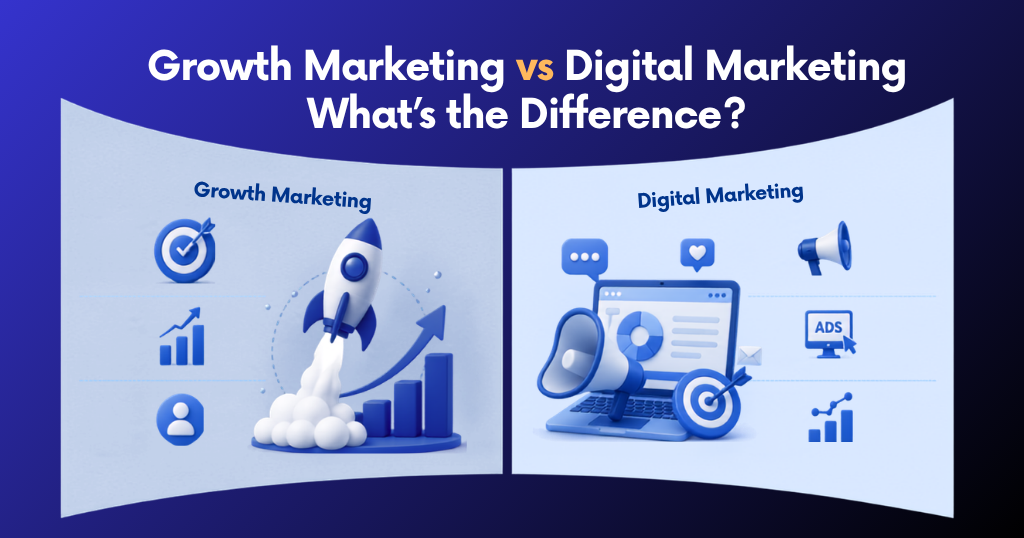
Digital marketing is the use of online channels — search, social media, email, paid advertising — to reach and engage a target audience, while growth marketing is a broader discipline that applies systematic experimentation, data science, and full-funnel optimization across acquisition, activation, retention, revenue, and referral to maximize the rate at which a business grows. Every growth marketer uses digital marketing — but not every digital marketer practices growth marketing, because the mindset, methodology, and metrics are fundamentally different.
This guide draws the distinction precisely: what each discipline covers, how they operate in practice, when a business needs one versus the other, and how the two work together in the companies that grow the fastest. Whether you’re building your marketing function in-house or evaluating what kind of performance marketing agency in Chennai to work with, understanding this difference shapes every hiring, investment, and strategy decision you make.
The Definitional Distinction: What Each Term Actually Means
The confusion between growth marketing and digital marketing is partly semantic — different people use these terms differently — and partly structural, because growth marketing emerged from digital marketing and uses most of the same channels. The distinction lies in scope, mindset, and methodology.
What Digital Marketing Is
Digital marketing is a channel category. It refers to any marketing activity conducted through digital channels: search engine optimization (SEO), pay-per-click advertising (PPC), social media marketing, email marketing, content marketing, affiliate marketing, influencer marketing, and display advertising.
A digital marketer’s primary focus is typically on one or more of these channels — driving traffic, increasing engagement, generating leads, or converting visitors. The scope is primarily the acquisition phase of the customer journey: getting people to know about, find, and visit a product or service.
What digital marketing typically measures:
- Website traffic (sessions, users, pageviews)
- Keyword rankings
- Cost per click (CPC)
- Click-through rate (CTR)
- Cost per lead (CPL)
- Social media followers and engagement rate
- Email open and click rates
What Growth Marketing Is
Growth marketing is a methodology. It takes a scientific, experimental approach to identifying and scaling the most efficient drivers of business growth — across the entire customer lifecycle, not just acquisition.
Growth marketing was formalized as a discipline by Sean Ellis in 2010 when he coined the term “growth hacker” while at Dropbox. It was subsequently developed by practitioners at Airbnb, Facebook, LinkedIn, and other high-growth tech companies into what is now called growth marketing — a more systematic and mature version of growth hacking.
The core distinction: digital marketing optimizes channels; growth marketing optimizes the business system.
What growth marketing typically measures:
- Monthly Recurring Revenue (MRR) or Annual Recurring Revenue (ARR)
- Customer Acquisition Cost (CAC) and the trend over time
- Customer Lifetime Value (LTV) and LTV:CAC ratio
- Activation rate (% of new users reaching the “aha moment”)
- Retention rate and churn rate
- Net Promoter Score (NPS)
- Revenue growth rate (week-over-week or month-over-month)
- Referral rate (% of new customers acquired through referral)
The AARRR Framework: The Foundation of Growth Marketing
The clearest way to understand what makes growth marketing distinct from digital marketing is through the AARRR framework (also called the Pirate Metrics framework) developed by Dave McClure of 500 Startups. AARRR stands for:
- Acquisition: How do people find you?
- Activation: Do people have a great first experience?
- Retention: Do people come back?
- Revenue: Do people pay you?
- Referral: Do people tell others?
Digital marketing primarily operates in the Acquisition stage. A digital marketer’s job is to bring people to the product through channels — SEO, paid ads, social media, content. Excellent digital marketing fills the top of the funnel with qualified traffic.
Growth marketing operates across all five stages. A growth marketer asks: “Even if we fix Acquisition, how much of that traffic is converting in Activation? How many of those who activate are returning in Retention? How many of those who retain are generating Revenue? How many paying customers are generating Referral?” Optimizing any one of these stages can produce higher revenue growth than optimizing Acquisition alone — often at significantly lower cost.
The AARRR Optimization Opportunity
Consider a startup with the following funnel:
- 10,000 monthly website visitors (Acquisition)
- 15% sign-up rate = 1,500 sign-ups (Activation)
- 30% retention at 30 days = 450 retained users (Retention)
- 10% conversion to paid = 45 paying customers (Revenue)
- 5% refer a new customer = 2.25 referrals per month (Referral)
Digital marketing approach: Increase website visitors from 10,000 to 20,000 through better SEO and paid campaigns. Result: 90 paying customers at 2x the acquisition cost.
Growth marketing approach: Improve activation rate from 15% to 25% through better onboarding. Result: 10,000 visitors → 2,500 sign-ups → 750 retained → 75 paying customers — without increasing acquisition spend.
The growth marketing intervention (improving onboarding) produced more paying customers than doubling acquisition spend. This is why growth marketing consistently produces better unit economics than pure digital marketing optimization.
Key Differences Side by Side
| Dimension | Digital Marketing | Growth Marketing |
|---|---|---|
| Scope | Acquisition channels | Full customer lifecycle |
| Primary focus | Traffic and leads | Revenue and retention |
| Time horizon | Campaign-level (weeks–months) | System-level (quarters–years) |
| Core methodology | Channel management and optimization | Scientific experimentation and compound learning |
| Key metrics | Traffic, CTR, CPL, followers | LTV:CAC, activation rate, retention, NPS |
| Team structure | Channel specialists (SEO, PPC, social, email) | Cross-functional (product, data, engineering, marketing) |
| Primary tools | GA4, Google Ads, Meta Ads, SEMrush, Mailchimp | Mixpanel, Amplitude, Segment, SQL, growth loop models |
| Failure mode | Poor channel performance | Poor hypothesis design or measurement |
| Where it wins | Building brand awareness and qualified lead flow | Compressing time-to-growth and improving unit economics |
| Best suited for | Established business with defined product-market fit | Startups seeking product-market fit and scale |
How Growth Marketing Works in Practice: The Experimentation Engine
The operational mechanism of growth marketing is the experimentation engine — a systematic process of forming hypotheses, designing tests, measuring results, and scaling what works. This is explicitly scientific in structure, borrowed from product development and data science rather than traditional marketing.
The Growth Experimentation Cycle
Step 1: Hypothesis Formation Growth hypotheses follow a specific structure:
“We believe that [change] will produce [outcome] for [audience] because [rationale], and we’ll know this worked if [specific metric] improves by [amount] within [timeframe].”
Example:
“We believe that adding a progress bar to our onboarding flow will increase 7-day activation rate for new users by 20% because progress indicators reduce abandonment anxiety, and we’ll know this worked if 7-day activation improves from 32% to 38% within 30 days of deployment.”
Step 2: Prioritization with ICE or RICE Scoring With limited engineering and design resources, growth teams must prioritize which experiments to run first. Two widely used frameworks:
ICE Score (Sean Ellis): Impact × Confidence × Ease, averaged RICE Score (Intercom): (Reach × Impact × Confidence) ÷ Effort
Both systems ensure the team runs high-impact, high-confidence experiments first — rather than chasing the founder’s intuition or the loudest voice in the room.
Step 3: Experiment Design Each experiment is designed to test one specific variable — the same statistical principle as A/B testing. Changing multiple variables simultaneously produces results that cannot be interpreted.
Step 4: Measurement and Statistical Validity Growth marketers require statistical significance before declaring results — typically 95% confidence using chi-squared tests for conversion rate experiments or t-tests for revenue metrics. They also define minimum sample sizes before running experiments, preventing the early-termination bias that corrupts most informal marketing tests.
Step 5: Document, Scale, or Kill
- If the experiment wins with statistical confidence: scale to full audience, document learning, inform next hypothesis
- If the experiment loses: document what was learned, use the negative result to refine the next hypothesis
- Every experiment result is added to a Growth Learning Repository — the organization’s accumulated understanding of what makes its specific audience grow
This cycle, run continuously, produces the compounding learning effect that makes high-growth companies outpace their competitors in efficiency over time.
Digital Marketing Channels: The Acquisition Arsenal
While growth marketing encompasses more than channels, understanding the digital marketing channel landscape is essential — because these channels are the primary tools for the Acquisition stage that every growth framework depends on.
Search Engine Marketing (SEM and SEO)
SEO (Search Engine Optimization): Improving organic search rankings through technical optimization, content quality, and authority building. SEO is the compounding channel — results take 3–9 months to materialize but reduce CPL substantially over time.
SEM/PPC (Pay Per Click): Paying for immediate placement in search results (Google Ads, Bing Ads). High-intent traffic at controllable cost — the essential Tier 1 channel for businesses that need leads now.
Which businesses should prioritize which:
- Startups needing immediate leads: PPC first, SEO building in parallel
- Established businesses with budget for content: SEO for long-term CAC reduction
- Businesses with high LTV products: Both — PPC for acquisition speed, SEO for CAC efficiency
Social Media Marketing
Social media divides into organic (content posted to owned profiles, community building, influencer partnerships) and paid (Meta Ads, LinkedIn Ads, TikTok Ads, YouTube Ads).
For most businesses in 2025, organic social media’s primary value is brand building and community maintenance — not direct lead generation. Paid social is a significant direct-response channel, particularly for B2C and visual product categories.
The PPC agency in Chennai competency most relevant here: Managing paid social campaigns requires creative strategy, audience segmentation, bidding expertise, and continuous creative testing — distinct skills from organic social media management that many “social media agencies” don’t fully possess.
Email Marketing
Email is the highest-ROI digital channel — generating an average of ₹3,000+ in revenue for every ₹100 spent according to Litmus’s 2024 State of Email Report. But email marketing’s value in a growth context extends beyond newsletters to behavioral trigger sequences, lifecycle segmentation, and retention automation — all of which are growth marketing tools applied through an email channel.
Content Marketing
Content marketing (blogs, video, podcasts, webinars) serves multiple growth functions simultaneously: SEO (attracting organic search traffic), activation (educating new users on product value), retention (delivering ongoing value to existing customers), and referral (creating shareable expertise). It’s the channel most naturally aligned with full-funnel growth thinking.
Growth Marketing in Practice: What Teams Actually Do
The day-to-day work of a growth marketer looks different from a digital marketer’s work — even when they’re using some of the same tools.
The Growth Marketing Toolkit
Analytics and data:
- Mixpanel or Amplitude: Product analytics — tracking user behavior within a product (which features they use, where they drop off, which users convert to paid)
- Segment: Customer data infrastructure — connecting data from different tools into a unified customer profile
- SQL / Python: Many growth marketers write their own queries to extract insights from databases without waiting for a data analyst
- Looker or Tableau: Business intelligence dashboards for monitoring growth metrics
Experimentation:
- Optimizely or VWO: A/B testing for website and landing page experiments
- LaunchDarkly: Feature flag management for product experiments
- Google Optimize (or successor tools): Website experimentation
- Statsig: Statistical analysis for experiment results
Acquisition channels (same as digital marketing):
- Google Ads: Search, Display, YouTube
- Meta Ads Manager: Facebook and Instagram
- LinkedIn Campaign Manager: B2B paid social
- SEMrush or Ahrefs: SEO and keyword intelligence
Retention and lifecycle:
- Customer.io, Iterable, or Braze: Behavioral trigger email and push notification automation
- Intercom: In-app messaging and customer support
- Delighted or Typeform: NPS and CSAT surveys
The key distinction: A digital marketer primarily uses the acquisition tools. A growth marketer uses all of them — with a particular emphasis on the analytics and experimentation tools that connect acquisition to downstream business outcomes.
When Does a Business Need Digital Marketing vs. Growth Marketing?
The choice between a digital marketing focus and a growth marketing focus is not permanent — it evolves with business stage.Stage-Based Guidance
Pre-product-market fit (very early stage): Neither formal digital marketing nor growth marketing is the right primary focus. At this stage, the priority is manual customer discovery — talking to potential customers directly, iterating the product based on feedback, and finding the initial ICP through direct outreach. Spending on digital marketing before product-market fit produces traffic that doesn’t convert because the product isn’t right yet.Early traction (some paying customers, unclear scalability): Focus: Digital marketing for channel validation. Run experiments across 2–3 digital marketing channels with small budgets to identify which channel produces the best CAC. Use that data to prioritize investment. Begin applying growth thinking to activation (are the customers you acquire actually using the product?) and retention (are they coming back?).Growth stage (proven product-market fit, scaling): Focus: Growth marketing. With a validated product and a proven lead generation channel, the priority shifts to optimizing the full funnel — improving activation rates, extending retention, increasing revenue per customer, and building referral mechanisms. Formal growth experimentation methodology becomes essential.Scale stage (large business, multiple products/markets): Focus: Both in parallel. At scale, dedicated channel teams (the digital marketing function) run the acquisition engine while a separate growth team optimizes the full funnel, explores new growth loops, and experiments on retention and monetization.Practical Business-Stage Matrix
| Business Stage | Primary Focus | Secondary Focus | What to Hire |
|---|---|---|---|
| Pre-revenue | Customer discovery (manual) | Basic digital presence | None yet; founders do it |
| ₹0–₹1Cr ARR | 1–2 validated digital channels | Activation optimization | Digital marketing specialist or agency |
| ₹1Cr–₹10Cr ARR | Full-funnel optimization | Channel diversification | Growth marketer + channel specialists |
| ₹10Cr–₹100Cr ARR | Growth team + channel teams | New market/product expansion | VP Growth + channel leads |
| ₹100Cr+ ARR | Dedicated growth pods | Brand + acquisition + retention | Full growth org + brand org |
Growth Loops vs. Marketing Funnels: The Structural Difference
One of the clearest conceptual distinctions between digital marketing and growth marketing is the model each uses to describe customer acquisition.
The Marketing Funnel (Digital Marketing’s Model)
The traditional marketing funnel flows linearly: Awareness → Consideration → Decision → Purchase. Traffic enters at the top; a percentage converts at each stage; revenue exits at the bottom. The funnel is replenished by continuous marketing input.
The fundamental limitation of the funnel model: It’s linear, not compounding. Every customer you win had to enter the funnel at the top, progress through every stage, and complete the purchase — independently of every other customer. The funnel doesn’t get more efficient as it processes more customers; it just processes more of them.
Growth Loops (Growth Marketing’s Model)
Growth loops are cyclical systems where the output of one cycle becomes the input of the next — meaning the growth system accelerates over time rather than remaining constant.
Example growth loops:
Content SEO loop (Acquisition loop):
- Publish high-quality content → 2. Content earns organic search rankings → 3. Rankings drive traffic → 4. Traffic converts to users/customers → 5. Some customers share or link to the content → 6. Links improve rankings further → back to Step 2
Each cycle of this loop makes the next cycle more efficient (stronger domain authority makes future content easier to rank). This is the compound interest of marketing.
Virality loop (Referral loop):
- New user joins the product → 2. Product delivers value → 3. User refers a friend (through sharing, inviting, or recommendation) → 4. Friend joins as a new user → back to Step 1
This is the Dropbox, Slack, and Duolingo growth model. Each new user potentially generates another user, creating exponential rather than linear growth.
User-generated content loop (Content + Community loop):
- Users create content within the platform → 2. Content is indexed by search engines → 3. Search engines surface the content to new potential users → 4. New users join and create more content → back to Step 1
This is the Wikipedia, Reddit, and Quora growth model.
Why loops matter for business choice: A business that has identified and is operating a sustainable growth loop grows more efficiently every month. A business relying purely on a linear marketing funnel grows proportionally to its marketing spend — which plateaus at some point. Building growth loops is one of growth marketing’s primary strategic functions.
Growth Marketing Metrics vs. Digital Marketing Metrics: The Measurement Gap
The metrics each discipline tracks reveal the depth of the difference in perspective.
Digital Marketing Metrics in Depth
Traffic metrics: Sessions, users, new vs. returning, page views per session — measure how many people arrive and how they navigate. Important for understanding channel performance but disconnected from revenue.
Engagement metrics: Time on page, scroll depth, video view rate, social engagement rate — measure content resonance. Useful for creative quality assessment but not revenue predictive.
Acquisition metrics: CPL, CPC, CTR, impressions, keyword rankings — the core performance indicators for channel management. Essential but limited to the top of the funnel.
Growth Marketing Metrics in Depth
North Star Metric: Every growth-oriented company defines one primary metric that best captures the value delivered to customers and the company’s ability to grow. Common examples:
- Spotify: Monthly Active Listeners
- Airbnb: Nights Booked
- HubSpot: Weekly Active Teams
- Slack: Daily Active Users
The North Star Metric is not a revenue metric — it’s a leading indicator of the health of the product-customer relationship that precedes revenue.
Product-level metrics:
- Activation rate: % of new users who complete a defined “activation event” (the moment they’ve experienced the product’s core value)
- Day 1/7/30 retention: % of users who return on days 1, 7, and 30 after their first use. These cohort retention curves reveal whether product-market fit is present (high retention) or absent (steep drop-off)
- Feature adoption rate: % of users who use specific product features
- NPS (Net Promoter Score): Measures customer satisfaction and referral likelihood on a -100 to +100 scale
Business-level metrics:
- LTV:CAC Ratio: Lifetime value divided by customer acquisition cost. Below 3:1 = unsustainable; 3:1–5:1 = healthy; above 5:1 = may be underinvesting in acquisition
- Payback period: How many months of revenue from a customer are required to recoup the cost of acquiring them
- Revenue growth rate: Month-over-month or quarter-over-quarter revenue percentage change
- Churn rate: % of customers who cancel or don’t renew per period
The Organizational Question: What Kind of Marketing Team Delivers Each?
Understanding the difference between digital marketing and growth marketing is useful — but for most business leaders, the actionable question is: “What kind of people and structure do I need?”
The Digital Marketing Team Structure
A traditional digital marketing team is organized by channel:
- SEO Specialist/Manager: Organic search optimization, content strategy, technical SEO
- PPC/SEM Manager: Google Ads, Bing Ads, paid search management
- Social Media Manager: Organic and/or paid social content and community
- Email Marketing Specialist: Newsletter, automation sequences, list management
- Content Writer/Manager: Blog, landing pages, video scripts
- Analytics Manager: GA4, reporting dashboards, attribution
Each specialist optimizes their channel. A marketing manager or CMO coordinates across channels.
Limitation: Channel specialists rarely cross into each other’s territory or into product/engineering territory — which means funnel stages outside their channel (activation, retention) are often no one’s explicit responsibility.
The Growth Marketing Team Structure
A growth marketing team is organized by function and stage:
- Growth Lead/Head of Growth: Owns the growth strategy, experimentation roadmap, and North Star Metric
- Growth Analyst/Data Analyst: Builds dashboards, runs experiment analysis, manages customer data
- Growth Engineer: Implements experiments, builds growth features, manages tools integration
- Acquisition Marketer: Manages the channels that bring new users (the digital marketing function, typically)
- Lifecycle/Retention Marketer: Manages activation, retention, and revenue expansion through email, in-app, and lifecycle programs
- Product Marketer: Translates product features into customer value and manages onboarding experience
Key distinction: Growth teams include engineering and data science talent that digital marketing teams don’t — because improving activation, retention, and referral mechanisms requires changing the product, not just the marketing messaging.
How Weboin Bridges Digital Marketing and Growth Marketing for Clients
At Weboin, a specialist digital marketing agency in Chennai working with businesses across growth stages, the distinction between digital marketing execution and growth marketing strategy shapes how we engage with each client.
For businesses in the acquisition phase: We function as a high-performing digital marketing company in Chennai — managing SEO, Google Ads, Meta Ads, content, and email as channel specialists with a shared revenue attribution framework that connects every channel to business outcomes. Every rupee of ad spend is traceable to leads, pipeline, and revenue.
For businesses in the scaling phase: We extend beyond channel management into growth marketing territory — analyzing activation rates, designing referral programs, building retention email sequences, identifying growth loops, and building the measurement infrastructure that makes every growth decision data-driven.
The practical bridge: we treat digital marketing channels as the acquisition layer of the growth system, not as isolated channel objectives. A blog post is not just content — it’s a node in the content SEO growth loop. A Google Ad is not just a traffic source — it’s an acquisition mechanism connected to an activation experiment and a retention program.
This approach, combined with full attribution infrastructure (GA4, UTM parameters, CRM integration), means Weboin clients can see exactly which marketing activity at which funnel stage is driving revenue — and make compounding investment decisions based on that intelligence.
Frequently Asked Questions About Growth Marketing vs. Digital Marketing
Digital marketing focuses on using online channels (SEO, PPC, social media, email) to attract and engage audiences — primarily the acquisition stage of the customer journey. Growth marketing is a full-funnel discipline that applies systematic experimentation to optimize acquisition, activation, retention, revenue, and referral simultaneously. Every growth marketer uses digital marketing; not every digital marketer practices growth marketing.
Neither is universally "better" — they serve different purposes at different business stages. Digital marketing is essential for building channel-level expertise and driving acquisition volume. Growth marketing is essential for maximizing the efficiency of that acquisition by ensuring users convert, retain, and refer. The most sophisticated marketing functions combine both.
Growth marketers typically add to the digital marketer's channel skills: SQL and data analysis, statistical experimentation design, product analytics (Mixpanel, Amplitude), customer lifecycle automation, and the business acumen to connect marketing metrics to revenue metrics like LTV, CAC, and payback period. The strongest growth marketers also understand product and engineering enough to collaborate on product-level experiments.
A specialist performance marketing agency in Chennai like Weboin can serve as the acquisition layer of a growth marketing system — managing the paid channels that drive acquisition while providing the measurement infrastructure (attribution, cohort analysis, funnel analytics) that connects acquisition to downstream growth metrics. True growth marketing also requires product-side capability — which is typically built in-house while the acquisition function is managed by a performance agency.
In the pre-product-market fit stage, neither is the primary focus — customer discovery and product iteration are. Post product-market fit, digital marketing channels should be validated first (identifying which acquisition channels work). Growth marketing methodology becomes essential when the startup is scaling — because optimizing retention and activation at that stage often produces better ROI than increasing acquisition spend.
Summary: Choosing the Right Focus for Your Business
Choose digital marketing as your primary focus when:
- You need to build awareness in a new market
- You’re validating which acquisition channels work for your product
- Your product experience and retention are already strong (low churn, high NPS)
- Your business model is relatively simple (clear product, clear ICP, clear conversion mechanism)
Choose growth marketing as your primary focus when:
- You have paying customers but struggle to retain them
- Your CAC is stable or rising but LTV isn’t keeping pace
- You need to improve the efficiency of your growth — not just the volume
- You’re scaling across multiple channels and need a unified framework
- You’re building a product-led growth model where the product itself is the acquisition mechanism
Build both when:
- You’re at ₹5Cr+ ARR and scaling across multiple markets
- You have a team large enough to specialize
- You’ve validated your primary acquisition channel and need to optimize the full funnel
The businesses that grow the fastest — the Airbnbs, the Dropboxes, the Slacks of any era — are those that figured out that growth is a system, not a campaign. Digital marketing builds the top of that system. Growth marketing builds the rest.
Whether you build that system independently or with a specialist digital marketing company in Chennai like Weboin, the framework in this guide — from the AARRR model to growth loops to the stage-based investment matrix — gives you the conceptual architecture to make every marketing decision with strategic clarity.
About Weboin: Weboin is a full-service digital marketing agency in Chennai offering performance marketing, SEO, PPC management, social media strategy, and growth-focused digital programs for businesses at every stage. As a trusted performance marketing agency in Chennai and PPC agency in Chennai, Weboin helps businesses connect digital marketing execution to growth marketing outcomes — with full attribution, measurable ROI, and a framework that scales.

No comment yet, add your voice below!