
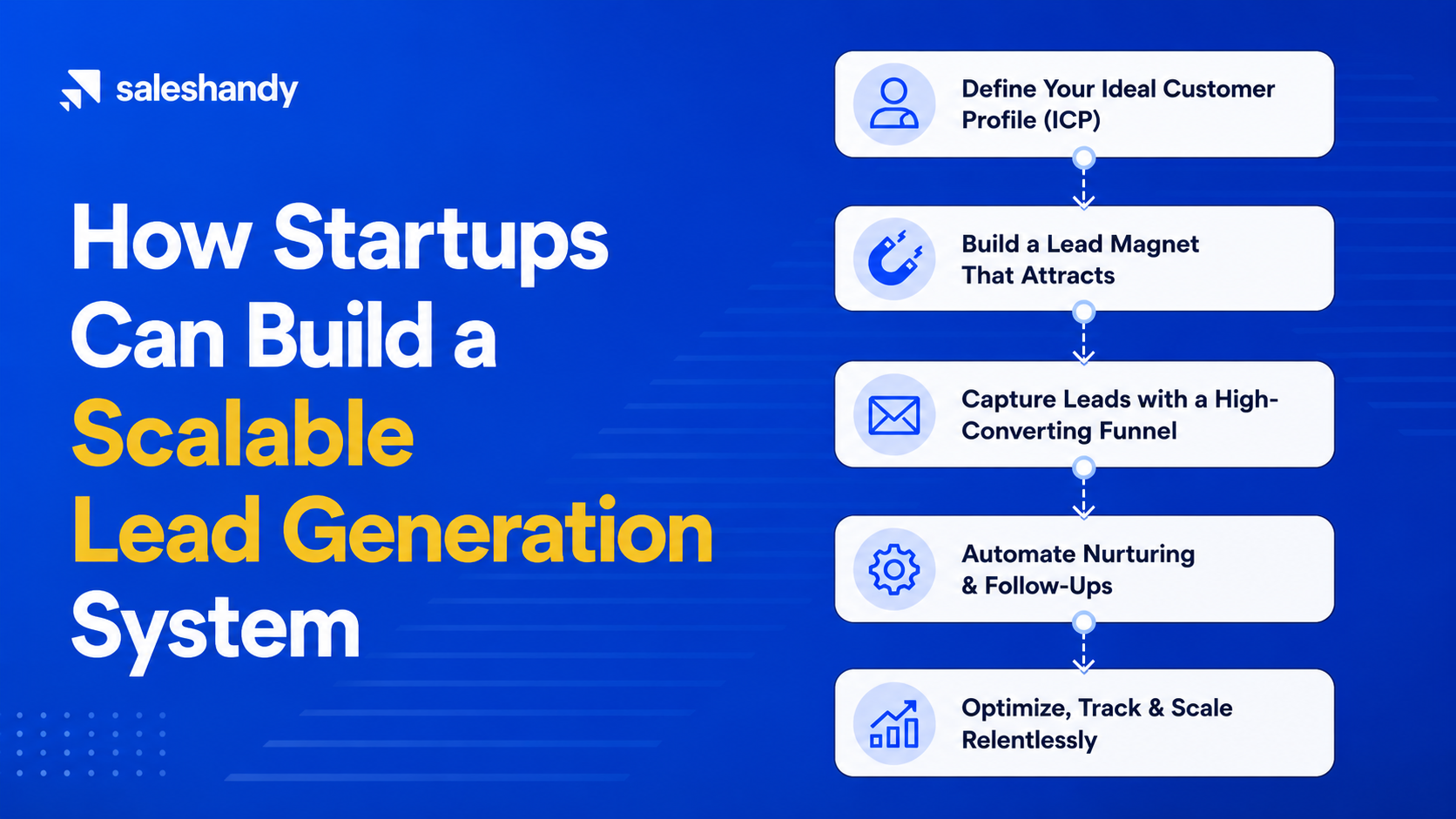
A scalable lead generation system for startups is built by combining one fast channel (paid ads or cold outreach) that delivers qualified leads immediately with one compounding channel (SEO or content) that reduces cost per lead over time — both connected to a CRM and attribution system that makes every lead source traceable, every conversion measurable, and every scaling decision defensible with data. Without this architecture, most startups either run out of budget before finding what works or generate leads they can’t systematically convert.
This guide covers the complete system: how to design a lead generation architecture that scales, which channels to prioritize at each growth stage, how to build the measurement infrastructure that turns activity into intelligence, and how to automate the nurture process that converts first-touch leads into revenue. Whether you build this in-house or with a performance marketing agency in Chennai, the framework remains the same.
Why Most Startup Lead Generation Systems Break When You Try to Scale Them
The majority of early-stage startups generate their first leads through founder-led networking, personal relationships, and one-off tactics — a referral here, a cold email there. This works for the first 10–20 customers. It breaks completely at customer 50.
The reason is structural: these methods are not systems. They’re individual actions that produce individual outcomes without leaving behind infrastructure that can be repeated, measured, or improved. Scaling them means doing more of everything manually — which doesn’t scale.
The data on startup lead generation failure is instructive:
- CB Insights’ analysis of startup failures found that 42% of startups fail because of “no market need” — but the second most common cause, 29%, is running out of cash. For most failed startups, running out of cash and failing to generate sufficient qualified leads are the same event described differently.
- According to Salesforce’s State of Sales 2024, 79% of marketing leads never convert to sales — primarily because of poor lead qualification, absent nurture sequences, and lack of timely follow-up. The problem is rarely lead volume; it’s lead system quality.
- HubSpot’s research found that companies with documented lead generation processes generate 133% more revenue than those without — because documented systems are reproducible, measurable, and improvable.
- A Gartner B2B Buying Study found that the average B2B buying decision now involves 6–10 stakeholders and takes place across multiple channels and sessions before a purchase decision — which means a single-touchpoint lead generation approach captures an increasingly small fraction of available buyers.
The difference between a startup that grows and one that stalls is almost always a documented, measured, channel-diversified lead generation system that improves with every cycle.
The Lead Generation System Architecture: The 5 Components
A scalable lead generation system is not a collection of tactics — it’s a documented architecture with five interdependent components. Each component must be built and connected before the system scales.
Component 1: The Ideal Customer Profile (ICP)
Before any channel is activated, the startup must define precisely who they’re generating leads for. An ICP (Ideal Customer Profile) is not a demographic description — it’s a specific set of attributes that define the customer most likely to buy, most likely to get value, and most likely to become a reference or referral source.
ICP dimensions for B2B startups:
- Company size (employees or revenue range)
- Industry vertical and sub-vertical
- Geography (city, state, country, or “anywhere”)
- Technology stack or existing tools (relevant for SaaS)
- Job title and decision-making authority of the contact
- Specific business signal that indicates buying readiness (recent funding, hiring for a specific role, new leadership appointment, regulatory change affecting them)
ICP dimensions for B2C startups:
- Demographics (age, income, life stage)
- Behavioral signals (purchase history, browsing behavior, content engagement)
- Psychographic profile (values, aspirations, pain points)
- Geographic targeting (for location-based businesses)
Why ICP precision matters for scaling: A vague ICP (“small businesses in India”) produces lead generation campaigns that spread spend across thousands of companies that have widely different needs, budgets, and purchasing processes. A precise ICP (“B2B SaaS founders in Chennai with 5–50 employees, currently using manual processes for sales tracking, who have recently raised Seed or Pre-Series A funding”) produces campaigns where every rupee targets the most likely buyer.
Component 2: The Channel Architecture
A scalable lead generation system uses a deliberate mix of channels designed to serve different functions — not just “try everything and see what works.”
The 3-tier channel architecture:
| Tier | Function | Time to First Lead | Cost Structure | Primary Channels |
|---|---|---|---|---|
| Tier 1: Immediate | Generates leads now | Days | Higher CPL | Google Ads, LinkedIn Ads, cold outreach |
| Tier 2: Compounding | Reduces CPL over time | 3–9 months | Decreasing CPL | SEO, content marketing, email |
| Tier 3: Viral | Multiplies leads at zero marginal cost | Unpredictable | Near-zero CPL | Referral programs, word-of-mouth, community |
The startup sequence: Most startups make the mistake of either:
- Only running Tier 1 channels (unsustainable — CPL stays constant, no compounding)
- Only building Tier 2 channels (slow — no revenue while waiting for SEO to mature)
- Trying everything simultaneously (unfocused — spread too thin to execute well)
The right sequence:
- Months 1–3: Validate one Tier 1 channel to prove the business case (that someone will actually pay)
- Months 3–6: Begin building Tier 2 infrastructure (SEO foundation, content calendar) while Tier 1 generates revenue
- Months 6–12: Launch Tier 3 infrastructure (referral program, community) once there are enough satisfied customers to activate it
- Month 12+: Scale Tier 1 with confidence because Tier 2 data shows what messaging and offers convert best
Component 3: The Conversion Architecture
Leads are generated when traffic or outreach meets a compelling offer and a frictionless conversion mechanism. The conversion architecture is the set of landing pages, forms, and offers that turn interest into a trackable lead record.
The 3-level offer structure:
Level 1 — High-intent offer (for bottom-of-funnel traffic): Direct conversion offer — a free consultation, a demo booking, a personalized audit. Requires minimum commitment from the visitor; appropriate for traffic that has already done significant research.
Examples: “Free 30-Minute PPC Audit,” “Book a Product Demo,” “Get a Custom Growth Plan”
Level 2 — Mid-intent offer (for warm but not ready traffic): Value exchange offer — a resource in exchange for contact information. Lower commitment than Level 1; appropriate for visitors who are researching but not yet ready to commit.
Examples: “Download the Startup Marketing Playbook,” “Get the 2025 Lead Generation Benchmarks Report,” “Free 5-Day Email Course on B2B Growth”
Level 3 — Low-intent offer (for cold top-of-funnel traffic): Content consumption offer — educational content that builds awareness without requiring personal information. Appropriate for brand-new audiences.
Examples: Blog post, YouTube video, social media content, podcast episode
The conversion architecture principle: Match offer level to traffic temperature. Cold traffic from social media ads should hit Level 3 first; warm retargeting audiences should be presented Level 1 or Level 2. Presenting a high-commitment offer (demo request) to cold traffic that has never heard of you produces the low conversion rates that cause startups to abandon paid channels prematurely.
Component 4: The CRM and Measurement Infrastructure
A lead generation system that doesn’t track every lead’s source, quality, and outcome doesn’t improve — because you can’t optimize what you can’t measure.
The minimum viable CRM and attribution setup:
CRM configuration:
- Every lead record must capture: source channel, source campaign, date of first contact, and lead magnet/offer that converted them
- UTM parameters from every paid and organic link must be passed through to the CRM record
- Lead status tracking (lead → MQL → SQL → Opportunity → Closed Won/Lost) with timestamps
Attribution requirements:
- Google Analytics 4 with conversion events for every lead action (form submission, phone click, chat initiation)
- UTM naming convention documented and applied consistently across all channels
- CRM integration with GA4 to connect online lead generation to offline revenue outcomes
Recommended CRM stack for startups:
| Stage | CRM | Best For | Monthly Cost |
|---|---|---|---|
| Pre-revenue | HubSpot Free | Getting organized; basic contact management | Free |
| Early traction (0–50 leads/month) | HubSpot Starter or Pipedrive | Pipeline management, email sequences | ₹1,500–₹4,000 |
| Growth stage (50–500 leads/month) | HubSpot Professional, Zoho CRM, Salesforce | Advanced automation, complex workflows | ₹5,000–₹20,000 |
| Scale stage (500+ leads/month) | Salesforce, HubSpot Enterprise | Enterprise-grade segmentation, attribution | ₹20,000+ |
Component 5: The Nurture and Follow-Up System
44% of salespeople give up after one follow-up (HubSpot research) — despite the data showing that 80% of sales require 5+ follow-up contacts. The gap between these two numbers represents the majority of startup revenue left on the table.
A nurture system automates the follow-up cadence that most salespeople abandon manually, keeping the startup visible and relevant to leads across the multi-week or multi-month consideration period that characterizes most B2B purchases.
The minimum viable email nurture sequence:
- Email 1 (Day 0): Deliver the lead magnet + introduce the brand story
- Email 2 (Day 2): Deliver the most useful piece of educational content you have
- Email 3 (Day 4): Social proof — a specific client story with measurable result
- Email 4 (Day 7): Address the most common objection your prospects have
- Email 5 (Day 10): Direct offer — consultation, demo, or first-step CTA
After Day 10, transition to a monthly newsletter that maintains brand presence without pressuring conversion. The goal: be present in the inbox when the lead’s buying window opens — which may be 3 months after initial contact.
Email automation tools: Mailchimp (entry-level, free tier), ConvertKit (creator/startup focus), ActiveCampaign (advanced automation), HubSpot (CRM-integrated sequences)
Building the Paid Acquisition Layer: The Fastest Path to Validated Lead Flow
For startups that need leads now — not in 6 months when SEO matures — paid acquisition is the essential Tier 1 channel. The goal in the first 90 days is not maximum lead volume; it’s minimum-viable lead flow with maximum attribution clarity.
Google Ads for Startup Lead Generation
Google Search Ads intercept buyers who are actively searching for what the startup offers — making it the highest-intent paid channel available.
The startup Google Ads configuration:
Week 1–2: Tight initial setup
- Match types: Phrase and exact match only (avoid broad match until you have 30+ days of search term data)
- Keywords: 10–20 high-commercial-intent keywords maximum (e.g., “startup lead generation agency Chennai,” “B2B lead generation service India”)
- Negative keywords from day one: “free,” “DIY,” “tutorial,” “jobs,” “salary,” “course” — terms that indicate non-buyer intent
- Budget: ₹500–₹1,500/day minimum to generate enough data for optimization; less produces too few clicks to learn from
- Bidding: Manual CPC for weeks 1–2 to understand cost landscape; shift to Target CPA after 15+ conversions
The Quality Score startup trap: New Google Ads accounts start with no Quality Score — which means higher CPCs than established accounts. Investing in landing page quality (fast-loading, message-matched, well-structured) and tight ad-keyword alignment improves Quality Score faster and reduces CPCs within 3–4 weeks.
A specialist PPC agency in Chennai managing startup Google Ads campaigns typically structures the account with 3–5 ad groups (one per service category or audience segment) rather than one large ad group — because tight grouping enables better keyword-ad-landing page alignment, which drives Quality Score improvement.
LinkedIn Ads for B2B Lead Generation
For B2B startups targeting specific job titles, company sizes, or industries, LinkedIn Ads offers targeting precision that Google and Meta cannot match — at a higher CPC but significantly higher lead quality for enterprise-facing products.
LinkedIn Ads configuration for B2B startups:
| Element | Recommendation | Rationale |
|---|---|---|
| Objective | Lead Generation (native form) for cold traffic | Lower friction than external landing page |
| Audience size | 15,000–80,000 for India targeting | Too small limits delivery; too large reduces relevance |
| Daily budget | ₹2,000–₹5,000 minimum | CPCs are ₹400–₹800; need minimum 5 clicks/day for data |
| Content format | Single image or document ads | Document ads generate 3x more engagement for B2B |
| Offer | Free resource or audit (not “demo request”) | Cold LinkedIn traffic needs value before commitment |
| Frequency cap | 2–3 impressions/week per person | Prevents ad fatigue while maintaining visibility |
The LinkedIn lead gen form advantage: Native lead gen forms (where the user fills out a form within LinkedIn rather than visiting an external site) reduce friction significantly for mobile users. Pre-filled forms using LinkedIn profile data produce 2–3x higher conversion rates than equivalent external landing pages for cold B2B traffic.
Building the Compounding Layer: SEO and Content for Sustainable Lead Flow
While paid channels provide immediate leads, SEO and content marketing build the compounding infrastructure that makes every subsequent lead cheaper than the last.
The Startup SEO Foundation (Months 1–6)
Most startups delay SEO because results take time. The businesses that dominate their organic categories in year 2 are those that started SEO in month 1 of year 1.
The startup SEO priority stack:
Priority 1: Technical foundation (Month 1)
- Sitemap submitted to Google Search Console
- Core Web Vitals passing (LCP under 2.5s, CLS under 0.1)
- Correct URL structure with no duplicate content issues
- HTTPS with no mixed content warnings
Priority 2: Bottom-of-funnel keyword content (Months 1–3) Start with commercial-intent content targeting buyers closest to purchase:
- Service/product page optimization for high-commercial-intent keywords
- Case study pages with specific results and client names
- Location-specific pages if targeting specific geographies (e.g., “lead generation for startups in Chennai”)
Priority 3: Mid-funnel content (Months 3–6)
- Comparison pages (“X vs Y” for your category)
- Buyer guides (“how to choose a lead generation agency”)
- Tool and resource pages that rank for problem-aware queries
Priority 4: Top-of-funnel content (Months 6+)
- Educational blog content answering audience questions
- Industry research and original data
- Thought leadership content that builds topical authority over 12+ months
The Content Compounding Effect
A startup that publishes 2–3 well-researched, SEO-optimized blog posts per month from month 1 will have 24–36 indexed articles by month 12 — each generating some organic traffic, collectively generating significantly more. The compounding effect of content SEO means that year 2 organic leads are substantially cheaper than year 1 paid leads, creating the unit economics improvement that enables aggressive scaling.
Cold Outreach: The Zero-Budget Lead Generation Channel
For pre-revenue or early-stage startups with minimal marketing budget, cold email and LinkedIn outreach remains the fastest path to qualified conversations — with near-zero cost beyond time investment.
The high-response cold outreach framework:
Step 1: Build a hyper-targeted prospect list Tools: Apollo.io (contact database with email finder), LinkedIn Sales Navigator (company and title filtering), Hunter.io (email verification)
Target: No more than 50–100 new prospects per week — quality of targeting over volume of outreach.
Step 2: Research each prospect individually The single biggest differentiator between cold outreach that converts (5–15% positive response) and cold outreach that is ignored (under 1% response) is personalization. Spend 3–5 minutes per prospect finding one specific, genuine reason to reach out:
- A post they published on LinkedIn
- A recent company announcement
- A shared connection or industry event
- A specific challenge their role typically faces
Step 3: Write the email in 5 sentences
Sentence 1: One specific, genuine reference that proves you researched them
Sentence 2: What you do and who you do it for (one sentence, outcome-focused)
Sentence 3: One specific result you’ve delivered for a similar company
Sentence 4: The specific ask — low-friction, clearly defined
Sentence 5: Sign-off that leaves the door open without pressure
The word count rule: Cold emails over 100 words have dramatically lower response rates than those under 80 words. Brevity signals respect for the recipient’s time and confidence in the offer.
Referral Systems: The Highest-Quality Lead Channel
Referrals convert at 3–5x the rate of cold leads and have higher average order values — because they arrive with pre-existing trust. Most startups wait until they have 100+ customers to build a referral system. The right time is when they have 5–10 satisfied ones.
The startup referral system architecture:
Identify the right moment: The optimal referral ask moment is immediately after a customer achieves a meaningful outcome — their first successful campaign, their first measurable result, the completion of their onboarding. This is when enthusiasm is highest and the likelihood of referring is greatest.
Make the ask personal: “We’re growing and looking for more customers like you. If you know anyone who’d benefit from what we’ve done for you, we’d be grateful for an introduction” — personal, direct, and respectful.
Create the mechanism: For B2B referrals: a direct introduction email template the customer can send with a single click, plus a clear incentive (agency credit, gift, cash, upgrade).
For B2C/SaaS: a shareable referral link with tracked attribution, automated reward delivery, and social sharing integration.
Tools: ReferralHero (referral program builder), Viral Loops (SaaS-focused), PartnerStack (B2B partner program management)
The Lead Quality Problem: Why Volume Metrics Miss the Point
The most common startup lead generation mistake is optimizing for lead volume rather than lead quality. 1,000 unqualified leads cost more to process than they’re worth; 50 highly qualified leads generate more revenue than most founders realize.
The Lead Quality Measurement Framework
Quantity metrics (necessary but insufficient):
- Total leads generated per month
- Cost per lead (CPL) by channel
- Lead velocity (month-over-month growth rate)
Quality metrics (where revenue actually lives):
- Lead-to-MQL rate by channel (what % of raw leads become Marketing Qualified?)
- MQL-to-SQL rate (what % of MQLs become Sales Qualified?)
- SQL-to-Close rate (what % of opportunities close?)
- Average deal size by lead source
- Revenue per lead by channel
The channel quality comparison that changes investment decisions:
| Channel | CPL | Lead-to-Close Rate | Revenue Per Lead |
|---|---|---|---|
| Referral | ₹500 (avg time investment) | 35% | ₹31,500 |
| LinkedIn Ads | ₹2,800 | 18% | ₹14,400 |
| Google Search Ads | ₹1,800 | 12% | ₹9,600 |
| Cold Email | ₹350 | 15% | ₹9,750 |
| Content/SEO | ₹1,200 (time amortized) | 15% | ₹9,000 |
| Social Media (organic) | ₹400 | 8% | ₹3,200 |
Example figures for illustration — actual figures vary significantly by industry, deal size, and execution quality.
This analysis shows that optimizing only for CPL (cold email wins at ₹350) misses the full picture: referrals generate 3x more revenue per lead despite costing more per contact. Investment decisions made from revenue-per-lead data produce dramatically different (and better) channel mix choices than those made from CPL data alone.
How Weboin Builds Lead Generation Systems for Startups
At Weboin, a specialist digital marketing agency in Chennai working with startups across B2B SaaS, D2C, professional services, and technology, scalable lead generation is the primary brief for most early-stage engagements.
Our startup lead generation system build:
Month 1 — Foundation: We define the ICP with the founding team, build the conversion architecture (landing pages, offer structure, forms), configure GA4 conversion tracking with full UTM attribution, set up CRM lead source tracking, and launch the first Tier 1 paid channel with a ₹15,000–₹30,000 test budget.
Month 2 — Validate and Optimize: We analyze which campaigns and landing pages are producing qualified leads at acceptable CPL, kill underperformers, scale winners, and begin building Tier 2 SEO infrastructure (keyword research, technical foundation, first content pieces).
Month 3+ — Build the System: We launch email nurture sequences for each lead source, build the referral program once 10+ satisfied customers exist, and begin the compounding content program. Monthly reporting connects every channel to revenue outcomes — CPL, MQL rate, SQL rate, and marketing-attributed revenue.
As a full-service digital marketing company in Chennai with performance marketing and SEO under one roof, Weboin’s startup engagements consistently avoid the channel fragmentation that happens when startups use separate agencies for paid, organic, and CRM — ensuring all three layers of the system are aligned toward the same ICP and the same revenue targets.
The 90-Day Scalable Lead Generation Launch Plan
Days 1–30: Infrastructure
- Define ICP with specific firmographic and behavioral attributes
- Build or audit conversion landing pages for primary offer
- Configure GA4, UTM tracking, and CRM integration
- Launch one Tier 1 paid channel (Google Search or LinkedIn) with test budget
- Set up email nurture sequence (5 emails minimum)
- Launch cold outreach program: 20–30 personalized emails per day
Days 31–60: Validate and Adjust
- Review CPL and lead quality data: kill underperforming campaigns
- A/B test landing page headline and CTA
- Scale winning paid campaigns by 20–30%
- Publish first 2–3 SEO-targeted blog posts (BOFU keywords)
- Review cold outreach response data: refine ICP and messaging
Days 61–90: Layer and Systematize
- Add retargeting campaigns for warm audiences (website visitors, lead form openers)
- Launch lead magnet for email list building
- Publish 2 more SEO-targeted content pieces
- Initiate referral ask with satisfied early customers
- Build first monthly lead generation dashboard in Looker Studio
- Generate first marketing ROI report: CPL, MQL rate, attributed revenue by channel
Frequently Asked Questions About Scalable Lead Generation for Startups
A scalable lead generation system is a documented, measurable architecture of channels, conversion mechanisms, and nurture sequences that consistently produces qualified leads and can be increased in output by increasing investment (paid channels) or content volume (organic channels) — without proportionally increasing the cost per lead or the manual effort required.
For B2B startups: cold email (immediate, zero budget) + Google Search Ads (immediate, paid). For B2C startups: Meta Ads (immediate, paid) + SEO content (compounding). The combination of one fast channel and one compounding channel is the optimal starting point — fast channels validate the business case while compounding channels build sustainable unit economics.
The minimum viable system — one paid channel, basic CRM tracking, and an email nurture sequence — can be operational in 2–4 weeks. A fully built system with compounding channels, referral infrastructure, and optimized conversion architecture typically takes 6–9 months. The first 90 days are critical: they establish the data, learnings, and validated channel mix that all subsequent scaling is built on.
Start with the minimum required to generate enough data to optimize — typically ₹15,000–₹30,000/month for a single paid channel (this generates 10–30 leads/month, enough to identify what's working). Scale budget only after achieving a validated CPL and acceptable lead quality. Investing ₹1,00,000/month before validating lead quality is one of the most common startup marketing budget mistakes.
Connect every lead source to revenue: track CPL by channel, lead-to-close rate by channel, and average deal size by channel. Revenue per lead = (close rate × average deal size). Calculate ROI as: (marketing-attributed revenue − marketing cost) ÷ marketing cost × 100. Any channel producing positive ROI at validated scale should receive increasing budget allocation.
Final Thought: Systems Beat Tactics, Every Time
The difference between a startup that grows sustainably and one that lurches between lead generation crises is almost always a documented, measured, channel-diversified lead generation system versus a collection of disconnected tactics that each founder tries and abandons.
Tactics produce results until they don’t. Systems produce results that compound — because each campaign cycle generates data that improves the next, each satisfied customer enters the referral flywheel, each piece of content adds to the organic traffic pool, and each optimization builds on the accumulated knowledge of every previous decision.
Building that system takes longer than launching a single campaign. But it’s the only approach that produces the kind of repeatable, scalable, declining-cost lead generation that enables a startup to grow confidently rather than spending every quarter wondering whether the phone will ring.
Whether you build this system in-house or with a specialist performance marketing agency in Chennai like Weboin, the 5-component architecture in this guide — ICP, channels, conversion, measurement, and nurture — gives you the complete blueprint for lead generation that grows with your business rather than capping out at your current team’s capacity.
About Weboin: Weboin is a full-service digital marketing company in Chennai offering performance marketing, PPC management, SEO, content strategy, and lead generation system development for startups and growing businesses. As a trusted digital marketing agency in Chennai and PPC agency in Chennai, Weboin has helped startups across B2B, SaaS, and D2C categories build lead generation systems that scale from first 100 leads to first 1,000 customers.

No comment yet, add your voice below!