
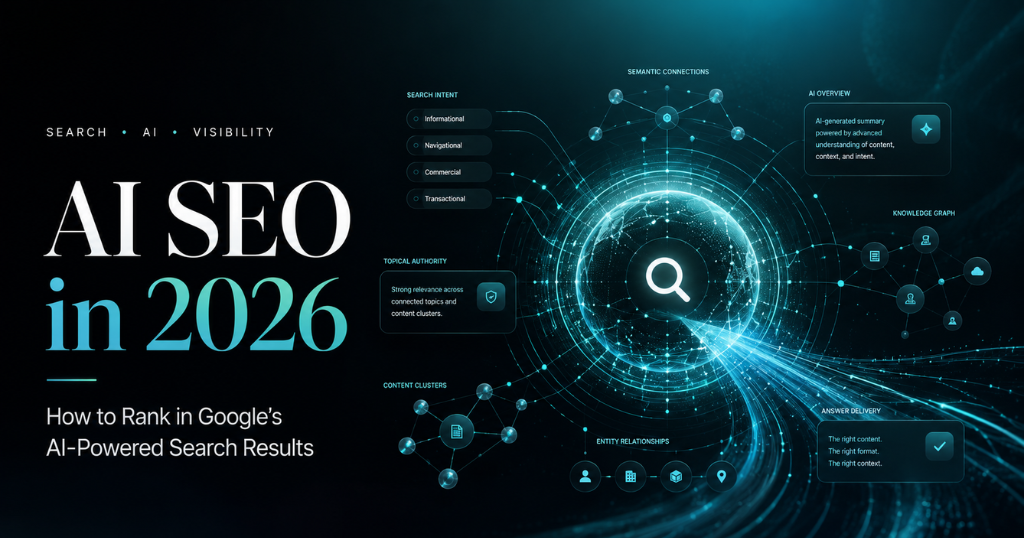
Ranking in Google’s AI-powered search results in 2026 requires optimizing content for two audiences simultaneously: Google’s AI systems (which extract and cite structured, authoritative answers) and the human readers who click through to your full content — because AI Overviews don’t eliminate organic clicks; they filter them, sending significantly more qualified traffic to pages whose content demonstrably earns citation. The brands winning in AI search are not those who changed everything they know about SEO — they’re those who executed the fundamentals with greater precision and built the entity authority that AI systems specifically reward.
This guide covers exactly how to rank in Google’s evolving AI-powered search landscape: how AI Overviews work, what content signals earn AI citations, how entity-based SEO has become the new authority architecture, and the specific tactical changes that separate the brands gaining traffic from the brands losing it. Whether you’re managing SEO internally or working with an SEO agency in Chennai, this is the 2026 playbook.
How Google’s AI-Powered Search Has Changed the SERP in 2026
Google’s AI Overviews (previously called SGE — Search Generative Experience) became the dominant SERP feature for informational and commercial research queries across most categories following their global expansion in 2024 and further refinement in 2025. By 2026, AI Overviews appear in an estimated 25–30% of all search queries — with significantly higher prevalence for informational, how-to, comparison, and research-intent queries.
The data on AI Overviews’ impact on organic traffic is nuanced and has been widely misreported:
- BrightEdge’s 2025 AI Search Impact Study found that queries with AI Overviews showed a 23% reduction in clicks to the first organic result — but a significant increase in click-through rates for pages cited within the AI Overview itself
- According to Semrush’s 2025 AI Overview Correlation Report, pages cited in AI Overviews received an average of 3.2x more organic traffic from the query than equivalent pages not cited
- Ahrefs’ research found that AI Overview citations correlate strongly with three factors: Domain Rating (authority), content structure (headers and schema markup), and topical depth (comprehensive coverage of related semantic concepts)
- A Search Engine Land analysis of 1 million queries found that 65% of AI Overview citations come from pages ranking in positions 1–5 for the query — but the remaining 35% come from positions 6–20, indicating that citation in an AI Overview is achievable even without the top organic ranking
The practical implication: AI Overviews have not made traditional organic SEO irrelevant. They have made the gap between pages that win citations and pages that don’t significantly larger — because citations now deliver disproportionate traffic while uncited positions see reduced click-through rates.
What Google’s AI Systems Are Actually Evaluating
Understanding what Google’s AI systems — primarily Gemini, integrated into Search — evaluate when deciding which content to cite requires moving beyond traditional SEO concepts and into the language of knowledge graphs, entity relationships, and semantic confidence.
The 3 Layers of AI Search Evaluation
Layer 1: Entity Recognition and Authority
Google’s Knowledge Graph contains billions of entities — people, organizations, places, concepts, products — and the relationships between them. When Google’s AI evaluates content for an AI Overview citation, it first asks: “Is this content connected to trusted entities in a way that establishes its authority on this topic?”
Entity authority for a website is built through:
- NAP consistency (Name, Address, Phone — for local businesses) across the web
- Author entity establishment — named authors whose expertise is documented across multiple sources
- Brand entity recognition — citations, mentions, and links from other trusted entities in the same topical domain
- Topic cluster breadth — a website covering a topic comprehensively signals entity authority in that domain
Layer 2: Content Confidence Score
Google’s AI evaluates the “confidence” it has in extracting an accurate answer from a piece of content. High confidence correlates with:
- Direct, declarative statements that answer questions without ambiguity
- Structured presentation (headers, lists, tables) that makes information hierarchy clear
- Verifiable specificity — specific numbers, dates, names, and sources that can be cross-referenced
- Consistency with other trusted sources — AI systems are more confident citing information that aligns with what they’ve learned from multiple authoritative sources
Layer 3: E-E-A-T Signals
Google’s E-E-A-T framework (Experience, Expertise, Authoritativeness, Trustworthiness) has become increasingly important as AI-generated content has flooded the web with technically correct but experientially hollow information. The AI systems specifically look for:
- Experience signals: First-hand accounts, original data, direct testing — content that could only exist if the author actually did the thing they’re writing about
- Expertise signals: Author credentials, institutional affiliations, peer recognition
- Authoritativeness signals: External citations, media mentions, industry recognition
- Trustworthiness signals: Transparent authorship, clear sourcing, accurate and current data
The 6 Core Strategies for Ranking in AI-Powered Search Results
Strategy 1: Answer-First Content Architecture
AI Overviews extract answers — they don’t summarize articles. The difference is significant: an article that builds up to its answer over several paragraphs will be consistently outperformed by an article that states the direct answer in the first 50–70 words of the relevant section.
The answer-first architecture for AI-cited content:
[H2 — Mirrors the question the searcher is asking]
[Direct answer paragraph — 40–70 words, complete standalone answer]
[Supporting context — 2–4 paragraphs expanding on the answer with
specifics, evidence, and nuance]
[Structured proof element — table, list, or case study that validates
the direct answer]
This structure serves the AI extraction (the direct answer paragraph becomes the citation source) and the human reader (the full section provides the depth they need to trust and act on the answer).
What not to do: Begin sections with “It’s important to understand that…” or “There are several factors to consider…” These hedging openings signal to AI systems that the direct answer hasn’t arrived yet — and increase the probability that the AI will look for a more direct source to cite.
Strategy 2: Entity-Based Content Development
Traditional keyword SEO focused on the presence of specific strings of text. AI-powered search operates at the entity level — understanding concepts, relationships, and the semantic network around a topic.
The practical shift for content strategy:
Old approach: Target “digital marketing agency in Chennai” → write content containing this phrase repeatedly New approach: Build entity authority for [Weboin] as an entity recognized by Google as a credible, expert [digital marketing agency] in [Chennai] — through content breadth, external citations, author entity establishment, and semantic coverage of all related concepts
How to build topic entity authority:
- Create comprehensive content clusters that cover a topic from every relevant angle — not just the highest-volume keywords
- Include entities (specific brands, tools, people, places, techniques) relevant to your topic in your content — entity co-occurrence signals topical authority to AI systems
- Build author entity pages that document the credentials, expertise, and published work of the people whose names appear on your content
- Earn citations from other recognized entities in your domain — academic institutions, industry publications, tool vendors, established brands
Tools for entity SEO analysis: Google’s Natural Language Processing API (free, shows how Google sees entities on your page), InLinks (entity-based SEO platform), Wordlift (semantic knowledge graph builder)
Strategy 3: Structured Data and Schema Markup at Scale
Schema markup has evolved from a “nice to have” into a near-prerequisite for AI citation eligibility in several content categories. Google’s AI systems use structured data as a confidence signal — pages that explicitly declare their content type, author, organization, and data points in machine-readable format give AI systems the certainty they need to cite confidently.
Priority schema implementations for AI SEO in 2026:
| Schema Type | AI SEO Impact | Implementation Priority |
|---|---|---|
| Article + Author | High — establishes content type and author entity | All blog posts |
| FAQ | Very High — FAQ content is directly eligible for AI Overview citation | All pages with Q&A sections |
| HowTo | Very High — step-by-step instructions are frequently cited in AI Overviews | Tutorial and process content |
| Organization | High — establishes brand entity for Google’s Knowledge Graph | Homepage and About page |
| LocalBusiness | Very High for local SEO in AI results | All local business pages |
| Person (Author) | High — establishes author entity and expertise | Author bio pages |
| Product / Service | Medium-High — for commercial queries | Service and product pages |
| Speakable | Emerging — marks content specifically optimized for voice/AI extraction | Key sections of high-traffic pages |
The Speakable schema opportunity: The speakable schema property marks specific sections of a page as optimized for text-to-speech and AI synthesis. While not yet a dominant AI Overview ranking factor, early adoption signals to Google’s AI systems which sections of your content are designed for extraction — which may provide a citation advantage as AI search continues to evolve.
Strategy 4: Topical Authority Through Content Depth
Google’s AI systems don’t just evaluate individual pages — they evaluate the topical authority of the entire domain. A website with 50 deeply researched, interconnected articles on digital marketing topics builds the topical authority that enables any individual article to earn AI citations more easily.
The topical authority architecture for AI SEO:
- Pillar pages: Comprehensive, long-form guides on the primary topics of your domain. For a digital marketing company in Chennai like Weboin, pillar pages might cover: SEO fundamentals, PPC management, social media strategy, content marketing, and conversion rate optimization.
- Cluster content: Specific, deeply detailed articles covering every significant subtopic within each pillar. 15–25 cluster articles per pillar, all internally linked to the pillar and to each other.
- Data and original research: Original surveys, proprietary data, or unique analyses that no other site can replicate. Original data earns external citations — which are the most powerful topical authority signals available.
- Expert author bios: Every major content area should have a named expert whose credentials specifically support the content they’re contributing to.
Why topical depth matters for AI citation: Google’s AI systems are essentially asking “Is this the most knowledgeable source about this topic that exists?” Wide, shallow coverage says “no.” Deep, comprehensive coverage of a well-defined topic says “yes.”
Strategy 5: Conversational and Long-Tail Query Optimization
AI-powered search has amplified the long-tail SEO opportunity that existed before AI Overviews. When users interact with AI systems, they ask questions in natural, conversational language — often much longer and more specific than the keyword-optimized queries that dominated pre-AI search behavior.
BrightEdge research found that AI-influenced queries are on average 40% longer than traditional search queries — and are frequently phrased as complete questions or multi-part research tasks.
How to optimize for conversational AI search queries:
- Build FAQ sections into every major content piece — structured Q&As that mirror the conversational questions your audience asks. Each Q&A pair is a potential AI Overview citation.
- Use People Also Ask (PAA) data from Google Search Console and tools like AlsoAsked.com to identify the specific conversational questions associated with your target topics.
- Create content that answers follow-up questions — AI search interactions frequently involve multi-turn conversations. Content that addresses the natural follow-up to an initial query is more likely to remain relevant across the full research session.
- Optimize for voice-phrased queries: “What is the best digital marketing agency in Chennai?” rather than just “digital marketing agency Chennai.” The conversational phrasing of voice-first AI search requires content written in natural language, not keyword-stuffed text.
Strategy 6: Technical SEO for AI Crawlability
Google’s AI systems must be able to efficiently crawl, parse, and understand your content before they can consider citing it. Technical SEO has always been important — but several technical factors have become significantly more important for AI citation eligibility.
Critical technical factors for AI SEO in 2026:
Page speed and Core Web Vitals: Google’s AI content ingestion systems prioritize fast-loading pages. LCP (Largest Contentful Paint) under 2.5 seconds is the threshold for optimal AI crawl priority. Slow pages are crawled less frequently, meaning updates and new content take longer to be indexed and considered for AI citation.
Clean HTML structure: AI extraction algorithms parse HTML structure directly. Pages with clean, semantic HTML (proper heading hierarchy, semantic elements like <article>, <section>, <aside>) are easier for AI systems to parse accurately. JavaScript-rendered content that requires execution before meaningful HTML is available creates extraction difficulty.
Canonical and indexation clarity: Duplicate content creates confidence ambiguity for AI citation. A page with multiple URL variants serving the same content creates uncertainty about which version to cite. Strong canonical implementation ensures AI systems consistently cite the correct URL.
Content freshness signals: AI systems weight content recency for time-sensitive topics. The dateModified property in Article schema, the Last-Modified HTTP header, and regular content updates all signal freshness. For rapidly evolving topics (like AI SEO itself), freshness is a significant citation factor.
How AI Overviews Have Changed the Search Funnel
Understanding the changed search funnel helps prioritize which content types and query categories deserve the most AI SEO investment.
The 2026 AI Search Funnel
| Query Stage | AI Overview Prevalence | Optimal Content Type | Traffic Pattern |
|---|---|---|---|
| Awareness (What is X) | Very High (40%+ of queries) | Definitional content, explainers, concept guides | AI Overview captures most clicks; few click-throughs |
| Research (How does X work) | High (25–35%) | How-to guides, comparison content, structured tutorials | Cited pages get 3x+ CTR; uncited pages get significantly less |
| Comparison (X vs Y) | High (20–30%) | Comparison tables, pros/cons, decision frameworks | Mixed — AI surface key comparisons; users click for depth |
| Commercial (Best X for Y) | Medium (15–20%) | List content, buyer guides, case studies | Click-through rates remain relatively strong |
| Transactional (Buy/Hire X) | Low (5–10%) | Service/product pages with clear CTAs | AI Overviews rare; traditional SEO factors dominant |
Strategic implication: Awareness-stage content faces the greatest AI Overview click displacement. Commercial and transactional content retains stronger direct traffic patterns. A balanced content strategy invests in both — building AI citation authority through awareness content while maintaining strong commercial pages that capture high-intent traffic directly.
Building E-E-A-T for AI Search: The 2026 Standard
Google’s E-E-A-T requirements have become significantly more stringent in the AI era — precisely because AI content generation has made it trivially easy to produce content that looks comprehensive but lacks genuine expertise, first-hand experience, or original insight.
The E-E-A-T Signals That Specifically Influence AI Citation
Experience Signals (the newest and most differentiating):
- First-person accounts of doing the thing the content is about (“When we audited 50 SEO campaigns in Chennai, we found…”)
- Original screenshots, data visualizations, or photos that can only exist if the author performed the described activity
- Specific details that reveal direct interaction (exact tool settings, specific error messages encountered, precise methodologies tested)
- Dates of experience that establish the content as current first-hand practice, not recirculated theory
Expertise Signals:
- Named authors with verifiable credentials (LinkedIn profiles, published work, institutional affiliations)
- Author schema markup connecting author entity to article
- Cross-publication bylines — the same author published on multiple authoritative sites in the same domain
- Specific qualifications, certifications, or professional recognition relevant to the content topic
Authoritativeness Signals:
- External mentions and citations in authoritative publications (industry blogs, news sites, academic papers)
- Google Knowledge Panel presence for the author or organization
- Wikipedia mentions or citations
- Backlinks from recognized entities in the same topical domain
Trustworthiness Signals:
- Accurate, verifiable statistics with sources and dates
- Transparent conflict-of-interest disclosures (e.g., “We are a digital marketing agency — this content reflects our practice, which you should evaluate accordingly”)
- Factual consistency with consensus expert sources
- Regular content updates that correct outdated information
The AI SEO Audit: Assessing Your Current Position
Before implementing AI SEO strategies, audit your current visibility in AI-powered search results. This baseline assessment determines where the largest opportunities and gaps exist.
The 5-Point AI SEO Audit
Audit Point 1: AI Overview Appearance Search your top 20 target queries in Google. For each query:
- Does an AI Overview appear?
- If yes, are you cited in the AI Overview?
- If cited, what specific section of your content was used?
- If not cited, which competitor is cited?
Audit Point 2: Entity Recognition Check Use Google’s Natural Language API (cloud.google.com/natural-language) to analyze your top content pages:
- What entities does Google identify on your pages?
- Does Google correctly identify your brand as the relevant entity type?
- Are the relevant topic entities present in your content?
Audit Point 3: Schema Implementation Audit Use Google’s Rich Results Test and Schema Markup Validator:
- Which pages have no schema markup?
- Which schema implementations have errors?
- Which schema types relevant to your content are not yet implemented?
Audit Point 4: Content Confidence Assessment For your top 10 content pages, evaluate each section against the answer-first principle:
- Does each H2 section begin with a direct, declarative answer?
- Are there ambiguous, hedging openings that reduce AI confidence?
- Is specific, verifiable data present in each major claim?
Audit Point 5: E-E-A-T Gap Analysis Evaluate each major content piece:
- Is there a named author with a bio and credentials?
- Does the content contain first-hand experience signals?
- Are external sources cited with links?
- Is the content dated and recently updated?
How Weboin Approaches AI SEO for Clients
At Weboin, a specialist SEO company in Chennai working with businesses across India and internationally, AI SEO has been integrated into every content and technical SEO engagement since 2024. Our approach is built on the principle that AI-era SEO rewards the same fundamentals that always mattered — expertise, structure, and genuine usefulness — but demands greater precision in their execution.
Our AI SEO implementation framework:
Phase 1 — Entity Authority Audit: We assess the client’s current entity recognition using Google’s Knowledge Graph, Natural Language API, and Search Console data. We identify entity gaps — topics where the client should be recognized as an authority but isn’t — and build an entity authority development roadmap.
Phase 2 — Content Architecture for AI Citation: We restructure existing high-traffic content using the answer-first architecture, adding FAQ schema, improving H2 question alignment with PAA data, and establishing author entities for key content contributors.
Phase 3 — Schema Implementation: We implement the full priority schema stack — Article + Author, FAQ, HowTo, Organization, and LocalBusiness — across the appropriate pages, validate with Google’s Rich Results Test, and monitor rich result appearances in Search Console.
Phase 4 — Topical Depth Expansion: We identify topical authority gaps through competitor cluster analysis and build content roadmaps that fill those gaps — ensuring the client’s domain develops the comprehensive coverage that AI systems specifically reward.
Phase 5 — Monitoring and Iteration: We track AI Overview citation rate for target queries monthly, adjusting content structure and schema based on which formats are earning citations in the client’s specific topical domain.
As a full-service digital marketing agency in Chennai, Weboin integrates AI SEO with performance marketing, social media, and content strategy — ensuring that AI search authority supports and amplifies every other marketing channel.
Common AI SEO Mistakes to Avoid in 2026
Mistake 1: Creating Content Specifically to “Trick” AI Overviews Optimizing content with the explicit goal of appearing in AI Overviews without genuinely improving content quality produces content that may earn brief citations but lacks the depth to sustain them. AI systems update continuously; quality-based citation authority is more durable than tactical optimization.
Mistake 2: Abandoning Long-Form Content for Short AI-Targeted Snippets Some marketers have interpreted AI SEO as requiring extremely short, snippet-optimized content. This misunderstands the AI citation dynamic: the answer paragraph earns the citation, but the surrounding in-depth content is what earns the domain authority that makes the page citation-eligible in the first place.
Mistake 3: Ignoring Author Entity Development Producing content without named authors in 2026 is an increasingly significant competitive disadvantage. AI systems weight author expertise signals — and content without an identifiable expert author increasingly struggles to compete with content from verified experts.
Mistake 4: Over-Indexing on Technical Schema Without Improving Content Quality Schema markup signals structure and type — it doesn’t improve the content itself. A poorly written, thin article with perfect schema implementation will not earn AI citations. Schema amplifies content quality; it doesn’t substitute for it.
Mistake 5: Treating AI SEO as Separate from Traditional SEO The fundamentals of AI SEO — deep expertise, structured content, strong entity authority, excellent technical performance — are the same fundamentals that have always driven traditional organic rankings. The most effective approach is not to build a parallel “AI SEO strategy” but to execute traditional SEO with the greater precision and entity-awareness that AI-powered search rewards.
AI SEO in 2026: Quick Reference Summary
What Google’s AI evaluates:
- Entity authority and topical expertise of the domain
- Content confidence (directness, specificity, verifiability)
- E-E-A-T signals (especially first-hand Experience)
- Structured data implementation
- Technical crawlability and freshness
What earns AI Overview citations:
- Answer-first section structure (40–70 word direct answer at section opening)
- FAQ schema with questions mirroring PAA queries
- HowTo schema for process content
- Comprehensive topical coverage of the domain
- Named expert authors with verifiable credentials
What reduces AI citation eligibility:
- Hedging, vague, or qualifier-heavy content openings
- Anonymous content without author expertise signals
- Thin coverage without entity depth
- Poor technical performance (slow LCP, messy HTML, crawl errors)
- Outdated information without freshness signals
Frequently Asked Questions About AI SEO in 2026
AI SEO refers to the practice of optimizing content and technical website structure to rank in Google's AI-powered search features — primarily AI Overviews — in addition to traditional organic results. It emphasizes entity authority, structured content architecture, E-E-A-T signals, and schema markup because these are the signals Google's AI extraction systems specifically evaluate when deciding which content to cite.
AI Overviews reduce click-through rates for uncited pages at the top of the SERP. However, pages cited within AI Overviews typically receive 3x more organic traffic from those queries than equivalent uncited pages. The net effect depends heavily on whether you're cited or not — which is why earning citations through content quality is the core AI SEO strategy.
The strongest citation signals are: (1) answer-first content structure with direct, declarative answers at the beginning of each section, (2) FAQ schema markup on pages with Q&A content, (3) comprehensive topical coverage that establishes domain authority, (4) named expert authors with verifiable credentials, and (5) specific, verifiable data cited with sources. There is no guaranteed path to AI citation — it's earned through content quality and entity authority.
Yes — more so than ever. Pages ranking in positions 1–5 are cited in AI Overviews at significantly higher rates than lower-ranking pages. Earning traditional rankings through technical SEO, backlink authority, and content quality remains the foundation. AI SEO adds the additional layer of content structure and entity optimization that maximizes citation probability from within those rankings.
Traditional SEO focuses primarily on keyword alignment, backlink authority, and technical performance. AI SEO extends these with entity authority development, author expertise signals, structured data at scale, and answer-first content architecture. The distinction is less a different discipline and more an evolution of existing SEO practice — the same fundamentals, applied with greater semantic precision.
Final Thought: AI Search Rewards What Good SEO Always Required
The arrival of AI-powered search has not disrupted the principles of good SEO — it has clarified and amplified them. The brands gaining traffic in AI search are those that always invested in genuine expertise, comprehensive content, transparent authorship, and clean technical execution. The brands losing traffic are those that optimized for search engines rather than for people — because AI systems are significantly better than previous algorithms at distinguishing between the two.
The 2026 AI SEO opportunity is available to any brand willing to demonstrate genuine authority on a defined set of topics, structure that expertise in a format that AI systems can confidently extract and cite, and build the entity signals that tell Google “this is a credible source.”
Whether you implement these strategies in-house or with a specialist digital marketing company in Chennai like Weboin, the framework in this guide — entity authority, answer-first architecture, schema implementation, E-E-A-T signals, and topical depth — is your complete playbook for ranking in the search results of 2026.
About Weboin: Weboin is a full-service SEO agency in Chennai specializing in AI-era SEO, technical optimization, content strategy, entity authority development, and performance marketing. As a trusted SEO company in Chennai, Weboin helps businesses across India build organic search authority that performs in both traditional and AI-powered search environments.

No comment yet, add your voice below!