
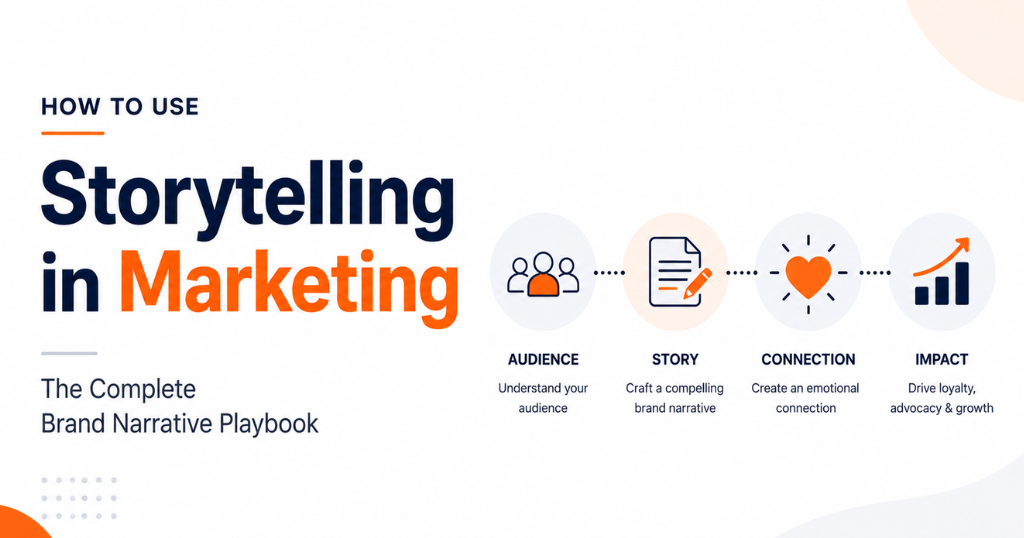
Using storytelling in marketing means structuring your brand communications around a narrative arc — a character, a conflict, and a resolution — rather than around features and claims, because human brains are neurologically wired to process, remember, and act on stories far more effectively than factual information presented in isolation. A brand that tells a compelling story doesn’t just sell a product or service; it gives people a reason to care — and caring is the precondition for every meaningful customer relationship.
This guide covers the complete storytelling-in-marketing framework: the neuroscience that makes it work, the specific story structures that convert, how to apply storytelling across every marketing channel, and the practical techniques for extracting and telling the stories already living inside your business. Whether you manage content in-house or work with a social media marketing agency in Chennai, storytelling is the multiplier that makes every other marketing investment more effective.
Why Storytelling Works: The Neuroscience Behind the Strategy
Marketing storytelling isn’t a creative preference — it’s a response to how the human brain actually processes information. Understanding the neurological mechanisms behind storytelling explains why well-told brand stories consistently outperform fact-heavy marketing across every channel and format.
Neural Coupling and the Shared Experience Effect
When a person reads or hears a fact, their brain’s language processing areas activate — Broca’s area and Wernicke’s area decode the information. But when the same person hears a story, something fundamentally different happens: the storyteller’s brain and the listener’s brain begin to synchronize. Princeton neuroscientist Uri Hasson’s research using fMRI scanning showed that a story told well causes the listener’s brain activity to closely mirror the narrator’s — a phenomenon he called “neural coupling.”
The practical implication: a well-told story doesn’t just communicate information. It creates a shared experience in which the listener feels what the storyteller felt. That felt experience is the substrate of trust.
The Oxytocin Effect: Why Stories Build Trust
Neuroeconomist Paul Zak’s research at Claremont Graduate University found that stories with a clear narrative arc (a character facing a challenge and overcoming it) reliably cause the brain to release oxytocin — the neurochemical associated with trust, empathy, and cooperation. His 2014 study published in Harvard Business Review demonstrated that people who watched a character-driven story before being given the option to donate money gave significantly more than those who watched non-narrative informational content.
For marketing, the direct implication is this: storytelling triggers the neurochemical precondition for purchase decisions. Trust is not built through claims — it’s built through shared emotional experiences. Stories are the technology for delivering those experiences at scale.
The Memory Advantage: Stories vs. Facts
Stanford University research by Jennifer Aaker (now at Stanford Graduate School of Business) found a ratio that every marketer should memorize: stories are 22x more memorable than facts alone. When people are asked to recall what they heard in a presentation, they remember approximately 5–10% of statistics — but 65–70% of stories.
The mechanism: stories engage the hippocampus (memory formation), the amygdala (emotional processing), and the prefrontal cortex (meaning-making) simultaneously. Facts engage primarily linguistic processing areas. The multi-system activation of story processing creates stronger, more durable memories.
The commercial implications compound: a brand whose story is remembered is a brand that occupies mental real estate. Mental real estate is what produces the moment when a customer, facing a purchase decision, reaches for your brand rather than the competitor’s.
The Engagement Data
The performance data across marketing channels consistently validates the neuroscience:
- According to Headstream’s 2015 Brand Storytelling Report (still widely cited in academic marketing literature), 55% of people who love a brand’s story say they would buy the product, and 15% would buy the product immediately
- Content Marketing Institute research found that story-based content generates 300% more engagement than pure informational content across social media platforms
- A 2023 Nielsen study found that ads with a narrative structure (beginning-middle-end story arc) achieve 25% higher brand recall and 11% higher purchase intent than equivalent ads without narrative structure
- According to Sprout Social’s 2024 data, the most-shared social media content across all platforms is story-based — personal narratives, transformation stories, and behind-the-scenes accounts outperform promotional content by a ratio of approximately 3:1 in organic sharing
The 4 Universal Story Structures for Marketing
Stories can take infinite specific forms, but effective marketing storytelling almost always follows one of four underlying structures. Understanding these structures allows you to apply storytelling deliberately — not just when inspiration strikes.
Structure 1: The Hero’s Journey (Brand and Customer Stories)
Originally formulated by mythologist Joseph Campbell and adapted for screenwriting by Christopher Vogler, the Hero’s Journey follows a character from their ordinary world, through a call to adventure, across trials and transformation, to a return with new capability or wisdom.
For marketing, the Hero’s Journey is most powerful when your customer is the hero — not your brand. Your brand is the guide (Yoda to the customer’s Luke Skywalker; Gandalf to Frodo).
The Hero’s Journey in marketing context:
| Story Stage | Marketing Application | Brand’s Role |
|---|---|---|
| Ordinary World | Customer’s current situation (with the problem) | Acknowledge the reality your customer lives in |
| Call to Adventure | The moment the customer recognizes the problem | Show that the status quo is changeable |
| The Guide Appears | Introduction of your brand | The guide who has navigated this journey before |
| Trials and Transformation | The journey of using your product/service | Support, expertise, resources you provide |
| Return with Reward | Customer achieves their desired outcome | Celebrate the transformation |
This structure is why the most effective testimonials and case studies follow a before → journey → after pattern. It’s the Hero’s Journey compressed into a conversion asset.
Structure 2: The Problem-Agitate-Solution (PAS) Story Arc
PAS is the most widely used structure in direct response marketing — and at its core, it’s a story about a character (your customer) experiencing a specific pain, the consequences of that pain deepening, and a resolution emerging.
Structure:
- Problem: Name the specific, felt frustration your audience experiences
- Agitate: Deepen the emotional reality of that problem — show what it costs, what it prevents, what it makes impossible
- Solution: Present your offering as the narrative resolution
The key to PAS storytelling (as opposed to PAS as a copywriting formula) is that the problem and agitation must be specific and felt enough to trigger genuine emotional recognition in the reader. Generic problem statements produce generic responses.
PAS example (for a social media agency):
“You spend 3 hours creating a post that took real creative thought. You hit publish. Crickets. Twenty likes, three of them from your mother. Three hours of your time — time that could have been spent on a client call, a strategy session, or sleep — produced content that reached 0.3% of your followers and drove zero business outcomes. This isn’t a content quality problem. It’s a strategy problem. And it has a specific solution.”
Structure 3: The Transformation Story
Transformation stories document a specific, measurable change in state — from pain to relief, from confusion to clarity, from failure to success. They work because humans are fundamentally motivated by the desire to improve their circumstances, and transformation stories make that improvement vivid and believable.
In marketing, transformation stories appear as:
- Case studies: Client X was experiencing Y; we implemented Z; they achieved W
- Founder stories: We built this company because we experienced this problem ourselves
- Product origin stories: This product exists because we couldn’t find a solution that worked
The transformation story is most effective when the specificity is high (exact numbers, real names, specific timeframes) and the “before” state is emotionally resonant with the target audience.
Structure 4: The Origin Story (Brand Narrative)
The origin story is the brand’s own narrative — how and why it came into existence, the problem the founder was trying to solve, the journey from idea to reality, and the values that emerged from that journey.
Origin stories work because they make abstract brands human. Humans trust humans; they have to learn to trust institutions. An authentic origin story collapses the distance between a business and a person.
Characteristics of a compelling origin story:
- Specific inciting incident (not “we saw a gap in the market” — but the specific moment that made the problem undeniable)
- Genuine conflict (what was the actual challenge in building this? What was risked?)
- A specific person (the founder or team member who is the protagonist)
- A clear connection between the origin narrative and the current brand values
How to Extract the Stories Already Living in Your Business
One of the most common marketing storytelling challenges is “we don’t have any stories.” This is almost never true. Every business contains dozens of compelling stories — they simply haven’t been extracted, structured, and published.
The 5 Story Sources Inside Every Business
Story Source 1: Customer Transformation Stories Every client or customer who achieved a meaningful outcome with your help has a story. The transformation story framework (before → journey → after) can be applied to virtually any customer success.
Extraction process:
- Identify customers with specific, measurable outcomes
- Conduct a structured 20-minute conversation with 5 questions:
- “What was your situation before working with us?”
- “What were you most worried about?”
- “What was the experience of working with us like?”
- “What specific result did you achieve?”
- “What would you tell someone similar to you who’s considering working with us?”
- Record the conversation (with permission), transcribe it, and extract quotable sections
- The customer’s own language is always more powerful than your summary of it
Story Source 2: The Founding Story The specific moment the founder first confronted the problem the business solves. The decision to build something. The early obstacles. The first sale.
Story Source 3: Product/Service Evolution Stories How a specific product or service feature came into existence — typically because a customer had a need that couldn’t be met any other way. These stories make abstract capabilities tangible and demonstrate responsiveness to customer needs.
Story Source 4: Team Stories Who are the people behind the brand, and why are they there? What expertise, experience, or personal history makes them particularly suited to solving the problems your customers have? Team stories build the human connection that converts institutional trust into personal trust.
Story Source 5: Failure and Recovery Stories The most trusted brands are those that demonstrate the integrity to acknowledge and learn from failure. A story about a mistake made and how it was resolved often builds more trust than a story about unbroken success — because it demonstrates honesty and accountability, which are the foundations of trust.
Storytelling Across Every Marketing Channel
Storytelling is not a format — it’s a structure that can be applied across every marketing channel. The story is the same; the telling adapts to the channel’s format, character limit, and audience behavior.
Storytelling in Social Media Content
Social media storytelling requires adapting narrative structures to the specific constraints and behaviors of each platform.
Instagram and Facebook:
- Carousel stories: Multi-slide carousels are the most effective format for structured storytelling on Instagram — each slide advances the narrative, creates a reason to swipe, and builds toward a conclusion. The hook (first slide) must create enough tension or curiosity to earn the swipe.
- Reels: Short-form video storytelling follows the same structure as long-form but compressed. 15–60 second Reels can tell a complete transformation story when the structure is tight: problem (seconds 0–5), agitate/journey (seconds 5–30), resolution + CTA (seconds 30–45).
- Stories (temporary): Behind-the-scenes micro-narratives — showing the process, the team, the imperfect moments — that accumulate into a larger brand story over time.
LinkedIn: LinkedIn is the highest-engagement platform for narrative text posts. Founder-led storytelling — specific, vulnerable, professionally relevant experiences — consistently generates the highest engagement of any LinkedIn content type.
LinkedIn story post structure:
Opening line (hook — must earn the “see more” click):
[Specific, surprising, or emotionally resonant statement]
Lines 2–5 (story body):
[The specific situation, conflict, or turning point]
Lines 6–8 (resolution/lesson):
[What happened or what you learned]
Final line (engagement invitation):
[Question that invites the audience to connect or share]
For a digital marketing company in Chennai building a LinkedIn presence, this structure applied 3–4 times per week with genuine, specific stories consistently produces higher reach and engagement than equivalent informational content.
Storytelling in Email Marketing
Email is the highest-ROI channel for storytelling because it reaches a self-selected audience that has specifically asked to hear from the brand.
The story email framework:
- Subject line as story hook: “The day we almost lost our biggest client” outperforms “Monthly marketing tips from Weboin” in open rate — because the subject line creates a narrative tension the reader wants resolved.
- First paragraph as story entry: Drop the reader into the middle of the story — “It was a Tuesday. The client had just seen the monthly report.” Not “Today I want to talk to you about client management.”
- Middle as transformation: The journey, the challenge, the turning point
- Conclusion as lesson/offer: What did this teach us? How does it apply to the reader? What should they do with this insight?
Newsletter storytelling structure: The most effective email newsletters use a single story to illustrate a single lesson — rather than multiple topics and multiple lessons. One story, well told, is more memorable and more actionable than five tips with no narrative context.
Storytelling in Paid Advertising
Story-structured ad creative consistently outperforms feature-list creative in both recall and conversion — as documented by Nielsen’s narrative structure research cited earlier.
Platform-specific storytelling adaptations:
| Platform | Story Format | Length | Key Narrative Element |
|---|---|---|---|
| Meta (Facebook/Instagram) | Video hook → transformation → CTA | 15–60 seconds | Open with the “before” state the audience recognizes |
| YouTube pre-roll | Problem declaration → evidence → resolution | 15–30 seconds after skip | The first 5 seconds must create an unresolved question |
| LinkedIn Sponsored Content | Text post with narrative arc | 150–300 words | Lead with specific, surprising professional insight |
| Google Display | Visual story in single frame | Static: 300×250, 728×90 | One clear “transformation” visual with minimal text |
| Instagram Stories Ads | 3-frame story (problem/journey/solution) | 3 × 5 seconds | First frame must create immediate recognition |
The ad storytelling rule: Every paid ad story must be complete enough to stand alone — the viewer may not see any of your other content. The story must introduce a character, establish tension, and offer resolution within the ad format’s constraints.
Storytelling in Long-Form Content (Blog and SEO)
Long-form content is the best medium for complete story arcs — the format allows for character development, conflict exploration, and detailed resolution that short-form channels cannot accommodate.
For an SEO-focused blog post, storytelling and keyword optimization are not competing priorities — they’re complementary ones. A case study structured as a transformation story is simultaneously:
- A genuinely compelling piece of content that earns links and shares
- A demonstration of E-E-A-T (Experience, Expertise, Authoritativeness, Trustworthiness) that Google’s algorithm rewards
- A source of long-tail keyword traffic (“how [specific problem] was solved with [specific approach]”)
- A conversion asset that pre-sells the brand’s approach to readers evaluating their options
Storytelling elements that improve SEO content performance:
- Named protagonist (real client, real team member) → increases credibility signals (E-E-A-T)
- Specific outcome with numbers → increases featured snippet eligibility
- Journey narrative → increases time-on-page (behavioral quality signal)
- Transformation structure → increases social sharing (backlink generation)
The Brand Story: Your Overarching Narrative Architecture
Individual stories are powerful. A coherent brand narrative — a single overarching story that all individual stories serve — is transformational.
The brand narrative is the largest-scale story structure: the story of why your brand exists, who it exists for, what problem it’s committed to solving, and what the world looks like when it succeeds.
Building Your Brand Narrative
The Brand Narrative Components:
- The Villain (The Problem Worth Fighting) Every compelling narrative has an antagonist. For brand narratives, the villain is the problem — the specific, real, consequential problem your brand exists to solve. Not “inefficiency” or “lack of growth” (abstract) but “Chennai businesses spending on digital marketing and getting nothing measurable in return” (specific).
The villain should be named specifically enough that your target audience immediately recognizes it from their own experience.
- The Hero (Your Customer) Not your brand. Your customer is the hero of the brand narrative. Your brand is the ally — the guide, the tool, the partner — that makes the hero’s success possible. This distinction is not semantic; it fundamentally reorients how the brand communicates.
Brands that make themselves the hero (“We are the best digital marketing agency…”) produce marketing that feels self-promotional. Brands that make the customer the hero (“You’re trying to build a real business, and digital marketing should serve that ambition”) produce marketing that feels like it was written specifically for the reader.
- The Guide (Your Brand) The brand’s role in the narrative: experienced, trustworthy, capable — but subsidiary to the hero’s journey. The guide is valuable because they’ve navigated the journey before and can shortcut the hero’s path. Your brand’s expertise, experience, and capabilities are all character attributes of the guide — and they’re most persuasive when demonstrated through story, not claimed through assertion.
- The Stakes What is genuinely at risk if the hero fails? What does the villain cost in real, specific terms? The stakes determine whether the audience invests emotionally in the narrative. Low-stakes narratives generate low engagement. Specific, real stakes (“₹3 lakh per month in ad spend that can’t be connected to a single verified lead”) generate the emotional urgency that motivates action.
- The Transformation Vision What does the world look like after the hero wins? This is the aspirational endpoint of the brand narrative — the specific future state your customer can inhabit if they succeed with your help. The transformation vision should be vivid enough to be visceral: a specific, detailed description of the customer’s life or business after the problem is solved.
How Weboin Uses Storytelling in Client Marketing Programs
At Weboin, a specialist digital marketing agency in Chennai, storytelling is the connective tissue that makes every other marketing discipline more effective. We don’t treat storytelling as a separate content strategy — we embed narrative structure into every channel and every format we manage.
Our storytelling integration approach:
Brand Narrative Workshop: Every new client engagement begins with a brand narrative session — identifying the villain (the specific problem the client solves), the hero (their customer persona), the guide’s character (the client’s unique approach, expertise, and values), and the transformation vision (the specific outcome the client helps their customers achieve). This narrative becomes the strategic brief that all subsequent content decisions serve.
Content as Story Architecture: Our content calendars are built around a narrative arc — not a topic list. Each month’s content contributes to the ongoing brand story: customer transformation content, behind-the-scenes team content, educational content that demonstrates guide expertise, and direct conversion content that invites the hero to begin their journey.
Social Media Storytelling: As a social media agency in Chennai managing brand presence across platforms, Weboin produces and schedules story-structured social content that accumulates into a brand narrative over time — each post a chapter, each series a story arc, the full social presence a coherent brand story.
Performance Content: Even performance marketing content — Google Ads, Meta Ads, landing pages — is story-structured at Weboin. Ad creative follows the narrative principles: a hook that names the villain (the problem), a body that deepens the stakes and introduces the guide, a CTA that invites the hero to begin. This story-structured performance creative consistently outperforms feature-list alternatives in our testing.
Common Storytelling Mistakes in Marketing
Mistake 1: Making the Brand the Hero “We are the best digital marketing company in Chennai” makes the brand the subject and the hero. “Your business deserves marketing that can be measured in revenue, not impressions” makes the customer the subject and the hero. The second version creates connection; the first creates distance.
Mistake 2: Generic Stories That Could Belong to Any Brand “A customer came to us with a problem. We helped them. Now they’re happy.” This template has zero specificity and generates zero emotional engagement. Every detail — the client’s name, their industry, the specific problem, the specific numbers, the specific timeframe — makes the story more compelling.
Mistake 3: Telling Rather Than Showing “Our team is passionate and dedicated.” This is a claim. “At 11 PM on a Thursday, our account manager noticed an error in a client’s ad campaign that was burning budget. She fixed it before anyone else saw the bill.” This is a demonstration. The demonstration earns trust; the claim asks for it.
Mistake 4: Abandoning the Story Before the Resolution Many brand stories begin well (compelling problem introduction) but abandon the narrative arc before delivering a resolution, leaving the audience with no emotional completion. Every marketing story should have a clear endpoint — a resolution that allows the audience to feel something and take an action.
Mistake 5: Inconsistent Narrative Voice Across Channels A brand that tells transformation stories on Instagram but switches to feature-list copy in email destroys the narrative coherence that makes brand storytelling compound over time. The story should feel consistent across all channels — adapted to format, but serving the same brand narrative.
A 30-Day Storytelling Marketing Implementation Plan
Days 1–7: Story Extraction
- Conduct transformation story interviews with 5 of your best customers
- Document your brand’s origin story in the 4-part structure: inciting incident, conflict, journey, values
- List 10 specific micro-stories from recent team experiences
- Review your last 30 pieces of content and classify each: story-based vs. informational
Days 8–14: Structure and Strategy
- Build your brand narrative (villain, hero, guide, stakes, transformation vision)
- Choose 2 content channels to prioritize for storytelling implementation
- Draft your first 3 story-structured pieces (one per story structure type)
- Create a story repository document where all extracted stories are catalogued for future use
Days 15–21: Publish and Test
- Publish story-structured content on selected channels
- Track engagement metrics: compare story-structured posts to previous informational posts
- Test one story-based email subject line against a standard informational one
- Document which story formats and structures generate the strongest audience response
Days 22–30: Build the System
- Create a story-based content calendar for the next 90 days
- Brief your team or agency partner on the brand narrative and story extraction process
- Build a story bank template that makes recurring story extraction systematic
- Define the 3 story metrics you’ll track: shares per post, time-on-page, email open rate for story-subject-line emails
Frequently Asked Questions About Storytelling in Marketing
Storytelling in marketing is the practice of structuring brand communications around a narrative arc — a character (typically the customer), a specific conflict or challenge, and a resolution — rather than around product features or company claims. It works because human brains are neurologically optimized to process, remember, and act on narrative information more effectively than factual information presented without narrative context.
The most versatile and consistently effective marketing story structure is the Hero's Journey with the customer as the hero — your brand as the guide. This structure appears in case studies, testimonials, brand narratives, and campaign creative. For direct response content, PAS (Problem-Agitate-Solution) provides a compressed narrative arc that's effective in shorter formats.
Apply story structure at the post level (each individual post follows a micro-narrative arc) and at the brand level (the accumulation of posts over time tells a larger brand story). On Instagram, carousels and Reels are the strongest storytelling formats. On LinkedIn, narrative text posts (leading with a specific, surprising opening line) generate the highest engagement. On all platforms, specificity — real names, real numbers, real situations — dramatically outperforms generic narrative.
Storytelling is as effective in B2B marketing as in B2C — and arguably more so, because B2B purchase decisions involve higher stakes, longer sales cycles, and more risk for the buyer. A B2B customer evaluating a digital marketing company in Chennai for a six-figure annual contract is making a high-stakes, emotionally charged decision. Stories that demonstrate specific expertise, authentic values, and real client outcomes reduce perceived risk more effectively than credentials and feature lists.
Measure storytelling impact through: engagement rate differential (story-structured posts vs. informational posts), time-on-page for story-structured articles vs. standard posts, email open rates for story-based subject lines vs. informational ones, and social sharing rates (story content is shared at higher rates). Over time, measure brand trust through NPS scores and the proportion of new business that arrives from referrals — both of which are influenced by the cumulative brand trust that storytelling builds.
Final Thought: Story Is the Operating System of Human Connection
Every buying decision has an emotional component — and every emotional component is either served or neglected by how a brand communicates. The brands that consistently build stronger customer relationships, higher conversion rates, and more durable loyalty are the ones that have understood a simple truth: people don’t connect with products, services, or features. They connect with stories — because stories are how humans have always made meaning, built trust, and decided who to follow.
The frameworks in this guide — the Hero’s Journey, the PAS arc, the transformation story, the origin narrative — are not creative tricks. They’re blueprints for the kind of communication that the human brain is specifically optimized to receive, process, remember, and act on.
Building storytelling into your marketing is not a project with an end date. It’s a practice — of extracting, structuring, and telling the real stories already present in your business, your customers’ experiences, and your team’s journey. It compounds over time: each story adds to the brand’s narrative capital, and narrative capital is one of the few marketing assets that genuinely can’t be replicated by competitors with bigger budgets.
Whether you develop your storytelling practice independently or with a specialist social media marketing agency in Chennai like Weboin, the playbook in this guide gives you the complete architecture — from neuroscience to narrative structure to channel-specific application — to make every piece of content more memorable, more trusted, and more effective.
About Weboin: Weboin is a full-service digital marketing company in Chennai offering brand storytelling strategy, social media management, content marketing, performance marketing, and SEO. As a trusted digital marketing agency in Chennai and social media agency in Chennai, Weboin helps brands across industries discover and tell the stories that build genuine audience connection — across every channel and at every stage of the customer journey.

No comment yet, add your voice below!