
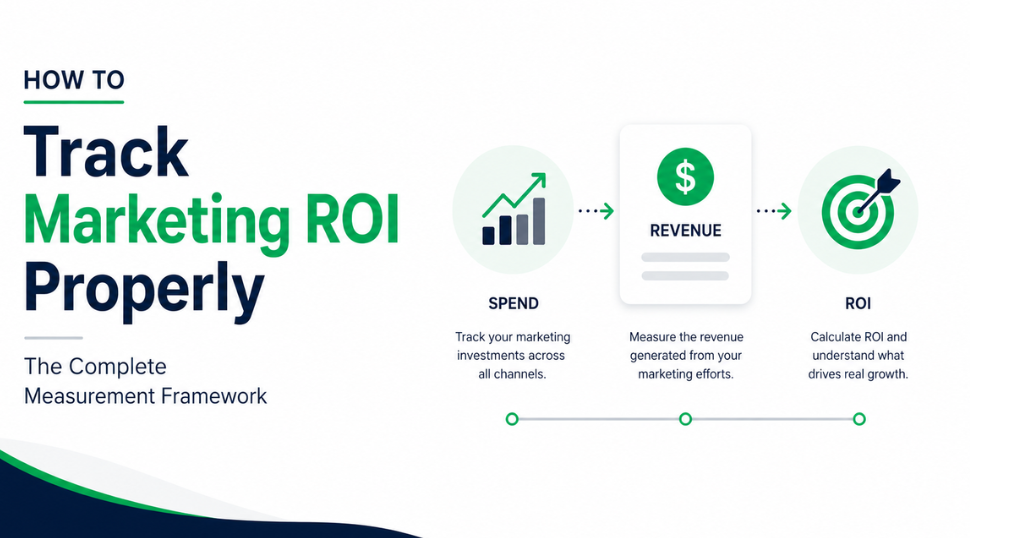
Tracking marketing ROI properly requires connecting every marketing touchpoint — ad click, email open, social media visit, organic search landing — to a specific revenue or pipeline outcome through a documented attribution system, not just monitoring platform-level vanity metrics that don’t connect to business results. The difference between a business that knows its marketing is working and one that hopes it is comes down to whether they’ve built this connection deliberately or left it to chance.
This guide walks through the complete marketing ROI measurement framework: what to measure, how to connect marketing activity to business outcomes, which attribution models apply to which business models, and how to build the technical infrastructure that makes accurate measurement possible. Whether you manage measurement internally or work with a performance marketing agency in Chennai, this is the system that turns marketing spend from a cost center into a demonstrably profitable investment.
Why Most Businesses Are Measuring Marketing ROI Wrong
The majority of businesses that report “marketing metrics” are reporting activity metrics — impressions, clicks, followers, open rates — and treating them as proxies for business impact. They’re not.
The evidence for this measurement gap is significant:
- According to Gartner’s 2024 CMO Survey, only 23% of marketing leaders say they can demonstrate the impact of marketing investment on business outcomes with clear evidence. 77% are measuring activity, not results.
- HubSpot’s State of Marketing 2024 found that 75% of marketers struggle to accurately measure the ROI of their marketing activities — despite the proliferation of analytics tools
- A Nielsen Advertising Intelligence study found that brands correctly attribute only 58% of their actual conversions to marketing — meaning the remaining 42% of sales influenced by marketing are being incorrectly attributed to other factors (direct traffic, organic search) or not attributed at all
- According to Forrester Research, companies with mature marketing measurement practices grow revenue 3.2x faster than companies with basic measurement — because they make better investment decisions based on accurate data
- Google’s Think with Google research found that 60% of conversions occur across multiple devices and sessions before completing — meaning single-touch attribution (which most basic setups use) misattributes the majority of conversions
The implication is direct: most businesses are making marketing investment decisions based on incomplete or misleading data, which means they’re both underinvesting in channels that work and overinvesting in channels that don’t.
A PPC agency in Chennai or digital marketing agency in Chennai that reports only on platform-level metrics — impressions, clicks, cost-per-click — without connecting those metrics to actual revenue is providing incomplete accountability. Proper ROI measurement is the standard that separates marketing partners who deliver accountability from those who deliver activity reports.
The Full Cost of Marketing (Most Commonly Understated)
| Cost Category | What to Include |
|---|---|
| Paid media spend | All ad platform spend (Google Ads, Meta Ads, LinkedIn Ads, etc.) |
| Agency fees | Management fees for any performance marketing agency or PPC agency in Chennai managing campaigns |
| Creative production | Design, video production, copywriting for ad creative |
| Tool subscriptions | CRM, email marketing platform, analytics tools, landing page builders |
| Internal team time | Hours spent by in-house marketers × their loaded hourly cost |
| Overhead allocation | A proportional share of fixed overhead attributed to marketing operations |
Most ROI calculations include only paid media spend and possibly agency fees—omitting creative costs, tool costs, and internal time. This produces an overstated ROI that can mislead investment decisions.
The 3-Level Marketing Measurement Framework
Effective marketing ROI tracking operates across three measurement levels simultaneously. Each level answers a different question, serves a different decision-making purpose, and requires a different data infrastructure.
Level 1: Activity Metrics (What We Did)
Activity metrics measure marketing execution — the volume and reach of marketing efforts. They are the easiest to measure and the least directly connected to business outcomes.
Activity metrics to track:
| Metric | What It Measures | Primary Use |
|---|---|---|
| Impressions | Total content views | Awareness reach assessment |
| Clicks / CTR | Engagement with links | Ad quality evaluation |
| Follower/subscriber growth | Audience building pace | Brand reach trajectory |
| Email open rate | Subject line effectiveness | Email health indicator |
| Content publish frequency | Execution consistency | Operational indicator |
Why they matter but aren’t sufficient: Activity metrics tell you what happened in your marketing channels. They do not tell you whether any of it affected revenue.
Level 2: Engagement Metrics (What Worked)
Engagement metrics measure audience response to marketing — whether content and messages resonated with the target audience.
| Metric | What It Measures | Primary Use |
|---|---|---|
| Engagement rate | Content resonance | Creative quality signal |
| Time on page / scroll depth | Content quality | SEO and content evaluation |
| Email click-to-open rate | Content relevance | Email content quality |
| Video completion rate | Content retention | Creative performance |
| Social media saves and shares | Content value signal | Top-performing content identification |
Level 3: Business Outcome Metrics (What It Generated)
This is where marketing ROI actually lives. Business outcome metrics connect marketing activity to revenue, pipeline, and customer acquisition.
| Metric | Formula | Why It Matters |
|---|---|---|
| Cost Per Lead (CPL) | Total marketing spend ÷ Total leads generated | Channel efficiency comparison |
| Marketing Qualified Lead (MQL) Rate | MQLs ÷ Total leads | Lead quality assessment |
| Customer Acquisition Cost (CAC) | Total marketing + sales cost ÷ New customers | Sustainability indicator |
| Marketing-Attributed Revenue | Revenue from customers acquired through marketing | Core ROI numerator |
| Customer Lifetime Value (LTV) | Average revenue per customer × Average customer lifespan | CAC viability context |
| LTV:CAC Ratio | LTV ÷ CAC | Marketing economics health |
| Marketing ROI | (Attributed revenue − Marketing cost) ÷ Marketing cost | Overall efficiency |
| Payback Period | CAC ÷ (Monthly revenue per customer) | Capital efficiency |
The LTV:CAC rule: A healthy business typically maintains an LTV:CAC ratio of 3:1 or higher — meaning each customer generates at least 3x what it cost to acquire them. Ratios below 3:1 indicate marketing economics that may not be sustainable; ratios above 5:1 may indicate underinvestment in growth.
Attribution Models: How to Correctly Assign Credit to Marketing Touchpoints
Attribution is the mechanism by which credit for a conversion is distributed across the marketing touchpoints that contributed to it. Choosing the wrong attribution model produces a systematically distorted view of which channels are actually driving revenue.The 6 Attribution Models Explained
Model 1: Last-Click Attribution 100% of conversion credit goes to the last marketing touchpoint before conversion.Example: A customer finds you via an organic blog post, follows on Instagram, clicks a Google Ad, and converts. Google Ads gets 100% credit.Problem: Systematically overvalues bottom-of-funnel channels (paid search, retargeting) and undervalues awareness and nurture channels (organic content, social media).Best for: Never recommended for businesses with multi-touch buyer journeys. Legacy default that most platforms still use.Model 2: First-Click Attribution 100% of conversion credit goes to the first marketing touchpoint.Example: Same customer. The organic blog post gets 100% credit.Problem: Overvalues top-of-funnel channels; ignores the role of channels that drove the final conversion decision.Best for: Understanding which channels generate initial awareness; never the sole model for ROI decisions.Model 3: Linear Attribution Credit divided equally across all touchpoints in the conversion path.Example: 4 touchpoints → 25% credit to each.Best for: A neutral starting point for businesses new to multi-touch attribution. Avoids the extremes of first/last click but oversimplifies the reality that some touchpoints matter more than others.Model 4: Time-Decay Attribution More credit given to touchpoints closer in time to the conversion; less to earlier touchpoints.Example: The Google Ad click (1 day before conversion) gets more credit than the blog post visit (30 days before conversion).Best for: Short sales cycles where recency is a meaningful signal of conversion influence. Less appropriate for long B2B sales cycles.Model 5: Position-Based (U-Shaped) Attribution 40% credit to the first touchpoint, 40% to the last touchpoint, 20% distributed equally among middle touchpoints.Best for: Businesses that believe both initial awareness (first touch) and final conversion drivers (last touch) deserve significant credit, with some acknowledgement of nurture touchpoints in between.Model 6: Data-Driven Attribution (DDA) Machine learning analyzes actual conversion path data to assign credit based on statistically observed contribution of each touchpoint.Best for: Businesses with sufficient conversion volume (Google requires a minimum of 3,000 conversions in 30 days for DDA to function). The most accurate model when volume requirements are met.Attribution model selection guide:| Business Type | Recommended Model | Rationale |
|---|---|---|
| E-commerce (short purchase cycle) | Data-Driven or Time-Decay | Recency matters; ML can be fed sufficient data |
| B2B services (long sales cycle) | Linear or Position-Based | Long journeys require balanced credit distribution |
| SaaS (freemium to paid) | Position-Based | First touch (trial signup) and last touch (upgrade) both matter |
| Local service business | Last-Click or First-Click | Simpler journeys; single session common |
| Content-led growth | First-Click + DDA combined | Understanding both discovery and conversion channels |
The Technical Infrastructure for Accurate ROI Tracking
A measurement framework is only as reliable as the technical infrastructure that feeds it with data. Many businesses have a measurement framework in theory but unreliable data in practice — because the tracking setup is incomplete, inconsistent, or broken.
Step 1: UTM Parameter Discipline
UTM (Urchin Tracking Module) parameters are tags appended to URLs that tell Google Analytics 4 exactly where a visitor came from. Without UTMs, traffic from your email campaigns, social media posts, and paid ads often appears as “direct traffic” or “organic” — making accurate attribution impossible.
The 5 UTM parameters:
| Parameter | What It Captures | Example |
|---|---|---|
| utm_source | The origin of the traffic | google, facebook, newsletter |
| utm_medium | The marketing channel type | cpc, email, organic_social |
| utm_campaign | The specific campaign name | q2_lead_gen_chennai |
| utm_content | The specific ad or content piece | blue_cta_banner, video_testimonial |
| utm_term | The specific keyword (for search) | ppc_agency_chennai |
UTM naming convention rules:
- Lowercase only — UTMs are case-sensitive; Facebook and facebook appear as two different sources
- Use underscores or hyphens (not spaces) — spaces encode as %20 and make analysis messy
- Be consistent — decide your naming conventions before the first campaign and document them
- Never use UTMs on internal links — internal UTM tagging resets session source and corrupts attribution data
Step 2: Google Analytics 4 Conversion Configuration
GA4 (Google Analytics 4) is the current standard for web analytics — and it requires deliberate configuration to track marketing ROI accurately.
Critical GA4 setup for ROI tracking:
Configure conversion events: In GA4, “conversions” must be explicitly configured — they don’t default to anything useful. Every business outcome that matters must be set up as a conversion event:
- Contact form submission
- Phone click (for mobile traffic)
- WhatsApp button click
- Thank-you page view (post-form)
- Product purchase (e-commerce)
- Demo booking confirmation
Enable Google Signals: Google Signals connects GA4 with Google’s advertising data, enabling cross-device tracking that captures multi-device journeys — essential for accurate attribution when users research on mobile and convert on desktop.
Configure attribution settings: In GA4’s Admin → Attribution Settings, set the attribution model to “Data-driven” (if eligible) or “Position-based.” The default “Last click” setting is the weakest option for businesses with any meaningful marketing mix.
Link all ad accounts: Connect GA4 to Google Ads, Meta Ads, LinkedIn Ads, and any other active ad platforms. This enables importing conversion data from GA4 back into ad platforms — which improves Smart Bidding performance and ensures all platforms are optimizing toward actual business outcomes, not just clicks.
Step 3: CRM Integration — Closing the Online-Offline Gap
For service businesses and B2B companies, the most important conversion often happens offline — in a phone call, a proposal meeting, or a contract signing. Web analytics alone cannot measure these conversions. CRM integration closes this gap.
The CRM lead attribution process:
- A visitor arrives on your website from a Google Ad (UTM: source=google, medium=cpc, campaign=ppc_management_chennai)
- They fill out a contact form → GA4 records the form submission as a conversion with the UTM data
- The form submission creates a lead record in your CRM (HubSpot, Salesforce, Pipedrive, Zoho) with the UTM data passed as lead source fields
- The lead progresses through your sales pipeline to “Closed Won” → CRM records the deal value
- Monthly: export CRM data to calculate total revenue from leads attributable to each UTM source/campaign
This process connects paid media spend to closed revenue — producing a true marketing ROI calculation rather than a cost-per-lead calculation that can’t be connected to business outcomes.
CRM lead source fields to configure:
- First touch source (what brought them first)
- Last touch source (what brought them on the final converting visit)
- Campaign name
- Ad group / keyword (for PPC traffic)
Step 4: Platform-Level Tracking Verification
Each advertising platform has its own conversion tracking that must be independently verified:
Google Ads Conversion Tracking:
- Import conversion actions from GA4 into Google Ads
- Alternatively, deploy the Google Ads conversion tag directly via Google Tag Manager
- Verify in Google Ads Tag Assistant that conversions are firing correctly
- Use Google’s “Conversion Action” report to confirm conversion types and values are recording
Meta Pixel and Conversions API:
- Standard Meta Pixel captures browser-side events
- Conversions API (CAPI) captures server-side events — critical post-iOS 14.5, which disrupted browser-based tracking
- Implement both for maximum signal coverage; Meta’s Event Match Quality score indicates data quality
- Verify in Events Manager that all intended events are firing without errors
Google Tag Manager: Centralizing all tracking tags in GTM eliminates the need for developer involvement in every tag update and provides a single audit point for all tracking implementation. Every GTM container should have:
- GA4 configuration tag
- All conversion event tags
- Meta Pixel base code and events
- LinkedIn Insight Tag (if running LinkedIn Ads)
- Any other platform tracking tags
Channel-Specific ROI Benchmarks
Understanding what good ROI looks like for each marketing channel gives context for interpreting your own measurement data.
ROI and Performance Benchmarks by Channel
| Channel | Average ROI | Industry Variance | Key ROI Driver |
|---|---|---|---|
| Email Marketing | 36:1 (₹36 per ₹1 spent) | Low — consistent across most industries | List quality, segmentation, offer |
| SEO / Organic Search | Difficult to isolate; typically 500–1,200% over 12+ months | High — depends on competition and investment | Content quality, authority building |
| Google Search Ads | 2:1 to 8:1 ROAS (industry average ~3:1) | Very High — varies by industry and competition | Keyword targeting, quality score, landing page |
| Meta / Social Ads (B2C) | 2:1 to 6:1 ROAS | High — varies by creative quality | Creative quality, audience relevance |
| LinkedIn Ads (B2B) | Often negative in first 90 days; 3:1 to 10:1 over full funnel | Very High — high CPCs, long sales cycles | Audience targeting, content quality |
| Content Marketing | 3:1 to 6:1 over 12+ months | High — compounding over time | SEO integration, distribution, conversion optimization |
Source: Aggregate from Litmus (email), BrightEdge (SEO), WordStream (Google Ads), Smartly.io (social ads), HubSpot (content).
The important context: These benchmarks are long-run averages across large sample sizes. Individual campaign ROI varies enormously based on industry, offer quality, targeting precision, creative quality, and landing page performance. Use these benchmarks for directional orientation, not as pass/fail thresholds.
Building a Marketing ROI Dashboard
A marketing ROI dashboard consolidates all measurement data into a single view that enables regular, informed decisions — without requiring someone to manually pull data from five different platforms every week.
The Essential Dashboard Components
View 1: Revenue Attribution Summary
- Total marketing-attributed revenue (monthly and trailing 90 days)
- Revenue by channel (organic, paid search, paid social, email, direct)
- Marketing ROI by channel
- MoM and YoY comparisons
View 2: Lead Generation Funnel
- Total leads by source
- MQL rate by source (what % of leads from each source become marketing qualified?)
- SQL rate by source (what % progress to sales qualified?)
- Close rate by source
- CAC by source
View 3: Campaign-Level Performance
- Active campaigns with spend, CPL, and attributed revenue
- Creative performance (if running paid ads): top-performing ads by CTR and CVR
- Keyword performance (for search campaigns)
View 4: Channel Health Indicators
- Email: open rate trend, click rate trend, list growth rate, unsubscribe rate
- SEO: organic traffic trend, keyword ranking changes, backlink growth
- Paid: Quality Score trend (Google Ads), CPM trend (Meta Ads), ROAS trend
Dashboard tools:
| Tool | Best For | Price Range |
|---|---|---|
| Google Looker Studio | Connecting GA4, Google Ads, Google Search Console | Free |
| HubSpot Reporting | CRM + marketing attribution integration | Included with HubSpot |
| Supermetrics | Pulling data from multiple ad platforms into one view | ₹7,000–₹20,000/month |
| Databox | Pre-built dashboard templates, mobile-friendly | ₹5,000–₹15,000/month |
| Klipfolio | Flexible dashboard builder with API connections | ₹6,000–₹18,000/month |
How Weboin Tracks Marketing ROI for Clients
At Weboin, a specialist digital marketing company in Chennai offering performance marketing, PPC management, social media, and SEO services, marketing ROI measurement is not a reporting activity — it’s the foundation of every campaign decision we make.
Our ROI tracking infrastructure for every client engagement:
Week 1 — Tracking Audit: Before launching any campaign or creating any content, we audit the existing tracking infrastructure: GA4 setup (conversion configuration, data streams, attribution settings), UTM naming conventions and consistency, CRM lead source field configuration, and ad platform tracking (pixel status, conversion import, tag verification). This audit typically reveals 3–7 tracking gaps that are creating measurement blind spots.
Week 2 — Infrastructure Build: We implement the complete tracking stack: UTM convention documentation, GA4 conversion events for all meaningful business actions, Conversions API setup for Meta campaigns, CRM integration with lead source tracking, and Google Tag Manager organization for all tags.
Monthly Reporting: Every Weboin client receives a monthly ROI report covering: total marketing spend by channel, total attributed leads and revenue by channel, CPL and CAC by channel, MQL rate by source, active campaign performance vs. targets, and a clear statement of which channels are generating positive ROI and what the next optimization priority is.
For clients working with Weboin as their PPC agency in Chennai, this reporting directly connects every rupee of Google Ads spend to revenue outcomes — with the specific campaigns, ad groups, keywords, and creative elements that drove those outcomes identified and optimized continuously.
As a full-service digital marketing agency in Chennai, Weboin’s measurement practice ensures that clients can answer the question “Is our marketing working?” with specific evidence rather than assumption.
Common Marketing ROI Tracking Mistakes
Mistake 1: Measuring Only Last-Click Attribution Last-click attribution is the default in most platforms and the most systematically misleading model for businesses with multi-touch buyer journeys. It will consistently make content, SEO, and social media look worthless while making Google Search Ads and retargeting look like geniuses — because those channels almost always appear as the last touch before conversion.
Mistake 2: Excluding Agency and Creative Costs from ROI Calculations Reporting “Google Ads ROI” based only on ad spend — without including agency management fees, creative production costs, and tool subscriptions — produces an inflated ROI figure that doesn’t reflect the true economics of the marketing investment.
Mistake 3: Measuring the Wrong Timeframe B2B deals that close in month 4 after marketing touchpoints in months 1–3 won’t appear in a 30-day ROI calculation. Extending the attribution window to 90 days (or the full average sales cycle length) produces a more accurate picture of marketing’s revenue contribution.
Mistake 4: Trusting Platform-Reported Conversions Without Cross-Referencing Every ad platform (Google Ads, Meta, LinkedIn) reports its own conversions — and they always look better than reality, because each platform takes credit for every conversion that it touched, regardless of whether another platform also touched it. Cross-referencing platform-reported conversions with GA4 and CRM data reveals the actual (always lower) number.
Mistake 5: Not Tracking Offline Conversions For service businesses and B2B companies, a significant proportion of revenue closes offline. Marketing that drove the initial contact — a Google Ad, an organic blog post, a LinkedIn content piece — gets zero credit in an analytics-only measurement system. CRM integration with online lead source tracking is the essential fix.
A 30-Day Marketing ROI Tracking Implementation Plan
Days 1–7: Audit
- Document all active marketing channels and their current reporting setup
- Audit GA4: check conversion events, attribution model, data stream health
- Audit ad platforms: verify pixel/tag status, conversion tracking, campaign structure
- Interview sales team: understand the offline portion of the customer journey that analytics doesn’t capture
- Identify the 3 biggest tracking gaps
Days 8–14: Infrastructure
- Create and document UTM naming convention (source/medium/campaign taxonomy)
- Fix all identified GA4 conversion tracking gaps
- Configure CRM lead source fields and import process from web forms
- Implement Google Tag Manager container (if not existing)
- Deploy Meta Conversions API (if running Meta campaigns)
Days 15–21: Attribution and Dashboard
- Update GA4 attribution model to Position-Based or Data-Driven
- Link all ad accounts to GA4
- Import GA4 conversions into Google Ads for Smart Bidding optimization
- Build a basic Looker Studio dashboard with Level 3 business outcome metrics
- Define the monthly ROI reporting template
Days 22–30: Baseline and Calibration
- Pull baseline data: CPL, CAC, and attributed revenue by channel for the last 90 days using the new attribution model
- Compare against previous reporting — note discrepancies and investigate causes
- Document the “source of truth” for each metric (which tool, which report, which date range)
- Brief all stakeholders (internal team, agency partners) on the new measurement framework and reporting schedule
Frequently Asked Questions About Tracking Marketing ROI
Marketing ROI measures the financial return generated by marketing investment relative to the cost of that investment. Formula: (Revenue attributed to marketing − Total cost of marketing) ÷ Total cost of marketing × 100. A result of 300% means every ₹1 invested in marketing returned ₹4 (the original ₹1 plus ₹3 profit).
For most businesses, Position-Based (U-Shaped) attribution is a good starting point — it gives meaningful credit to both the channels that create awareness (first touch) and those that drive conversion (last touch), while acknowledging nurture touchpoints in between. Data-Driven attribution is the most accurate but requires minimum 3,000 monthly conversions. Avoid Last-Click attribution for any business with multi-touch buyer journeys.
Use UTM parameters on every social media link (in bio, Stories links, post links where clickable). In GA4, create a custom channel grouping for social media and track which social sessions lead to form submissions or conversions. Note that organic social often influences decisions without generating a direct tracked session — supplement quantitative tracking with periodic audience surveys ("How did you first hear about us?").
For paid search, 30–60 days provides sufficient data for reliable conclusions. For content and SEO, measure trailing 6–12 months to capture the full compounding effect. For email marketing, measure at the campaign level (each send) and the program level (trailing 90 days). Short measurement windows overweight recent activity and underweight foundational investments.
Each platform attributes conversions to itself when that platform appeared anywhere in the conversion path. This is called "over-attribution" — the sum of all platform-reported conversions will typically exceed the actual number of conversions by 30–100%. Use GA4 or your CRM as the neutral attribution source; treat platform-reported conversions as channel-specific performance indicators, not as the definitive revenue figure.
Final Thought: Measurement Is a Competitive Advantage
Businesses that measure marketing ROI accurately make better investment decisions than those that don’t. They scale what works faster. They stop what doesn’t work sooner. They negotiate with agencies from a position of evidence rather than opinion. And they compound their marketing advantage over time — because each measurement cycle produces data that makes the next cycle more effective.
The measurement infrastructure described in this guide — UTM discipline, GA4 configuration, CRM integration, attribution model selection, and dashboard reporting — requires meaningful upfront investment to build. But it pays back in every subsequent marketing decision that’s made with confidence rather than guesswork.
The question “Is our marketing working?” should always have a specific, evidence-based answer. Building the system that provides that answer is not a technical project — it’s a strategic investment in the decision-making quality that determines whether your marketing budget compounds into competitive advantage or evaporates into reporting that sounds good but doesn’t mean anything.
Whether you build that measurement system internally or with a specialist digital marketing company in Chennai like Weboin, the framework in this guide gives you the complete architecture — from formula to attribution model to technical infrastructure to dashboard design — for marketing measurement that actually produces accountability.
About Weboin: Weboin is a full-service digital marketing agency in Chennai offering performance marketing, PPC management, SEO, social media strategy, and comprehensive marketing analytics. As a trusted performance marketing agency in Chennai and PPC agency in Chennai, Weboin builds complete marketing measurement infrastructure for every client — ensuring that every rupee of marketing investment is tracked to a business outcome.

No comment yet, add your voice below!