
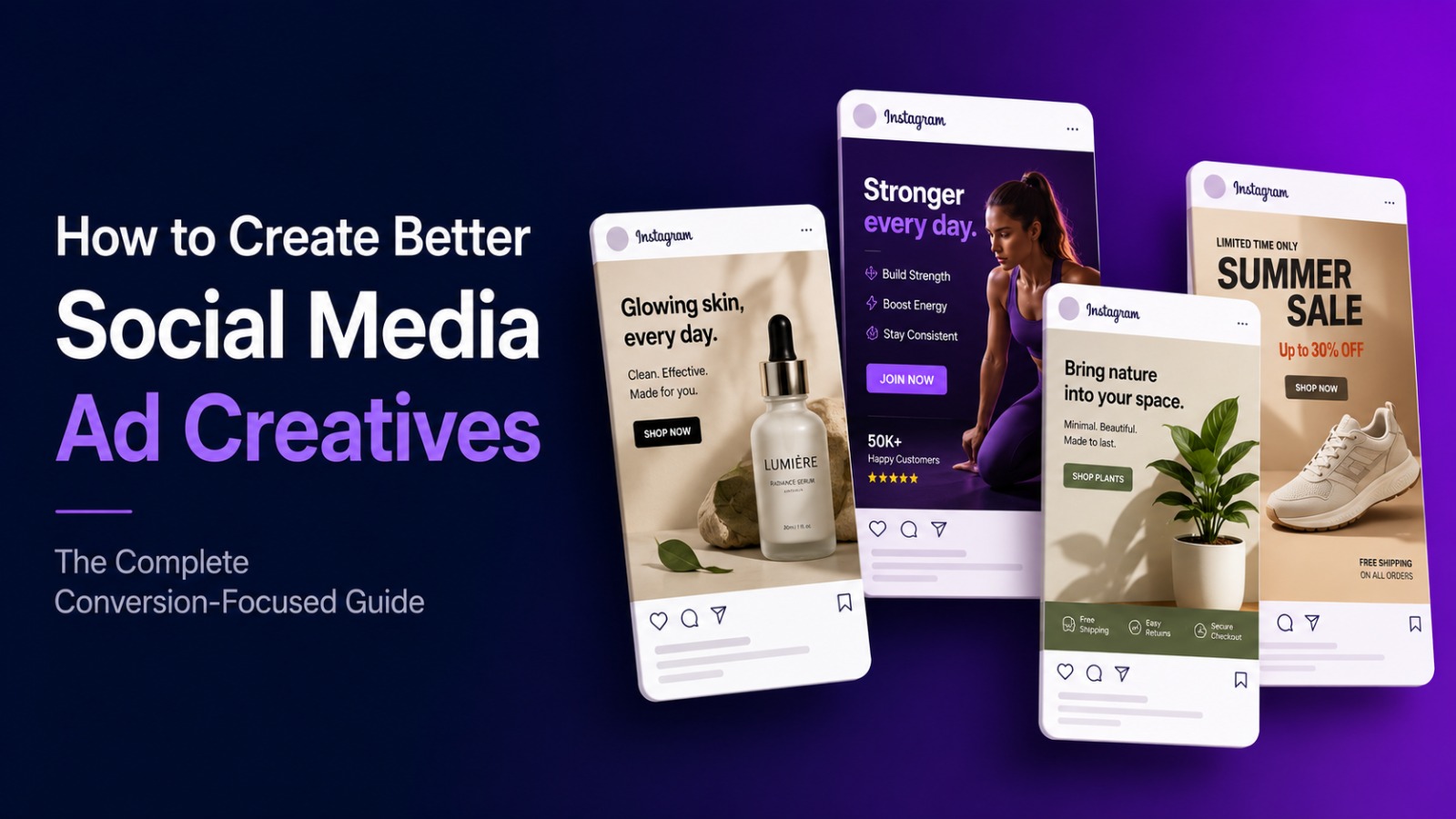
Better social media ad creatives are built on one principle: the first 1.5 seconds must earn the next 15 — through a visual or verbal hook that stops scrolling by triggering curiosity, recognition, or a strong emotional response in the specific audience you’re targeting. Everything else — copy, offer, design, CTA — matters significantly, but it only matters if the hook works, because an ad that isn’t watched isn’t an ad.
This guide builds the complete framework for creating ad creatives that perform — from understanding why certain visuals and copy formulas stop the scroll to the platform-specific production principles that maximize creative performance on Meta, Instagram, LinkedIn, and YouTube. Whether you manage creative production in-house or work with a social media marketing agency in Chennai, this is the operational guide for creatives that consistently convert.
Why Creative Quality Is Now the Primary Ad Performance Variable
The digital advertising landscape has shifted fundamentally over the past three years. Audience targeting — once the primary performance lever — has become increasingly automated. Meta’s Advantage+ targeting, Google’s Smart Bidding, and TikTok’s algorithm-driven delivery have commoditized much of what was once proprietary targeting skill.
What hasn’t been commoditized is creative. The intelligence required to build an ad concept that resonates with a specific audience, the craft to execute that concept in a format that earns attention, and the discipline to test systematically and learn from results — these remain distinctly human advantages.
The data confirms this shift unambiguously:
- According to a Nielsen Catalina Solutions meta-analysis of over 500 campaigns, creative quality accounts for 49% of sales impact in digital advertising — more than targeting, reach, recency, and brand combined
- A Meta-commissioned study found that top-performing creative generates 3–5x more revenue per impression than median creative — from the same audience and same budget
- Kantar’s 2024 Creative Effectiveness Report found that brands investing consistently in creative quality see 30–50% lower ad fatigue decay rates compared to brands running static, unrefreshed creatives
- According to Smartly.io’s 2024 State of Social Advertising report, advertisers running 5+ creative variants per ad set had 22% higher ROAS than those running 1–2 variants
- Meta’s internal data revealed that the first 1.5 seconds of a video ad determines whether a viewer watches the rest — making the creative opening the single most consequential decision in video ad production
These figures explain why a social media agency in Chennai managing performance campaigns in 2025 treats creative as the primary optimization variable — and why brands that invest in creative quality, testing, and iteration consistently outperform those that don’t, regardless of targeting sophistication.
The Creative Performance Framework: 4 Elements That Determine Ad Results
Before designing a single frame or writing a single line of copy, understand the four-element framework that every high-performing social ad creative fulfills:
Element 1: The Hook (Earn Attention)
The hook is the opening moment — the first image frame, the first spoken sentence, or the first text overlay that appears in the first 0–1.5 seconds of a video, or the primary visual in a static ad. The hook’s only job is to interrupt the scrolling pattern and earn the next few seconds of attention.
Hooks work by triggering one of five psychological responses:
| Hook Trigger | Psychological Mechanism | Example |
|---|---|---|
| Curiosity | Knowledge gap activation — the brain wants to close information gaps | “Most businesses are paying 40% more for leads than they need to. Here’s why.” |
| Recognition | Pattern match — the viewer sees themselves in the situation | “If you’re a Chennai business owner spending on ads with no results…” |
| Surprise | Cognitive interrupt — something unexpected breaks the scroll pattern | A counterintuitive visual or a statement that contradicts conventional wisdom |
| Desire | Aspiration activation — the viewer sees the outcome they want | Showing the “after state” before explaining how to get there |
| Fear/Loss | Loss aversion — potential loss is twice as motivating as equivalent gain | “Your competitors are capturing the customers your ads should be getting” |
Choosing the right hook trigger: Match the hook trigger to where your audience is in the buyer journey.
- Cold audiences (don’t know your brand): Curiosity and recognition hooks perform best
- Warm audiences (have interacted with your content): Desire and social proof hooks convert better
- Retargeting audiences (visited your site or started checkout): Loss aversion and urgency hooks produce highest conversion
Element 2: The Value Delivery (Earn Trust)
After the hook earns the first 1–3 seconds, the next 10–25 seconds must deliver genuine value — a useful insight, a compelling demonstration, a credible proof point, or an entertaining story beat. The value delivery is what makes the viewer feel that watching this ad was worth their time — even if they don’t convert immediately.
Ads that skip directly from hook to offer (hook → “sign up now!”) leave viewers feeling manipulated. Ads that invest in value delivery build the micro-trust that differentiates converting impressions from wasted ones.
Value delivery formats that build trust:
- The insight reveal: Share one genuinely useful piece of information your target audience didn’t know
- The before-after: Show a specific, documented transformation with real numbers
- The live demonstration: Show the product or service working in real time, in a real context
- The social validation: Let a real customer describe their experience in their own words
- The expert perspective: Share a counterintuitive professional observation that reframes how the viewer thinks about the problem
Element 3: The Offer (Create Desire)
The offer is what you’re asking the viewer to consider — the product, service, or next step you want them to take. Most ads fail not because the offer is bad, but because it’s presented too early (before trust is established), too vaguely (the viewer doesn’t know what they’re getting), or too aggressively (the ask doesn’t match the relationship depth).
High-converting offer presentation:
- State what the viewer receives, not what they do: “Get a free campaign audit” not “Fill out the form below”
- Make the value specific: “In 30 minutes, we’ll identify exactly where your ad budget is being wasted” not “Schedule a consultation”
- Risk-reverse where possible: “No obligation. No sales pitch. Just analysis.” removes the primary psychological barrier to a commitment
Element 4: The CTA (Remove Friction)
The call to action is the mechanism by which viewer intent becomes measurable action. Even highly interested viewers abandon if the CTA is unclear, asks for too much, or creates confusion about what happens next.
CTA effectiveness rules:
- One CTA per ad — never multiple competing asks
- Start with a verb: “Get,” “Book,” “Download,” “Start,” “Watch”
- State the next step precisely: “Book a free 30-minute call” is better than “Contact us”
- Match the CTA to funnel stage: Cold traffic CTAs should be lower commitment (free resource, free trial) than retargeting CTAs (book a call, buy now)
Platform-Specific Creative Principles: The Context Changes Everything
The same creative concept executed for Instagram Reels and LinkedIn simultaneously will underperform on both platforms — because the content culture, audience mindset, algorithm preferences, and technical requirements are fundamentally different. Platform-specific creative decisions are not optional optimizations; they are the baseline for competitive performance.Meta Ads (Facebook and Instagram): The Attention Economy
Meta’s ad environment is the most competitive creative landscape in digital advertising — billions of impressions delivered daily to audiences trained to scroll past anything that feels like advertising.Meta creative performance principles for 2025:Native-feeling creative outperforms polished advertising: Meta’s algorithm rewards content that generates organic-feeling engagement. Ads that look and feel like organic social content — phone-filmed, unscripted, conversational — consistently outperform studio-produced advertising creative for most categories. This is the UGC (user-generated content) principle: authenticity signals trust, and trust converts.Vertical format is non-negotiable: With 70%+ of Meta feed traffic on mobile, 9:16 vertical format fills the screen and generates significantly higher engagement than 1:1 or 16:9 formats. According to Meta’s own data, vertical video ads generate 27% higher brand lift than square or horizontal video.Text overlay drives comprehension for silent viewers: 60–80% of Meta video ads are watched with sound off. Subtitles and text overlays that communicate the key message independently of audio are not optional — they determine whether the majority of your video audience understands your ad.The 3-second frame rule: The first frame of a Meta Reel or video ad must be visually compelling without motion — because the feed displays the first frame before the video autoplays. Design the opening frame as a standalone image that would stop the scroll even if the video never played.Meta creative testing framework:| Test Variable | What to Test | Minimum Sample for Decision |
|---|---|---|
| Hook format | Text hook vs. visual hook vs. voice hook | 500 impressions per variant |
| Length | 15s vs. 30s vs. 60s | 1,000 impressions per variant |
| Offer framing | Benefit-led vs. social proof-led vs. urgency-led | 2,000 impressions per variant |
| CTA | “Learn More” vs. “Book Now” vs. “Get Free Audit” | 500 impressions per variant |
| Creative style | UGC vs. polished production | 3,000 impressions per variant |
Instagram Reels Ads: The Scroll-Stop Competition
Instagram Reels is the highest-organic-reach format on the platform — and the highest-reach format for paid ads when creative quality is sufficient to earn algorithmic distribution alongside the paid push.
Reels ad creative specifics:
Aspect ratio: 9:16 exclusively. Content not in 9:16 is letterboxed and immediately recognizable as an ad rather than native content.
Safe zone for text and UI: The bottom 250px of a Reels frame is covered by the native Reels UI (username, caption, audio credit). Design all critical text and CTA elements to appear in the upper 80% of the frame.
Audio strategy: Trending audio on Reels gives organic distribution boosts — and the same principle partly applies to ads. Creating an ad that uses or references trending audio makes the ad feel like native Reels content to the algorithm and the viewer simultaneously. Even for primarily voice-driven ads, adding trending background audio at low volume improves the native feel.
Pacing: Reels audiences expect faster pacing than other video formats. The average cut rate for high-performing Reels is every 2–4 seconds. Longer static shots signal “this is an ad” to experienced Reels viewers, triggering the swipe.
LinkedIn Ads: Credibility-Led Creative for Professional Audiences
LinkedIn’s advertising environment is fundamentally different from Meta and Instagram. Users are in a professional mindset — they’re not passively entertaining themselves; they’re actively engaged with professional development, industry news, and business-relevant content. Creative that earns attention in this context must deliver professional value, not just interruption.
LinkedIn creative performance principles:
Lead with a specific insight, not a product pitch: LinkedIn users are among the most ad-literate audiences in digital media. They recognize promotional framing immediately and scroll past it. Ads that open with a genuine professional insight — a specific data point, a counterintuitive observation, a common mistake in their industry — earn the professional attention that product pitches don’t.
Founder or executive-led creative outperforms brand creative: LinkedIn’s algorithm already rewards individual content over company page content in organic distribution. The same principle applies to paid: ads featuring a real person (founder, executive, client) speaking to camera perform significantly better than brand-logo-led advertising creative.
Document ads (carousel/PDF format) are underused and high-performing: LinkedIn document ads — which display as slideable multi-page documents in the feed — generate significantly higher engagement than single-image or video ads for B2B audiences, because they provide immediate, swipeable value that professional audiences find genuinely useful.
Longer copy performs on LinkedIn: Unlike Meta, where copy should be concise, LinkedIn users read. Posts and ads with 150–300 words of substantive copy generate higher engagement than brief captions. The first sentence (always visible before the “See more” truncation) must earn the expand — use a specific, surprising, or professionally relevant opening.
YouTube Ads: The 5-Second Decision Point
YouTube’s skippable TrueView ad format gives viewers the power to skip after 5 seconds. This creates the clearest possible creative brief: earn enough attention in 5 seconds that the viewer doesn’t skip, then convert their attention into intent.
YouTube creative structure:
The first 5 seconds — the skip decision: The first 5 seconds must achieve one of two outcomes: create a curiosity gap that the viewer wants resolved, or establish enough relevance that the viewer believes the next 25 seconds will be valuable to them specifically.
High-performing 5-second openers:
- A bold, specific claim: “Your Google Ads are costing you 40% more than they should”
- A direct challenge: “Most Chennai businesses running YouTube ads make this mistake”
- A pattern interrupt: Something unexpected that breaks the expectation of “ad coming”
- A compelling visual hook: Something visually distinctive that earns an additional second of attention
The 5–30 second retention window: After the skip option disappears (or the viewer chooses not to skip), you have approximately 30 seconds to deliver enough value and momentum to reach the CTA without losing the viewer. Structure: value delivery → social proof → offer → CTA. The value delivery segment (seconds 5–20) is what determines whether viewers reach the CTA.
Non-skippable bumper ads (6 seconds): Bumper ads require a completely different creative approach — the entire message must land in 6 seconds, which means:
- One specific claim or brand impression (not a full pitch)
- High visual impact — the image carries meaning
- Simple verbal message: one benefit, one brand name, one CTA
- Often most effective as retargeting impressions for audiences already familiar with the brand
The UGC Creative Strategy: Why Authentic Outperforms Polished
UGC (user-generated content) style ads — designed to look like organic content created by real users rather than brand-produced advertising — have become the highest-performing creative format for most consumer-facing brands on Meta, Instagram, and TikTok.
The psychology is straightforward: audiences have developed sophisticated “ad detection” filters from years of exposure to brand advertising. When content bypasses these filters by appearing organic, it achieves trust levels that polished advertising cannot match.
According to TINT’s 2024 UGC and Advertising Report, UGC-style creative generates:
- 4x higher click-through rates than brand-produced creative on social platforms
- 50% lower cost per click due to higher engagement rates improving algorithmic favorability
- 29% higher conversion rates for e-commerce ads specifically
How to Create Effective UGC-Style Creative
Authentic UGC (from real customers): The most credible UGC is genuinely from customers — captured with their permission and used in paid campaigns. The process:
- Identify your best customers — high NPS scores, repeat purchasers, vocal advocates
- Ask them to film a 60–90 second honest review using their phone, in their natural environment
- Provide simple guidance: “Tell us your situation before you tried [product/service], what changed, and what you’d tell someone considering it”
- Use the raw footage — don’t over-edit. Remove only the technically unusable sections.
The resulting creative requires virtually zero production investment and consistently outperforms expensive studio-produced alternatives.
Produced UGC style (from your team or creator partners): For brands without sufficient authentic UGC, “UGC-style” creative can be produced intentionally:
- Film on a smartphone (not a professional camera) — the lower production quality is the point
- Film in real environments — a real home, a real office, a real street — not a studio
- Use natural lighting — window light, not studio lights
- Feature a real person speaking naturally, with occasional hesitation and imperfect framing
- Avoid branded lower-thirds, professional transitions, or logo animations until the final seconds
The result looks organic. The algorithm treats it like organic content. And audiences respond with the trust they reserve for peer recommendations.
Copy That Converts: The Ad Copywriting Principles Behind High-Performance Creatives
Great creative without effective copy is a beautiful ad that doesn’t sell. Copy in social ad creatives operates differently from website copy or email copy — because it must work at advertising speed, competing with everything else in the feed.
The Copy Formula Framework
Formula 1: PAS (Problem → Agitate → Solution) The most reliable direct response copywriting structure, applied to ad copy:
PROBLEM: Name the specific frustration your audience feels
AGITATE: Deepen the emotional cost of that frustration
SOLUTION: Present your offer as the obvious resolution
Example:
Your Google Ads are running. But most clicks aren’t converting. Every day that continues, you’re paying for traffic that funds your competitors. Weboin’s free campaign audit identifies exactly where budget is being wasted — and what to do instead.
Formula 2: BAB (Before → After → Bridge) Particularly effective for service businesses and transformation-based products:
BEFORE: The current painful reality
AFTER: The desired future state
BRIDGE: How your offer gets them from before to after
Example:
14 leads per month. ₹2.5L ad spend. 4-figure cost per acquisition. 47 leads per month. Same budget. Profitable scaling. That’s what a rebuilt campaign structure does. [Free audit link]
Formula 3: The Specificity Principle Specificity is not a formula — it’s the principle that makes every other formula work. Vague claims are ignored; specific claims are believed.
| Vague Copy (Ignored) | Specific Copy (Believed) |
|---|---|
| “We help businesses grow” | “We reduced CAC by 38% for 3 Chennai retail brands in Q1 2024” |
| “Our clients see great results” | “Average ROAS improvement of 2.8x within 90 days of campaign rebuild” |
| “Professional digital marketing” | “12 years. ₹50 crore+ in managed ad spend. 200+ Chennai brands served” |
| “Fast delivery available” | “Delivered within 24 hours across Chennai — or your next order is free” |
| “Trusted by businesses” | “Trusted by 400+ businesses across Tamil Nadu” |
Specificity isn’t about fabricating impressive numbers. It’s about choosing the most precise, verifiable expression of the genuine value you deliver — and trusting that precision is more persuasive than enthusiasm.
Headline and Primary Text Structure
Headline (for Meta/Instagram ads): 30 characters visible before truncation on mobile. The headline must:
- Start with the primary benefit or hook
- Include a keyword or phrase your audience would recognize
- Create enough curiosity or value to earn the body copy read
Primary text (caption/body copy): The first 125 characters are visible before “See more” truncation on Meta. The first line must stand alone as a compelling enough reason to expand. Structure:
Line 1 (Hook — visible before “See more”): [Strongest claim or question]
Line 2-3 (Value delivery): [Specific proof or elaboration]
Line 4 (Offer): [What they get and how to get it]
Line 5 (CTA): [Single, clear next step]
Line breaks are strategic, not aesthetic: Each line break in Facebook/Instagram ad copy creates a visual pause that the eye reads as a new thought. Short lines with deliberate breaks are significantly more readable in a feed environment than dense paragraph blocks.
Visual Design Principles for Social Ad Creatives
Strong concept and copy aside, the visual execution of a social ad creative determines whether it earns attention before any words are read. These are the design principles that consistently separate high-performing creatives from forgettable ones.The Visual Hierarchy Framework for Ad Design
Visual hierarchy in ad creative is the deliberate ordering of elements so the viewer’s eye travels through the ad in the sequence that maximizes both comprehension and persuasion.The optimal visual hierarchy for a static ad:- Primary visual (takes 70–75% of the frame): The hero element — either a product, a person, or a scene that immediately communicates the ad’s core message
- Headline text (10–15% of frame): Short, high-contrast, and placed in the natural scan path (upper-left for Western audiences, center for visual-first ads)
- Supporting copy or social proof (5–10%): A benefit statement, rating, or proof element — smaller, positioned below or beside the headline
- CTA/brand element (5–10%): The action directive and brand identification — typically bottom-right or bottom-center
- Avoid colors that blend with Facebook’s blue-and-white interface or Instagram’s generally muted aesthetic
- Use contrasting accent colors for CTA elements — the highest-contrast element draws the most attention
- Test bright, saturated backgrounds against pastel or neutral ones — the former typically generates higher initial attention; the latter can generate higher trust
The Design Mistakes That Kill Creative Performance
| Design Mistake | Why It Hurts Performance | Solution |
|---|---|---|
| Too much text in the frame | Cluttered visuals trigger “this is an ad” recognition and scroll | Limit to one key phrase or stat as text overlay |
| Logo placement as the first element | Logos activate “ad filter” — viewers skip before reading | Lead with hook visual; add logo in final seconds for video |
| Low-contrast text on busy backgrounds | Unreadable text is unread copy | Use solid color bars or text shadow for overlay readability |
| Inconsistent brand colors across variants | Visual inconsistency reduces cumulative recognition | Define a narrow color palette for all ad creative |
| Landscape format for mobile-first platforms | Letterboxed content loses 50%+ of screen real estate | Default to 9:16 for Meta/Instagram/TikTok; 1:1 for feed |
| Stock photography with generic people | Generic visuals reduce trust and distinctiveness | Use real team, client, or product photography |
| Headline too long for mobile reading | Long headlines are scanned, not read | Target 5–7 words for maximum mobile headline impact |
The Creative Testing System: From Hypothesis to Scale
The difference between a creative team that produces good ads and one that produces consistently great ads is not talent — it’s a testing system. Systematic creative testing turns every ad performance data point into a learning that informs the next creative, compounding quality improvements over time.
The Creative Testing Hierarchy
Test creative elements in order of impact potential. Higher-impact tests take priority because they generate bigger performance differences, providing clearer learnings:
Level 1: Concept Tests (Highest Impact — up to 200% CVR difference) Test fundamentally different creative angles — different hooks, different emotional appeals, different stories. This level of testing answers: “Which strategic approach resonates most with this audience?”
Example concept test:
- Concept A: Problem-led (“Your ads are wasting budget”)
- Concept B: Aspiration-led (“Here’s what 5x ROAS looks like for a business your size”)
- Concept C: Social proof-led (“How 3 Chennai brands reduced CPL by 40% in 60 days”)
Level 2: Format Tests (High Impact — 30–80% CVR difference) Test different creative formats for the same concept: UGC vs. polished production, video vs. static, carousel vs. single image. This level answers: “Which format executes this concept most effectively?”
Level 3: Hook Tests (High Impact — 20–50% CVR difference) Within a winning concept and format, test different hooks: different opening visuals, different opening lines, different initial text overlays. This level answers: “What specific entry point earns the most attention from our audience?”
Level 4: Copy and Design Tests (Medium Impact — 10–25% CVR difference) Test specific copy variations (headline wording, CTA text, body copy length), color treatments, and design layouts. This level refines execution after strategic direction is established.
Level 5: Audience-Creative Alignment Tests (Medium Impact — 15–35% CVR difference) Test the same creative against different audience segments — cold vs. warm vs. retargeting, different demographic segments, different interest clusters. This level answers: “Is there a specific audience segment where this creative significantly outperforms?”
Creative Learning Documentation
Every test produces a learning. A learning that isn’t documented is a learning that will be rediscovered at cost in a future campaign. Maintain a Creative Swipe File — a documented repository of:
- What was tested and when
- Performance metrics for each variant (CTR, CVR, ROAS, CPL)
- The specific learning: “Hook format X outperformed hook format Y with warm audiences but not with cold audiences”
- Application: “Future warm audience creatives should use [specific hook format]; future cold audience creatives should use [alternative]”
Over 6–12 months, this repository becomes a proprietary map of your specific audience’s psychology — expressed in performance data. It’s the asset that compounds: each future creative benefits from every previous test.
How Weboin Creates High-Performance Social Ad Creatives for Clients
At Weboin, a specialist digital marketing company in Chennai, social media ad creative is treated as both a strategic and a production discipline — requiring creative strategy, performance marketing expertise, and systematic testing to deliver results that compound over campaign cycles.
Our creative production process:
Phase 1 — Creative Strategy and Audience Intelligence Before producing a single creative, we research the specific audience through customer interview synthesis, competitor creative analysis (Meta Ad Library, TikTok Creative Center), and review mining from platforms like Google, Clutch, and Amazon. This research surfaces the specific language, fears, aspirations, and objections of the target audience — ensuring every hook and copy variant is grounded in how the audience actually thinks.
Phase 2 — Creative Concept Development We develop 3–5 distinct creative concepts per campaign, each based on a different hook trigger (curiosity, recognition, desire, social proof, loss aversion). Each concept specifies: the hook format, the value delivery approach, the offer framing, and the CTA. These are reviewed against the creative performance framework before production begins.
Phase 3 — Production at Multiple Quality Tiers We produce creatives at three quality tiers simultaneously: UGC-style (smartphone-filmed, authentic), standard production (professional but native-feeling), and polished production (high-quality brand-consistent). We test all three because which tier performs best varies by audience, product category, and funnel stage.
Phase 4 — Systematic Testing and Iteration Every new campaign launches with a minimum of 3 creative variants per ad set. We track performance weekly against the creative testing hierarchy — concept tests first, then format, then hook optimization. After each testing cycle, learnings are documented in the client’s Creative Swipe File and applied to the next production round.
As a full-service digital marketing agency in Chennai, Weboin ensures that creative performance compounds: each campaign cycle produces better creatives than the previous one, because each cycle generates documented learnings that inform the next.
Common Social Media Ad Creative Mistakes That Waste Budget
Mistake 1: Leading With the Brand Logo Opening a video ad with a logo animation is the fastest way to signal “advertisement” to an audience trained to skip ads. Lead with the hook — introduce the brand in the final 3–5 seconds when interest is established.
Mistake 2: One Creative for All Audiences A cold audience seeing your brand for the first time needs a different creative approach than a warm audience who has already engaged with your content. Using the same creative for both segments is a message mismatch that guarantees underperformance in at least one.
Mistake 3: Assuming Polished Is Better For most consumer categories on Meta and Instagram, polished studio production actively hurts performance because it triggers the “this is an ad” skip reflex. Test UGC-style creative against polished production before assuming more production investment equals better results.
Mistake 4: Long Hooks That Delay the Value “Hi, I’m [Name], and today I want to talk to you about something really important that I think you’ll find valuable…” is 10 seconds of viewer goodwill burned before a single useful thought is delivered. Hooks must be the first thing — not the preamble to the first thing.
Mistake 5: Changing Multiple Creative Variables Simultaneously If you change the hook, the offer, the visual treatment, and the copy in the same test, and performance improves, you have no idea which change drove the improvement. Test one variable at a time to generate learnable results.
Mistake 6: Running the Same Creative Until It Stops Working Ad fatigue — the diminishing returns of showing the same creative to the same audience repeatedly — is one of the most predictable performance killers in social advertising. Monitor frequency. When it exceeds 3–4 for a warm audience, refresh the creative before performance decline becomes severe.
Mistake 7: Ignoring Platform-Specific Format Requirements A 16:9 landscape video shown in an Instagram Reels placement is letterboxed into a fraction of the screen — immediately identifiable as an ad that doesn’t belong on the platform. Platform-native format is a prerequisite for competitive creative performance.
A 90-Day Social Ad Creative Improvement Roadmap
Days 1–30: Audit and Foundation
- Audit all current active ad creatives against the 4-element framework (hook, value delivery, offer, CTA)
- Install Meta Ad Library monitoring for top 5 competitors — document their strongest performing formats
- Conduct customer interview synthesis or review mining to document audience language
- Produce 3 new creatives using different hook triggers for your primary audience segment
- Establish Creative Swipe File documentation system
Days 31–60: Test and Learn
- Run first concept test: 3 creative variants per ad set with equal budgets
- Track daily metrics: hook rate (3-second video views / impressions), CTR, CPC, CPL
- Identify the winning concept at statistical significance (95% confidence, minimum 100 conversions per variant)
- Produce UGC-style variants of the winning concept
- Begin Level 2 format tests: UGC vs. polished production
Days 61–90: Scale and Optimize
- Scale winning creative variants and expand to secondary platforms
- Begin Level 3 hook tests on winning concept and format
- Produce retargeting-specific creatives for warm audiences (different angle from cold traffic creative)
- Review Creative Swipe File: document all learnings with specific performance data
- Build Month 4 creative brief based on accumulated learnings
Frequently Asked Questions About Social Media Ad Creatives
A good social media ad creative stops the scroll in the first 1.5 seconds with a relevant hook, delivers genuine value or a compelling story in the next 15–25 seconds, presents a specific and low-friction offer, and closes with a single clear CTA. Performance is measured by hook rate (retention past 3 seconds), CTR, and conversion rate — not by production quality or visual sophistication.
Start with a minimum of 3 creative variants per ad set — representing different hook approaches or conceptual angles. With sufficient budget (above ₹2,000/day per ad set), test up to 5–6 variants simultaneously. Testing fewer than 3 provides insufficient data for meaningful creative learnings; testing more than 6 dilutes impressions per variant and slows the learning cycle.
Not always. UGC-style creative consistently outperforms polished production for most D2C and consumer service categories on Meta and Instagram. For B2B, luxury brands, and professional services where credibility and quality are primary purchase drivers, higher production quality can outperform UGC. The answer is always in testing — not in assumption.
The most cost-effective high-performing creative format is authentic UGC from real customers — which requires only their time and permission. For produced creative, a modern smartphone + ring light + clip-on microphone (total under ₹5,000) enables production quality sufficient for high-performing social ads in most categories. The bottleneck is concept and hook quality, not production equipment.
Monitor frequency. When the frequency for a specific audience segment exceeds 3–4 (the same person has seen the ad 3–4 times), creative fatigue begins reducing performance. For high-spend campaigns, refresh creatives every 2–4 weeks. For lower-spend campaigns, monthly refreshes are typically sufficient.
A specialist social media agency in Chennai like Weboin provides the strategic frameworks, audience research, systematic testing infrastructure, and production capabilities that most in-house teams lack. Critically, agencies accumulate creative learnings across multiple clients and industries — building pattern recognition about what works for specific audience types and categories that individual brand teams rarely develop through their own limited testing history.
Final Thought: Creative Is the Compound Interest of Advertising
Every tested creative produces either a winner to scale or a learning to apply. Neither outcome is a failure — because even a creative that loses the A/B test adds a data point to your understanding of your audience’s psychology. Over time, that accumulated understanding translates into creatives that convert at rates that consistently outperform the competition.
The brands that dominate social advertising in 2025 are not spending more — they’re learning faster. They’re producing more creative variants, testing them with more discipline, documenting the results with more precision, and applying those learnings to the next production cycle with more consistency.
Creative quality isn’t an art form that some brands have and others don’t. It’s a system — and like all systems, it can be built, refined, and scaled.
Whether you’re building that creative system internally or partnering with a specialist social media marketing agency in Chennai like Weboin, the framework in this guide gives you the complete operational foundation — from hook psychology to testing hierarchy — to make your social ad creatives a genuine competitive advantage.
About Weboin: Weboin is a full-service digital marketing company in Chennai specializing in social media advertising, creative strategy, ad creative production, performance marketing, SEO, and brand building. As a trusted social media agency in Chennai, Weboin helps brands across industries build systematic social ad creative programs that generate consistent, compounding ROAS improvements through documented creative testing and audience intelligence.

No comment yet, add your voice below!