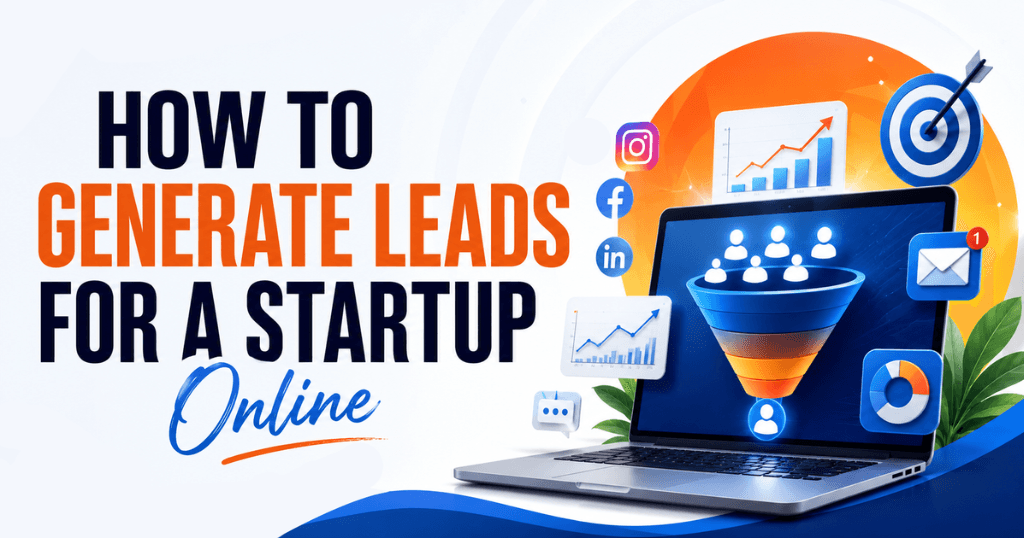
The most effective way for a startup to generate leads online is to combine one fast channel (paid ads or cold outreach) that delivers leads immediately with one compounding channel (SEO or content marketing) that builds sustainable lead flow over time. Relying on either in isolation — ads without content, or content without any paid amplification — leaves significant lead potential untapped and creates either a cost dependency or a growth ceiling.
This guide covers every proven online lead generation strategy available to startups, with specific guidance on what to prioritize based on budget, timeline, and business model. Whether you’re pre-revenue and bootstrapped or scaling with external funding, and whether you’re building in-house or working with a performance marketing agency in Chennai, this is the complete blueprint for generating startup leads online.
Why Lead Generation Is Different for Startups Than Established Businesses
Startups face a lead generation challenge that established businesses don’t: they need leads fast, but most high-volume channels take time to deliver. SEO takes months. Content marketing compounds slowly. Brand recognition starts at zero. Referrals don’t exist yet.
At the same time, startups typically have limited budgets, small teams, and an urgent need to validate whether their product or service actually converts. This creates a specific strategic requirement: test cheap, learn fast, and double down on what works.
The data on startup growth bears this out. According to a 2024 Salesforce State of Sales report, 79% of marketing leads never convert into sales — the primary reason being poor qualification and channel-audience mismatch. Startups that obsess over lead quality (not just volume) from the beginning build sales pipelines that actually close.
Additionally, HubSpot’s 2024 State of Marketing report found that companies with 10–15 landing pages generate 55% more leads than those with fewer than 10 — a finding particularly relevant for startups that often have a single homepage and no dedicated conversion architecture.
For startups working with or considering a digital marketing company in Chennai, the strategic question is always the same: which combination of channels, given our specific constraints, gets us to qualified leads at an acceptable cost fastest — and then scales?
The Lead Generation Hierarchy for Startups: Where to Start
Not all lead generation channels are created equal for startups. The right starting point depends on three variables: budget, timeline urgency, and whether you’re selling B2B or B2C.
The Startup Lead Generation Channel Matrix
| Channel | Speed to First Lead | Cost | Scalability | Best For |
|---|---|---|---|---|
| Cold Email / LinkedIn Outreach | 1–3 days | Very Low | Medium | B2B, high-ticket services |
| Google Search Ads (PPC) | 1–3 days | Medium–High | Very High | Any category with search demand |
| Meta Ads (Facebook/Instagram) | 1–3 days | Medium | Very High | B2C, visual products, services |
| SEO / Content Marketing | 3–12 months | Low–Medium | Very High | Long-term compounding growth |
| LinkedIn Ads | 1–3 days | High | High | B2B, enterprise, professional services |
| Referral Programs | 2–4 weeks | Low | Medium | Products with existing happy users |
| Email Marketing | Immediate (if list exists) | Very Low | High | Nurturing existing leads |
| Organic Social Media | 2–8 weeks | Low | Medium | Brand awareness + community |
| Product-Led Growth | Immediate (if product exists) | Low | Very High | SaaS, freemium products |
| Webinars / Events | 2–4 weeks | Medium | Medium | B2B, education, SaaS |
For a bootstrapped B2B startup (under ₹1L/month budget): Start with cold email outreach + LinkedIn content + SEO foundation. These three channels require time and skill, not budget.
For a funded B2C startup (₹2L–₹10L/month budget): Start with Meta Ads + Google Search Ads + landing page optimization. These channels generate leads within days and can scale quickly with data.
For a B2B SaaS startup: Cold outreach + Content SEO + Google Search Ads for bottom-of-funnel intent keywords. Add LinkedIn Ads once you have proof of conversion.
Strategy 1: Cold Outreach — The Fastest Lead Generation Channel for B2B Startups
Cold email and LinkedIn outreach is the most underrated lead generation channel for B2B startups. It requires no budget, delivers leads within days, and provides direct market feedback that no other channel matches. According to McKinsey, email is 40x more effective at acquiring new customers than Facebook or Twitter for B2B.
The reason most startups fail at cold outreach isn’t the channel — it’s the approach. Mass, generic cold emails (“Hi, I wanted to introduce our company…”) generate near-zero response. Personalized, value-led, research-backed outreach generates 5–15% positive response rates in most B2B categories.
The High-Response Cold Outreach Framework
Step 1: Define your Ideal Customer Profile (ICP) with precision
- Industry vertical
- Company size (employees and revenue range)
- Geography
- Job title of the decision-maker
- Signals of buying readiness (recent funding, hiring activity, new product launch, recent pain point expressed publicly)
Step 2: Build a targeted prospect list
- LinkedIn Sales Navigator: Filter by company size, industry, title, location, and posted activity. The most accurate B2B contact database available.
- Apollo.io: Contact database with email addresses and phone numbers, directly integrated with email sequencing
- Hunter.io: Find verified email addresses for any company domain
- LinkedIn itself (free): Connect requests + InMail for smaller outreach volumes
Step 3: Research each prospect before writing The single biggest differentiator in cold outreach is specificity. Before writing, find one specific, relevant thing about the prospect:
- A post they published on LinkedIn
- A recent company milestone (funding, expansion, award)
- A specific challenge their company/role faces
- A mutual connection or shared experience
Step 4: Write a personalized, short email The highest-converting cold email structure:
Subject: [Specific to their situation — not generic]
Opening line: [1 sentence referencing the specific thing you researched]
Value statement: [1–2 sentences on what you do and the outcome you deliver —
not features, outcomes]
Social proof: [1 specific result: “We helped [similar company type] achieve [result] in [timeframe]”]
Ask: [Low-friction CTA — not “Can we schedule a call?” but “Would it make
sense to send you a quick overview?”]
Signature
Length: Under 100 words. The longer the cold email, the lower the response rate.
Step 5: Follow-up sequence
- Email 1: Day 0 (initial outreach)
- Email 2: Day 3 (brief follow-up adding one new piece of value)
- Email 3: Day 7 (final “breakup” email — this often gets the highest response rate)
- LinkedIn message: Between emails 2 and 3
Tools for cold email at scale: Apollo.io, Instantly.ai, Lemlist, Smartlead.ai
LinkedIn Outreach for Startup Lead Generation
LinkedIn DM outreach follows the same personalization principles as cold email. The key differences:
- Response rates are typically higher on LinkedIn than email (10–25% for well-crafted messages)
- Connection requests with a note outperform cold messages sent via InMail
- LinkedIn content activity (publishing posts, commenting on prospects’ content) warms up outreach significantly — prospects who’ve seen your content before receiving a DM are 3–5x more likely to respond
Strategy 2: Google Search Ads — Capturing Buyers Who Are Already Looking
Google Search Ads is the highest-converting lead generation channel for startups with established search demand — because it intercepts buyers at the exact moment they’re searching for what you offer.
According to Google’s Economic Impact data, businesses make an average of $2 in revenue for every $1 spent on Google Ads. For high-intent B2B searches, the ROI can be significantly higher.
Why PPC Is Particularly Powerful for Startups
Paid search gives startups something organic channels can’t: immediate visibility. A startup with a DR of 5 and no existing SEO authority can appear at position 1 on Google for its target keywords on the same day it launches ads. For startups under time pressure to generate pipeline, this is invaluable.
A specialist PPC agency in Chennai running startup campaigns typically starts with a tightly defined keyword strategy — targeting high-intent, bottom-of-funnel queries — before expanding to broader terms as conversion data accumulates.
The Startup Google Ads Framework
Phase 1 — Foundation (Month 1)
Start with a small, tightly controlled campaign to generate initial conversion data:
- Campaign type: Search (not Performance Max — too little control for early-stage startups)
- Match type: Phrase match and exact match only — avoid broad match until you have conversion data
- Keywords: 10–20 high-intent keywords with clear buying intent (“hire [service],” “[service] agency,” “best [product] for [use case]”)
- Negative keywords: Build an aggressive negative keyword list from day one (common negatives: “free,” “DIY,” “jobs,” “salary,” “course,” “tutorial”)
- Budget: Start with ₹500–₹1,500/day — enough to generate 5–10 clicks per keyword per week
- Bidding: Manual CPC for first 2 weeks (to understand cost landscape) → then switch to Target CPA once you have 15+ conversions
Phase 2 — Optimization (Month 2)
- Review Search Terms report weekly — add irrelevant terms to negative keyword list
- Pause keywords with high spend and zero conversions
- Increase bids on high-converting keywords
- Test 2–3 headline variations per ad group
Phase 3 — Scale (Month 3+)
- Expand to RLSA (remarketing lists for search ads) — target people who’ve visited your website before
- Add broad match keywords now that you have negative keyword protection built up
- Test Performance Max campaigns alongside standard search campaigns
- Launch display remarketing to recapture visitors who didn’t convert
Key Google Ads metrics for startup lead generation:
| Metric | What It Tells You | Target Benchmark |
|---|---|---|
| CTR (Click-Through Rate) | Ad relevance and copy quality | Above 5% for search |
| Quality Score | Google’s rating of ad + keyword + landing page | 7+ (10 is maximum) |
| Cost Per Click (CPC) | Competitive efficiency | Industry-dependent; track trend not absolute |
| Conversion Rate | Landing page + offer quality | Above 3% for lead gen |
| Cost Per Lead (CPL) | Overall channel efficiency | Below your LTV/5 for sustainable economics |
| ROAS / ROI | Return on ad investment | Positive within 90 days for viable channel |
Strategy 3: Meta Ads — Scalable Lead Generation for B2C and Visual B2B
Meta’s advertising platform (Facebook and Instagram) is the highest-reach lead generation channel available to startups selling to consumers or to business owners who use social media actively. The platform’s targeting capabilities — interests, behaviors, lookalike audiences, and remarketing — allow startups to reach highly specific audiences at CPMs that Google Display cannot match.
According to WordStream’s 2024 benchmark data, the average conversion rate for lead generation on Facebook is 9.21% — significantly higher than most B2C channels. For startups with a clear offer and a well-designed landing page, Meta Ads can generate leads at costs that are difficult to match through any other paid channel.
Meta Ads Lead Generation Strategy for Startups
The Three-Campaign Structure for Startups:
Campaign 1 — Awareness (Cold Audience)
- Objective: Reach or Video Views
- Audience: Broad interest targeting or Lookalike (if you have data)
- Creative: Educational or entertaining content about the problem you solve
- Goal: Generate brand awareness and feed the remarketing pool
- Budget: 20% of Meta spend
Campaign 2 — Consideration (Warm Audience)
- Objective: Lead Generation or Traffic
- Audience: Engagement custom audiences (video viewers, Instagram engagers, website visitors)
- Creative: Proof-led content (testimonials, case studies, results)
- Goal: Convert awareness into contact information
- Budget: 50% of Meta spend
Campaign 3 — Conversion (Hot Audience)
- Objective: Lead Generation or Conversions
- Audience: Website visitors (last 30 days), engaged audience (last 7 days)
- Creative: Direct offer with strong CTA (free audit, demo, consultation)
- Goal: Maximize lead volume from high-intent audience
- Budget: 30% of Meta spend
Meta’s Native Lead Forms vs. Landing Page: Meta’s instant forms (lead gen ads that don’t require leaving the app) typically generate higher volume but lower quality leads. Sending traffic to a dedicated landing page generates lower volume but significantly higher intent. Test both for your specific offer — the right choice depends on your sales process.
Strategy 4: Content Marketing and SEO — The Compounding Lead Generation Engine
Content marketing and SEO are the channels that most startups deprioritize in year one because they don’t generate immediate leads. This is the mistake that creates lead generation fragility — complete dependence on paid channels that stop delivering the moment spend stops.
According to Demand Metric, content marketing generates 3x more leads than outbound marketing and costs 62% less. For startups with limited long-term budgets, this math is compelling — but only if you start building early enough for the compounding to matter.
How Content Marketing Generates Startup Leads
Content marketing generates leads through a process that looks slow at first and then accelerates:
- You publish high-quality content targeting keywords your potential customers search
- Content ranks in Google — generating consistent organic traffic
- Visitors find the content, get value from it, and enter your ecosystem (subscribe, follow, bookmark)
- A percentage of visitors convert — downloading a resource, requesting a demo, or contacting you
- Each ranking article compounds — generating leads month after month without additional investment
The key insight is that content marketing’s ROI is time-shifted: the investment is front-loaded (months 1–6), and the returns accumulate in months 6–24+.
The Startup Content Strategy Framework
Step 1: Keyword Research for Startup Lead Generation
Target three types of keywords, in this priority order:
- Bottom-of-funnel (BOFU): Keywords indicating buying intent (“best [solution] for [use case],” “hire [service] Chennai,” “[category] pricing”). Low volume but highest conversion — start here.
- Middle-of-funnel (MOFU): Comparison and evaluation keywords (“[option A] vs. [option B],” “alternatives to [competitor]”). These capture buyers in research mode.
- Top-of-funnel (TOFU): Educational queries (“how to [solve problem you address]”). High volume, longer conversion path — build after BOFU and MOFU are covered.
Step 2: Build Topic Clusters, Not Isolated Articles
A pillar page on a broad topic (e.g., “Complete Guide to [Your Category] for Startups in India”) supported by cluster articles on related subtopics builds topical authority that Google rewards with category-wide visibility.
Step 3: Optimize for Conversion, Not Just Traffic
Every piece of content should have:
- A lead magnet or content upgrade (a downloadable resource related to the article’s topic)
- An inline CTA connecting the content to your product/service
- A strong meta description and title tag that earns the click from the SERP
Content marketing tools for startups: Ahrefs or SEMrush (keyword research), Surfer SEO (content optimization), Google Search Console (performance monitoring), HubSpot (content + CRM), Notion (content calendar and brief management).
Strategy 5: Lead Magnets — Converting Traffic Into Qualified Leads
A lead magnet is a specific, valuable resource offered for free in exchange for contact information. It is the conversion mechanism between content traffic and leads — and one of the highest-leverage elements in any startup’s lead generation system.
According to Sumo’s analysis of 2 billion email popups, the average opt-in rate for lead magnets is 1.95% — but the top 10% of lead magnets achieve opt-in rates above 10%. The difference is entirely in the specificity and perceived value of the offer.
High-Converting Lead Magnet Formats for Startups
| Lead Magnet Type | Perceived Value | Conversion Rate | Best For |
|---|---|---|---|
| Free audit / assessment | Very High | Very High | Service businesses, agencies |
| Template or swipe file | High | High | SaaS, marketing, productivity |
| Mini-course (3–5 email series) | High | High | Education, complex products |
| Calculator / tool | Very High | Very High | Finance, marketing, operations |
| Case study / results report | High | Medium-High | B2B services, consulting |
| Checklist | Medium | High | Process-driven industries |
| Industry research report | High | Medium | B2B, thought leadership |
| Free trial / freemium | Very High | High | SaaS, software products |
| Webinar / workshop | High | Medium | Education, coaching, B2B |
| Demo / consultation | Very High | Medium | Enterprise B2B, high-ticket |
Lead Magnet Best Practices for Startups
- Be hyper-specific: “The Ultimate Marketing Guide” won’t convert. “The 5-Step Facebook Ads Checklist for Chennai D2C Brands Getting Under ₹200 CPL” will.
- Deliver immediate value: The lead magnet must be useful the moment they receive it — not a vague promise of value
- Match the magnet to the funnel stage: TOFU content → low-commitment magnet (checklist, template); BOFU content → high-intent magnet (audit, consultation)
- Gate strategically: Not everything needs a gate. Gating low-value content reduces trust; gating high-value resources generates qualified leads.
Strategy 6: Email Marketing — Nurturing Leads Into Customers
Email marketing is the highest-ROI digital marketing channel for converting leads into customers. According to Litmus’s 2024 State of Email report, email marketing generates an average ROI of ₹3,600 for every ₹100 spent — a 36x return that no other digital channel consistently matches.
For startups, email marketing serves two critical functions: converting leads who aren’t ready to buy immediately (most leads) and maintaining a relationship that brings them back when they are.
Building a Startup Email Marketing System
Step 1: Lead Capture Infrastructure
- Email service provider (ESP): Mailchimp (free up to 500 contacts), ConvertKit (creator-focused), HubSpot (free CRM + email), ActiveCampaign (advanced automation)
- Opt-in forms: Embedded in blog posts, pop-ups (timed or exit-intent), dedicated landing pages, lead magnet delivery pages
- Form placement: Top-performing placements — after content (“Did you find this helpful?”), mid-article, exit-intent pop-up, homepage hero section
Step 2: Welcome Sequence (Most Important Emails You’ll Write) The welcome email is the highest-opened email in any sequence — open rates of 50–80% are standard. Use it to:
- Deliver the lead magnet they signed up for
- Introduce your brand story and what makes you different
- Set expectations for what they’ll receive from you
- Include one soft CTA (read your best article, watch your intro video)
Welcome sequence structure:
- Email 1 (Day 0): Deliver the lead magnet + brand introduction
- Email 2 (Day 2): Your most valuable piece of content (best article, case study, or insight)
- Email 3 (Day 4): Social proof — client results, testimonials, or your most impressive outcome
- Email 4 (Day 7): Address the primary objection your prospects have
- Email 5 (Day 10): Direct offer — consultation, demo, or trial
Step 3: Ongoing Nurture After the welcome sequence, maintain consistent contact with a newsletter or regular email cadence. The goal: stay top-of-mind so you’re the first call when they’re ready to buy.
Email performance benchmarks for B2B startups:
- Open rate: Above 25% is strong (industry average: 21%)
- Click-through rate: Above 3% is strong (industry average: 2.5%)
- Unsubscribe rate: Below 0.5% per email
- Conversion rate from email to lead: 1–3% for nurture sequences; 3–10% for direct offer emails
Strategy 7: LinkedIn Organic — The B2B Lead Generation Channel Most Startups Ignore
LinkedIn organic content is one of the most underutilized lead generation channels for B2B startups. Unlike Instagram or TikTok where organic reach has declined sharply, LinkedIn’s algorithm still aggressively distributes content from individual accounts — particularly content that generates early engagement from connections.
According to LinkedIn’s own research, content published on LinkedIn reaches 6x more people through organic sharing than equivalent content on other platforms in a professional context. For a startup founder or senior team member with even 500 connections, a well-crafted LinkedIn post can regularly reach 5,000–50,000 professionals.
LinkedIn Content Strategy for Startup Lead Generation
What works on LinkedIn in 2025:
- Founder-led storytelling: Posts about the founder’s journey, challenges, learnings, and contrarian perspectives consistently outperform product-focused content
- Specific, data-backed insights: “We tried X. Here’s exactly what happened” — specificity and transparency drive engagement
- Process transparency: Behind-the-scenes content about how you work, decisions you make, and problems you solve builds trust at scale
- Short, formatted text posts: LinkedIn’s algorithm favors native text posts over link posts. Use line breaks generously. First line = your hook.
- Document carousels: Multi-slide PDF-style posts are LinkedIn’s equivalent of Instagram carousels — they keep users on the platform longer, which the algorithm rewards
LinkedIn lead generation funnel:
- Publish valuable content consistently (3–5x/week)
- Connection requests to ICPs who engage with your content
- Warm DM outreach to engaged connections (“I noticed you commented on my post about X — we help companies like yours with Y. Would it make sense to connect?”)
- Soft CTA in relevant posts (“I’ve written a guide on this — DM me ‘GUIDE’ and I’ll send it over”)
Strategy 8: Referral Programs and Community-Led Growth
Referrals are the highest-quality lead source available — because referred leads arrive with pre-existing trust. According to Nielsen, 92% of consumers trust recommendations from people they know more than any other form of marketing. Referred leads also convert at 3–5x the rate of cold leads and have significantly higher lifetime values.
For startups, building a referral system is often delayed until later — a mistake. Referral infrastructure is cheapest and easiest to build when you have 10–20 happy customers, before you need it urgently.
Building a Startup Referral System
Step 1: Identify your best existing customers (NPS promoters) Survey existing customers with a simple Net Promoter Score question: “On a scale of 0–10, how likely are you to recommend us to a colleague?” Anyone scoring 9–10 is a promoter — and the primary target for referral program activation.
Step 2: Create a referral mechanism
- For B2B: Direct ask (“We’re growing and looking for more clients like you. If you know anyone who’d benefit, we’d love an introduction. We’ll [offer incentive — discount, gift, cash, upgrade].”) — email-based, personal, high-conversion
- For B2C/SaaS: Built-in referral program (ReferralHero, Viral Loops, or custom-built) — shareable link, automated reward tracking, clear incentive
Step 3: Make the ask at the right moment The optimal referral ask moment is immediately after a success milestone — when a client achieves a result, when a customer finishes onboarding, or after a positive review or testimonial is given. This is when enthusiasm is highest and reciprocity is most active.
Strategy 9: Webinars and Virtual Events — High-Quality Lead Generation at Scale
Webinars generate some of the highest-quality leads of any digital channel because registration requires deliberate intent — no one accidentally signs up for a webinar. According to ON24’s 2024 Webinar Benchmark Report, the average webinar generates 400 registrations and 40% attendance — and 73% of B2B marketers say webinars are one of the most effective ways to generate high-quality leads.
The Startup Webinar Lead Generation Framework
Topic selection (most critical decision): Your webinar topic must solve a specific, urgent problem your ICP faces — not introduce your company. The rule: if someone would pay to attend this webinar, the topic is strong enough.
Examples:
- Weak: “How [Startup Name] Can Help Your Business Grow”
- Strong: “How Chennai D2C Brands Are Reducing CAC by 40% with Performance Marketing in 2025”
Promotion checklist:
- LinkedIn organic posts (3–4 posts in the 2 weeks before)
- Email to your existing list
- LinkedIn Ads to ICP targeting
- Partner promotion (co-host with a complementary brand to share audiences)
- Google Ads for the specific topic keyword
The webinar structure for lead conversion:
- 0–5 min: Set context and promise (what they’ll learn)
- 5–35 min: Deliver genuine value — teaching, not selling
- 35–45 min: Case study with specific results
- 45–55 min: Q&A (high engagement, extends attendance)
- 55–60 min: Offer (free audit, trial, consultation) — with urgency
Post-webinar lead nurturing:
- Immediate: Send recording to all registrants (captures non-attendees)
- Day 2: Send key takeaway email with the specific CTA from the webinar
- Day 5: Follow up with attendees who didn’t take the offer
- Day 14: “Late follow-up” for non-responders with a different angle
How Weboin Helps Startups Generate Leads Online
At Weboin, a specialist digital marketing agency in Chennai, startup lead generation is approached as a revenue engineering challenge — not a marketing activity. We work backwards from the startup’s growth targets and unit economics to design the lead generation system that achieves them most efficiently.
Our startup lead generation engagement typically includes:
Channel Audit and Strategy Design: We assess the startup’s current stage, budget, ICP, and competitive landscape, then design a channel stack that balances fast leads (paid/outreach) with compounding leads (SEO/content). Every channel recommendation is justified with benchmark data from comparable businesses.
Landing Page and Conversion Architecture: Before spending on paid channels, we build or optimize the landing page infrastructure — dedicated landing pages for each campaign, with message-matched copy, optimized forms, and conversion tracking fully set up in GA4 and the ad platforms.
Paid Campaign Management: Our team manages Google Ads and Meta Ads campaigns with a startup-specific approach: tight initial control (exact match keywords, narrow audiences), rapid iteration based on conversion data, and disciplined scaling of what works.
Content and SEO Foundation: While paid campaigns generate immediate leads, we simultaneously build the content infrastructure that will compound over 6–12 months — keyword research, content calendar, pillar pages, and on-page SEO — so the startup is not permanently dependent on paid spend.
Performance Reporting: Every engagement includes weekly reporting on CPL, conversion rate, channel-specific lead quality, and pipeline contribution. Startups see exactly where their leads are coming from and what they cost — enabling confident scaling decisions.
As a full-service digital marketing company in Chennai, Weboin has helped startups across SaaS, D2C, professional services, and B2B technology generate their first 100 leads, their first 1,000, and their first ₹1 crore in pipeline — through systems, not guesswork.
Lead Quality vs. Lead Volume: The Metric That Determines Startup Survival
Many startups optimize for lead volume — the number of contact forms submitted, the number of demo requests generated. This is a mistake. Lead quality — how likely a lead is to close into a paying customer — determines whether your unit economics work, not lead volume.
The lead quality framework for startups:
Define your ICP (Ideal Customer Profile) in detail:
- Company size, industry, geography
- Job title and decision-making authority
- Budget range and buying timeline
- Specific signals of readiness (trigger events)
Build lead scoring: Assign points to lead behaviors and attributes that correlate with closing:
- ICP match: +20 points
- Requested demo/consultation: +30 points
- Opened 3+ emails: +10 points
- Visited pricing page: +15 points
- Referred by existing customer: +40 points
Track lead source quality, not just volume:
| Lead Source | Lead Volume | Close Rate | Average Deal Size | CPL | Revenue per Lead |
|---|---|---|---|---|---|
| Google Search Ads | High | 12% | ₹50,000 | ₹2,000 | ₹6,000 |
| Cold Email | Medium | 18% | ₹75,000 | ₹300 | ₹13,500 |
| Referrals | Low | 35% | ₹90,000 | ₹500 | ₹31,500 |
| Content/SEO | Medium | 15% | ₹60,000 | ₹1,500 | ₹9,000 |
| Webinar | Low | 22% | ₹65,000 | ₹1,200 | ₹14,300 |
This analysis reveals that referrals, while generating fewer leads, produce 5x the revenue per lead of Google Ads. A startup optimizing purely for CPL would over-invest in ads and under-invest in referral development — a significant strategic error.
Common Lead Generation Mistakes Startups Make
Mistake 1: Launching Ads Before the Landing Page Is Ready Sending ad traffic to a homepage or an unoptimized page is burning money. A dedicated landing page with message-matched copy, a clear offer, and conversion tracking is the prerequisite for any paid campaign.
Mistake 2: Targeting Everyone “Our product is for everyone” is the fastest way to convert no one. Hyper-specific ICP targeting — especially for early-stage startups — generates smaller but infinitely higher-quality lead pools.
Mistake 3: No Follow-Up System According to HubSpot, 44% of salespeople give up after one follow-up — despite the fact that 80% of sales require 5+ follow-ups. The lead that doesn’t respond to the first email often closes on the fourth.
Mistake 4: Treating All Channels Equally Different channels serve different funnel stages and different buyer psychology. A startup that runs the same message on cold email, Google Ads, and content will underperform all three. Each channel requires channel-specific strategy.
Mistake 5: No Lead Attribution If you don’t know which channels are generating your best leads, you can’t make intelligent investment decisions. Set up UTM parameters on all links, conversion tracking in GA4, and lead source tracking in your CRM from day one.
Mistake 6: Scaling Before Validating Increasing ad spend on a campaign that’s generating expensive, low-quality leads produces more expensive, low-quality leads — faster. Validate conversion economics at small scale (₹15,000–₹30,000/month) before scaling.
A 90-Day Startup Lead Generation Roadmap
Days 1–30: Foundation
- Define ICP with 8–10 specific attributes
- Build 3–5 dedicated landing pages (one per channel/offer)
- Set up GA4 + UTM tracking + CRM lead source tracking
- Install Meta Pixel and Google Tag Manager
- Launch Google Search Ads with 10–20 exact/phrase match keywords
- Begin cold email outreach: 20–30 personalized emails per day
- Publish first piece of SEO-optimized content targeting a BOFU keyword
- Set up email welcome sequence (5 emails) in your ESP
Days 31–60: Validate and Iterate
- Review CPL by channel weekly — kill underperformers, increase budget on winners
- A/B test landing page headline and CTA
- Scale cold email volume based on initial response data
- Publish 2–4 more BOFU and MOFU content pieces
- Launch Meta Ads campaign to warm audiences (website visitors, email list)
- Host first webinar or virtual event
- Ask first 5 happy customers for referrals
- Review lead quality by source — calculate close rate and deal size per channel
Days 61–90: Scale
- Double budget on highest-ROI paid channel
- Launch LinkedIn content strategy (3x/week posts from founder)
- Build and launch a lead magnet for your highest-traffic content
- Set up lead scoring in CRM
- Expand cold outreach to new ICP segments based on early data
- Launch referral program for existing customers
- Begin link-building for SEO content
- Compile first full-funnel attribution report: leads → opportunities → revenue by source
Frequently Asked Questions About Online Lead Generation for Startups
This depends entirely on your close rate and average deal size. Work backwards: if your monthly revenue target is ₹10L, your average deal size is ₹50,000, and your close rate is 20%, you need 10 customers from 50 sales-qualified leads (SQLs). If your lead-to-SQL rate is 30%, you need approximately 167 raw leads per month.
CPL benchmarks vary enormously by industry and channel. The universal rule: your CPL must be below your LTV × your close rate. If your average customer is worth ₹2L over their lifetime and your close rate is 15%, a CPL of up to ₹30,000 is potentially viable. Track CPL by channel and optimize ruthlessly.
Quality, always. Ten highly qualified leads that convert at 30% are more valuable than 100 unqualified leads converting at 2%. Startups with small sales teams especially cannot afford to waste time on leads that won't close.
New content targeting low-competition keywords can begin ranking within 4–8 weeks on established domains. For startups with new domains, expect 3–6 months before meaningful organic lead flow begins. This is why starting SEO early — while running paid channels for immediate leads — is the optimal strategy.
For B2B startups: cold outreach (immediate, zero-budget) + Google Search Ads (immediate, paid). For B2C startups: Meta Ads (immediate, paid) + SEO content (compounding). The combination of one fast channel and one compounding channel is the optimal starting point for virtually every startup.
A specialist performance marketing agency in Chennai like Weboin provides the strategic architecture, technical infrastructure, and execution expertise that most early-stage startups lack internally. Rather than spending 3–6 months learning paid advertising, landing page optimization, and attribution through trial and error, startups that partner with an experienced agency compress that learning curve to weeks — and generate leads while learning.
Final Thought: Build a System, Not a Campaign
The startups that build durable lead generation don’t run campaigns — they build systems. A system generates leads whether the founder is working or not. It compounds over time. It improves with every iteration. It survives the departure of any individual team member.
The difference between a campaign and a system is documentation, process, and measurement. A campaign ends. A system learns and evolves.
Build the fast channels to survive the next 90 days. Build the compounding channels to thrive for the next three years. Measure everything with attribution precision. Kill what doesn’t work. Scale what does.
Whether you’re building this system yourself or partnering with a specialist PPC agency in Chennai like Weboin, the framework in this guide is your complete blueprint for turning an empty pipeline into a predictable, scalable lead generation engine — from day one through series A and beyond.
About Weboin: Weboin is a full-service digital marketing agency in Chennai offering performance marketing, PPC management, SEO, content strategy, and lead generation systems for startups and growing businesses. As a trusted digital marketing company in Chennai, Weboin has helped startups across B2B, SaaS, D2C, and professional services build lead generation systems that generate consistent, qualified pipeline from day one.

No comment yet, add your voice below!