
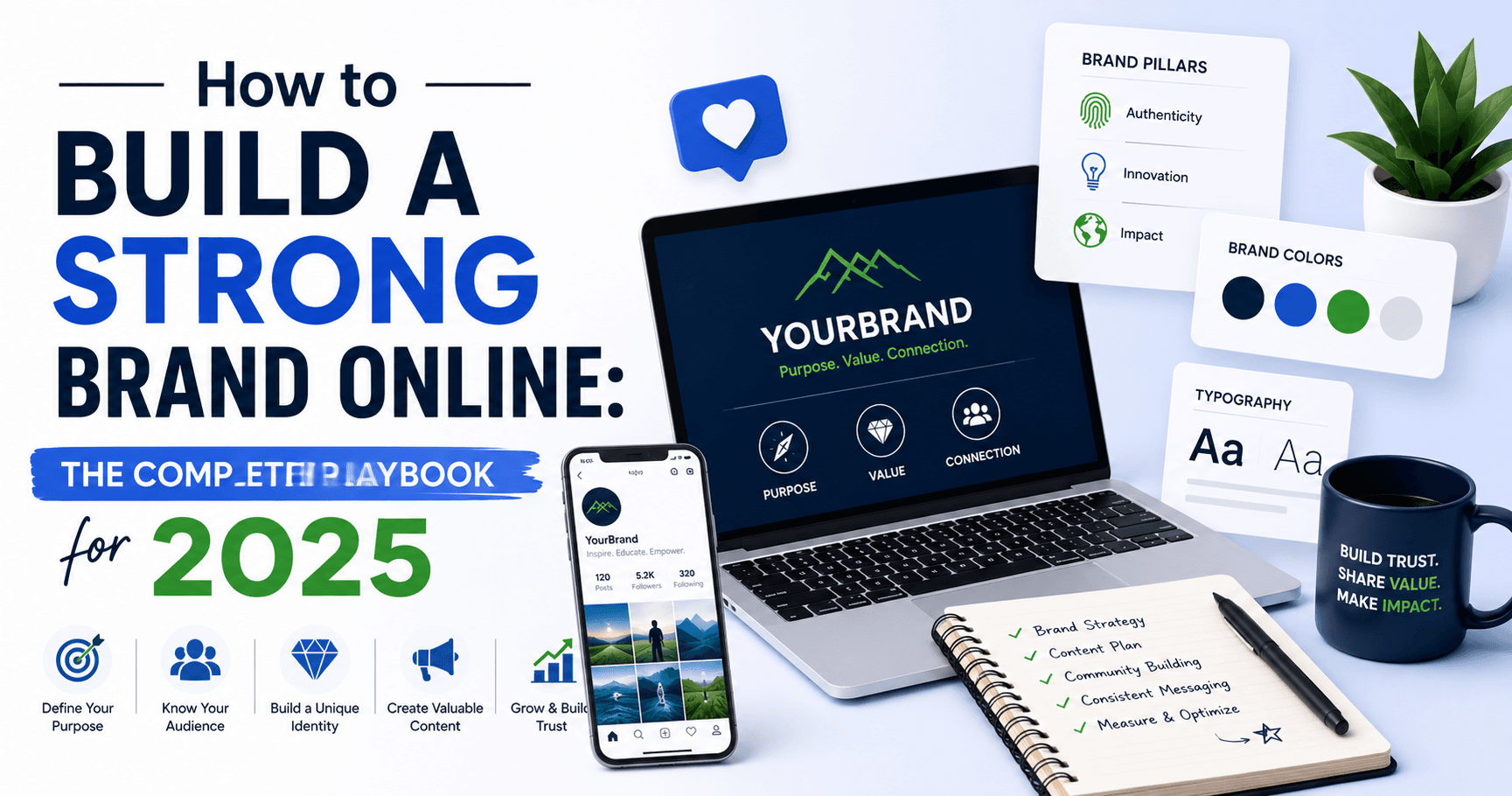
Building a strong brand online requires consistent visual identity, a distinctive voice, and a content strategy that delivers genuine value to a clearly defined audience — all coordinated across every platform your customers use. Brands that get this right don’t just generate traffic and followers; they create preference, trust, and the kind of recognition that makes marketing progressively cheaper over time.
This guide covers every dimension of online brand building — from identity foundations and content systems to social media strategy and community development. Whether you’re starting from zero or repositioning an existing brand, and whether you’re doing this in-house or with a digital marketing agency in Chennai, these are the frameworks that separate memorable brands from forgettable ones.
Why Online Brand Building Is Now a Business Imperative
Brand is not a marketing luxury. It’s a business asset with measurable financial impact — and the data on this is unambiguous.
According to Edelman’s 2024 Trust Barometer, 81% of consumers say brand trust is a deciding factor in their purchase decisions — ranking above price, product quality, and convenience for considered purchases. For businesses competing in crowded digital markets, trust is the moat.
The financial case is equally compelling:
- McKinsey research found that strong brands outperform weak brands in total shareholder return by 73% over a 10-year period
- Lucidpress reports that consistent brand presentation across all platforms increases revenue by an average of 23%
- Sprout Social’s 2024 Index found that 64% of consumers want brands to connect with them — yet most brands still communicate at customers rather than with them
- According to Nielsen, people are 4x more likely to purchase from a brand they recognize and trust, even if a lesser-known competitor offers a lower price
The digital dimension amplifies these effects. Online brand building compounds: every piece of content, every social interaction, every review, and every search result contributes to a cumulative brand impression that either builds equity or erodes it. A social media marketing agency in Chennai that understands this doesn’t manage posts — it manages brand perception, one touchpoint at a time.
Step 1: Define Your Brand Foundation Before You Build Anything
The most common brand-building mistake is jumping directly to tactics — content, social media, design — before establishing the strategic foundation. Tactics built on a weak foundation amplify inconsistency rather than cohesion.
Brand Purpose: Why You Exist Beyond Revenue
Your brand purpose is the reason your company exists that isn’t “to make money.” It’s the change you want to create in the world, the problem you’re committed to solving, or the people you’re determined to serve.
Purpose-driven brands consistently outperform in brand affinity and customer loyalty. In a 2023 Kantar study, brands with a clearly articulated purpose grew at 2x the rate of brands without one.
How to define your brand purpose:
- Ask: “If our company disappeared tomorrow, who would genuinely miss us — and why?”
- Identify the transformation your customers experience because you exist
- Separate purpose from mission: purpose is the “why,” mission is the “what”
- Test it: Would your team be proud to put this on a billboard? Would your best customers agree?
Purpose statement format:
“We exist to [transformation] for [audience] by [how you do it].”
Example: “We exist to help Chennai businesses compete globally by making sophisticated digital marketing accessible, measurable, and genuinely effective.”
Brand Positioning: Where You Live in the Market
Positioning is the specific market space your brand occupies in the minds of your target audience. A well-positioned brand is the automatic answer to a specific question — “Who should I call for X?” — for a defined group of people.
The positioning statement framework:
“For [target audience] who [need/desire], [Brand Name] is the [category] that [key differentiator] because [reason to believe].”
Positioning requires making choices about who you’re not for, which markets you’re not in, and what promises you won’t make. The brands with the clearest positions are often the most restrictive — Apple doesn’t chase every price segment; Rolex doesn’t chase volume. Constraint clarifies.
Brand Personality and Voice
Brand personality is the set of human characteristics associated with your brand. It determines how you write, what humor you use, how formal your communications are, and how you respond to criticism. It’s the reason Red Bull sounds nothing like Dove, even if both are selling to overlapping demographics.
Defining your brand personality:
Choose 3–5 personality traits from a list of archetypes and define what each means in practice:
| Archetype | Core Trait | Brands That Embody It |
|---|---|---|
| The Sage | Knowledge, wisdom, expertise | Google, McKinsey, Britannica |
| The Hero | Courage, achievement, mastery | Nike, Adidas, Under Armour |
| The Rebel | Disruption, freedom, boldness | Harley-Davidson, Diesel, Oatly |
| The Creator | Innovation, vision, craft | Apple, Adobe, Lego |
| The Caregiver | Empathy, service, nurturing | Johnson & Johnson, Dove |
| The Explorer | Adventure, discovery, authenticity | Patagonia, REI, The North Face |
| The Jester | Humor, playfulness, wit | Zomato, Durex, Burger King India |
| The Ruler | Authority, control, premium positioning | Rolex, Mercedes, Amex |
Once you’ve chosen your archetypes, write explicit guidelines for brand voice:
- Tone range: Where does the brand sit on a spectrum from formal to casual, serious to playful, expert to approachable?
- Words we use: List 10–15 words that reflect the brand’s vocabulary
- Words we avoid: List words that feel off-brand
- How we handle criticism: Do we respond with humor? Empathy? Directness?
- What we never do: Hard limits on tone (e.g., “We never use jargon to confuse; we use plain language to clarify”)
Step 2: Build a Visual Identity That Works Across Every Digital Surface
Visual identity is the most immediate expression of your brand. Before a customer reads a word, they’ve already formed a subconscious impression based on color, typography, and composition. This impression determines whether they lean in or scroll past.
The Core Components of a Digital-First Visual Identity
Logo System: A strong digital logo is simple enough to work at 16px (favicon) and distinctive enough to be recognizable at a glance. Modern brand identity systems include:
- Primary logo (full version)
- Secondary logo (compact version for small spaces)
- Icon/mark (for social profile pictures, app icons, favicons)
- Clear space rules (minimum padding around the logo in every application)
Color Palette: Color psychology is real and consistent across cultures — though specific associations vary. What matters more for digital brands is differentiation (owning a color space your competitors don’t use) and consistency (using the exact same hex codes everywhere).
A functional digital color palette includes:
- 1 primary brand color (dominant, immediately recognizable)
- 1–2 secondary colors (complementary, used for accents and CTAs)
- Neutral colors (backgrounds, text, dividers)
- Semantic colors (success green, error red — for UI/product contexts)
Typography: Choose 1–2 typefaces and use them exclusively. One for headings (personality-forward, distinctive), one for body text (readable at small sizes). Avoid free fonts that dozens of other brands are using — distinctiveness compounds over time.
Photography and Imagery Style: Define a visual language for photography: bright vs. muted, documentary vs. editorial, people-centric vs. abstract, color-graded vs. natural. Stock photos that look like stock photos erode brand trust. Brands that invest in consistent original photography — or a distinctive illustration style — build visual recognition faster.
Iconography and Design Elements: Proprietary design elements — custom icons, pattern systems, unique graphic treatments — extend the visual identity into touchpoints where the logo can’t always appear. These become powerful brand recognition cues over time.
Step 3: Build a Website That Works as a Brand Hub
Your website is the owned, permanent hub of your digital brand — the one channel you control completely, free from algorithm changes, platform policy updates, and follower counts. Every other digital channel should ultimately drive toward it.
What a Brand-Building Website Requires
First impression in 3 seconds: Nielsen Norman Group research found users form a first impression of a website in 50 milliseconds — and those impressions are remarkably sticky. Your homepage must communicate who you are, who you serve, and why you’re the right choice — in the first visible viewport, without scrolling.
Brand voice throughout: Your website copy is the most read brand communication you produce. It must reflect the brand voice established in your guidelines — not corporate boilerplate that could belong to any company.
Consistent visual expression: Colors, typography, photography style, and spacing must align precisely with your visual identity system. Inconsistency between your website and your social media profiles creates a “brand gap” that unconsciously signals lack of professionalism.
Social proof architecture: According to BrightLocal’s 2024 survey, 75% of consumers always read reviews before making a purchasing decision. Your website should present social proof at every stage of the buyer journey:
- Logos of recognized clients near the top of the page
- Testimonials with specific results and real names (not anonymous)
- Case study pages linked from service/product pages
- Review platform badges (Google, Clutch, G2) for third-party credibility
Technical performance: A brand-building website must also perform technically — fast load times (Core Web Vitals), mobile-first design, HTTPS security, and full accessibility. A beautiful website that loads in 6 seconds actively damages brand perception.
Step 4: Develop a Content Strategy That Builds Authority
Content is how brands demonstrate expertise, earn trust, and attract customers who are still in the research phase — before they’re ready to buy. The brands that build the strongest online presence invest in content that educates, not content that only promotes.
The Content Pillar Model
A content pillar is a broad, ownable topic area where your brand has deep expertise and your audience has consistent questions. Instead of publishing random content, pillar-based content strategy builds depth in a small number of areas — creating topical authority that compounds over time.
How to identify your content pillars:
- What topics do your best customers ask about most frequently?
- What expertise does your team have that competitors lack?
- What topics drive the purchase decisions your customers make?
- Where is the gap between what your audience needs and what currently exists?
For a social media agency in Chennai like Weboin, content pillars might be:
- Social media strategy and platform-specific growth
- Paid advertising and performance marketing
- Brand building and content marketing
- Local digital marketing for Chennai businesses
- Analytics, measurement, and ROI
Each pillar generates dozens of blog posts, social media content pieces, short videos, email newsletters, and downloadable resources — all reinforcing the same areas of authority.
Content Formats That Build Brand and Drive Traffic
| Format | Brand-Building Value | Traffic-Driving Value | Best Platform |
|---|---|---|---|
| Long-form blog posts (2000+ words) | High — demonstrates expertise | Very High — ranks for keywords | Website / SEO |
| Short-form video (15–60s) | Very High — personality and recognition | High — viral potential | Instagram, YouTube Shorts, LinkedIn |
| Original data / research | Very High — establishes authority, earns backlinks | High — press coverage | Website + PR |
| Podcast / audio | High — intimate, builds loyalty | Medium — niche discovery | Spotify, Apple Podcasts |
| Infographics | Medium — visual brand consistency | High — shareable, backlink-generating | Pinterest, LinkedIn, blog embeds |
| Newsletters | Very High — direct relationship, no algorithm | Low-Medium — owned channel | Email (Substack, Mailchimp) |
| Webinars / live video | Very High — trust and expertise | Low — real-time only | YouTube Live, LinkedIn Live |
| Case studies | Very High — proof and specificity | Medium — high-intent keyword traffic | Website |
The Content-Brand Connection
Content builds brand when it consistently expresses the brand voice, reflects the brand’s visual identity, and addresses topics only this brand — with its specific expertise and perspective — can address with authority.
The best brand content passes this test: could a competitor put their name on this and have it feel equally at home? If yes, it’s generic. If no, it’s brand-building.
Step 5: Master Social Media as a Brand-Building Channel
Social media is not a content distribution channel — it’s a brand perception channel. The sum of your social media presence is one of the most influential factors shaping how customers perceive your brand before they ever visit your website.
Platform Selection: Be Strategic, Not Everywhere
The worst social media strategy is being present on every platform with diluted, inconsistent effort. The best strategy is deep, consistent presence on the platforms where your specific audience spends the most time.
Platform selection guide by audience type:
| Platform | Primary Audience | Best Content Format | Brand-Building Strength |
|---|---|---|---|
| B2C, 18–40, visual categories | Reels, Stories, Carousels | Very High for visual and lifestyle brands | |
| B2B, professionals, decision-makers | Long-form posts, articles, video | Very High for B2B and professional services | |
| YouTube | All ages, research and entertainment intent | Long-form and short-form video | Very High for educational and thought leadership |
| 30–55 age range, community-driven | Groups, Events, video | Medium — reach declining but community strong | |
| X (Twitter) | News, tech, finance, real-time commentary | Short text, threads | Medium — strong for thought leadership niches |
| Women 25–45, design, home, fashion, food | Static images, idea boards | High for visual product categories | |
| Threads | Instagram crossover, conversational | Short text, reactions | Emerging — test for conversational brands |
For most businesses, presence on 2–3 platforms done well outperforms presence on 6–8 platforms done poorly. A focused social media marketing agency in Chennai will recommend the right 2–3 platforms for each client’s specific audience — not the full list.
The Social Media Brand-Building Framework
Consistency over frequency: Sprout Social data shows that consistent brand presentation across social platforms is more predictive of brand recognition than posting frequency. Publish less often if necessary — but publish with unwavering brand consistency.
The 70-20-10 content rule:
- 70% — Educational, entertaining, or inspiring content that serves the audience (not the brand)
- 20% — Content that builds brand authority and shares the brand perspective
- 10% — Direct promotional content (offers, products, services)
Brands that invert this ratio and post 70% promotional content see rapidly declining reach, engagement, and brand affinity.
Community engagement as brand building: Engagement — responding to comments, participating in conversations, sharing user content — is brand communication. Every response from a brand account is a public expression of brand personality. Brands that respond to 80%+ of comments and DMs within 24 hours consistently build stronger social media brand equity than those that broadcast without engaging.
According to Sprout Social, 79% of consumers expect brands to respond to their social media posts within 24 hours. Brands that do this consistently — and do it with authentic brand voice — build disproportionate loyalty.
Building Social Proof Through Social Media
User-generated content (UGC) is the most credible form of social proof available. When customers create content featuring your brand, they’re providing peer-to-peer endorsement that no amount of brand-produced content can replicate.
How to encourage and leverage UGC:
- Create a branded hashtag and feature it prominently on packaging, receipts, and your website
- Repost customer content (with credit) as a regular part of your content mix
- Run UGC campaigns: contests, challenges, or “show us how you use X”
- Feature customer stories in longer-form content (case studies, testimonials, interviews)
According to TINT’s 2024 UGC study, 79% of consumers say UGC highly impacts their purchasing decisions — significantly outperforming brand-produced creative in trust and conversion impact.
Step 6: Leverage SEO as a Long-Term Brand Visibility Engine
Brand and SEO have a symbiotic relationship that most brands underexploit. Strong brands rank more easily because Google’s algorithm rewards E-E-A-T (Experience, Expertise, Authoritativeness, Trustworthiness) — qualities that overlap directly with brand signals. And strong SEO builds brand because appearing consistently at the top of search results creates a halo of authority and trustworthiness.
Branded Search as a Brand Health Indicator
The volume of searches for your brand name — “Weboin,” “[Company Name] reviews,” “[Company Name] services” — is one of the clearest indicators of brand health. Branded search volume grows when brand awareness grows. It’s a leading indicator of organic demand.
How to grow branded search volume:
- Consistent social media presence (people search for brands they’ve seen on social)
- PR and media coverage (readers search for brands they read about)
- Word-of-mouth and referral programs (people search for brands they’ve heard about)
- Sponsorships and events (visibility creates curiosity and search behavior)
Why branded search matters for SEO: Google treats brand queries differently from generic queries. High branded search volume is a signal of real-world authority — one of the harder-to-fake signals in Google’s ranking system.
Content SEO as Brand Authority Building
Every blog post, guide, or tool that ranks on page one of Google for a relevant query contributes to brand authority. When a potential customer searches “how to run Google Ads” and finds your brand’s guide in position 1, they form a brand impression before they’ve even visited your website.
This is why the most sophisticated digital marketing company in Chennai teams treat SEO not just as a traffic acquisition channel but as a brand awareness and authority-building engine.
Brand-building SEO strategy:
- Target informational keywords where your audience is researching (not just transactional keywords)
- Create genuinely better resources than what currently ranks — not thin content designed to rank
- Build topical clusters around your core expertise areas — depth signals authority
- Ensure every piece of content visually and tonally reflects the brand identity
Step 7: Build and Protect Your Online Reputation
Online reputation is the sum of what other people say about your brand when you’re not in the room — on review platforms, in social media conversations, in press coverage, and in search results. It’s brand equity that lives outside your owned channels.
Review Management as Brand Strategy
Google reviews, Clutch ratings, G2 scores, Facebook recommendations, and industry-specific review platforms are visible in search results and directly influence purchase decisions. Managing them strategically is brand management.
Review generation best practices:
- Ask for reviews at peak satisfaction moments: immediately after project completion, after a successful outcome, after a positive support interaction
- Make it frictionless: send a direct link to your Google Business Profile review form — not just “please leave a review”
- Respond to every review — positive and negative — in brand voice
- Never incentivize reviews (violates Google’s policies) — earn them through excellence
Responding to negative reviews: A well-handled negative review can become a brand-building moment. Research shows that 53% of customers expect brands to respond to negative reviews within 7 days (ReviewTrackers, 2024) — and brands that respond thoughtfully see measurably higher trust scores than brands that ignore criticism.
Response framework for negative reviews:
- Acknowledge the experience without being defensive
- Express genuine empathy (not performative apology)
- Take the conversation offline (provide a direct contact)
- Resolve the issue where possible
- Follow up publicly if the resolution is positive
Reputation in Search Results
What appears in the first page of Google results for your brand name is your “digital storefront.” Manage it actively:
- Your own website should occupy position 1 for your brand name (almost always the case if your site is properly optimized)
- Your social media profiles should populate positions 2–5
- Review platforms (Clutch, G2, Justdial) often rank in positions 4–8 — ensure your profiles there are complete and positive
- Any negative press or reviews ranking on page 1 for your brand name should be addressed directly — either by resolving the underlying issue or by publishing enough positive content to push it off page 1
Step 8: Build a Brand Community — Not Just an Audience
The difference between an audience and a community is participation. An audience consumes your content; a community contributes to it, advocates for you, and recruits others. Community is the highest expression of brand loyalty — and it’s what makes brands defensible against competitors with bigger budgets.
Online Community Building Strategies
Owned community platforms:
- LinkedIn Groups for B2B brands — curate discussion around your content pillar topics
- Facebook Groups for consumer brands — build around shared interest, not the brand itself
- Discord servers for tech and developer brands — highly engaged, niche community
- WhatsApp/Telegram groups for local brands — high reach and engagement in Indian markets
Community building principles:
- The community must have value independent of the brand — members join for each other, not just for you
- Consistency of moderation and community management builds trust over time
- Feature community members publicly (showcase, highlight, interview) — recognition drives participation
- Set clear community guidelines — healthy communities have clear behavioral expectations
Micro-community over mass community: A community of 500 highly engaged, passionate brand advocates is worth more than 50,000 passive followers who never interact. Focus on depth of community engagement, not breadth of audience.
Brand Ambassadors and Influencer Partnerships
Influencer marketing is not about reach — it’s about borrowed trust. When a respected voice in your industry or niche recommends your brand, they’re transferring their credibility to you.
Influencer tiers and their brand-building applications:
| Tier | Follower Range | Engagement Rate | Brand-Building Strength |
|---|---|---|---|
| Nano (1K–10K) | Very high (5–10%+) | Very targeted | Highest trust, most authentic |
| Micro (10K–100K) | High (3–6%) | Niche authority | High credibility, cost-effective |
| Macro (100K–1M) | Medium (1–3%) | Broad category reach | Good awareness, moderate trust |
| Mega/Celebrity (1M+) | Low (0.5–1.5%) | Mass awareness | High awareness, lower trust conversion |
For most brands building an online presence — especially those working with a social media agency in Chennai — micro and nano influencers deliver the strongest brand-building return because their audiences are highly engaged and the endorsement feels genuinely authentic.
Step 9: Measure Brand Health — The Metrics That Matter
Most brands measure marketing metrics — traffic, followers, engagement. Few measure brand metrics — the indicators of actual brand equity growth. Here’s the full measurement framework.
Brand Awareness Metrics
| Metric | What It Measures | How to Track |
|---|---|---|
| Branded search volume | How many people search for your brand | Google Search Console, Google Trends |
| Direct traffic | People who type your URL directly | Google Analytics 4 |
| Social media mentions | How often your brand is discussed | Brandwatch, Mention, Google Alerts |
| Share of voice | Your brand mentions vs. competitors | SEMrush, Brandwatch |
| Brand recall surveys | Unaided awareness in target market | Custom survey (Typeform, Google Forms) |
Brand Affinity Metrics
| Metric | What It Measures | How to Track |
|---|---|---|
| Net Promoter Score (NPS) | Likelihood to recommend | Typeform, Delighted, in-product survey |
| Customer Lifetime Value (LTV) | Loyalty and repeat purchase | CRM data |
| Referral rate | Word-of-mouth brand advocacy | CRM, referral program tracking |
| Review sentiment | Qualitative brand perception | Google Reviews, Clutch, Sprout Social |
| Social engagement rate | Content resonance with audience | Native platform analytics |
Brand Conversion Metrics
- Branded keyword conversion rate: How well brand searches convert to leads/purchases
- Return visitor rate: People who came back — they remembered the brand
- Direct CTA response rate: How responsive the audience is to brand communications
How Weboin Builds Brands Online for Clients
At Weboin, a full-service digital marketing company in Chennai, brand building is the strategic layer that makes every other marketing investment more effective. We don’t run campaigns in isolation — we build the brand context that makes campaigns convert more efficiently.
Our brand-building approach integrates:
Brand Strategy: Before any creative work begins, we define purpose, positioning, personality, and voice — ensuring every subsequent decision is grounded in a coherent strategic foundation.
Visual Identity: Our design team builds digital-first identity systems — logo, color, typography, photography direction — built to perform across every screen size, platform, and touchpoint.
Content and SEO: We build topical authority through pillar-based content strategies that serve the audience and signal expertise to Google simultaneously — ensuring brand visibility compounds in organic search over time.
Social Media Management: As a dedicated social media marketing agency in Chennai, Weboin manages brand presence across relevant platforms with consistent voice, strategic content calendars, and active community engagement.
Reputation Management: We monitor, manage, and actively build online reputation across review platforms, search results, and social conversations — ensuring the brand perception outside owned channels matches the brand story inside them.
Performance Integration: Brand and performance are not opposites. Weboin ensures that brand-building content feeds performance campaigns and that performance data informs brand strategy — creating a flywheel where brand equity reduces the cost of every paid media impression over time.
Common Online Brand-Building Mistakes to Avoid
Brands at every stage make predictable errors. Recognizing these patterns is half the battle.
Mistake 1: Inconsistency Across Channels Different colors on Instagram vs. the website. Different tone on LinkedIn vs. email. Different value propositions on the homepage vs. the Google Ads landing page. Inconsistency is invisible to no one — it silently erodes trust.
Mistake 2: Building on Rented Land A brand that lives primarily on Instagram or Facebook is at the mercy of algorithm changes, policy updates, and platform shutdowns. Your website and email list are the only digital channels you fully own. Build there first.
Mistake 3: Confusing Activity With Progress Publishing 20 social media posts a week without a brand strategy is noise, not brand building. Volume without strategic intent creates brand blur rather than brand clarity.
Mistake 4: Neglecting the Existing Customer Experience The most powerful brand-building moment is delivering on your promises to existing customers. A referral from a happy client builds brand equity that no ad campaign can replicate. Invest in the post-purchase experience as much as the pre-purchase brand.
Mistake 5: Rebranding as a Substitute for Strategy A new logo doesn’t fix a positioning problem. A new color palette doesn’t repair a trust deficit. Cosmetic rebrands that don’t address the underlying strategic gaps are expensive ways to stay in the same place.
Mistake 6: Copying Competitor Brand Elements Imitation is the opposite of positioning. Brands that adopt similar colors, similar tone, and similar messaging to their competitors train customers to see the category, not the brand.
A 90-Day Online Brand-Building Roadmap
Days 1–30: Foundation
- Define brand purpose, positioning statement, and 3–5 personality traits
- Conduct competitive brand audit (what are competitors saying? What space is unclaimed?)
- Create or refresh visual identity system (logo, colors, typography, imagery direction)
- Audit existing digital touchpoints for brand consistency gaps
- Define 3–5 content pillars based on audience needs and brand expertise
- Set up brand monitoring (Google Alerts + Mention/Brandwatch)
Days 31–60: Content and Social
- Publish first pillar content piece (comprehensive, SEO-optimized, brand-voice-consistent)
- Establish social media presence on 2–3 selected platforms with consistent identity
- Build a 90-day content calendar aligned to content pillars
- Begin active community engagement — respond to every comment and mention
- Set up or optimize Google Business Profile with brand-consistent description, photos, and posts
- Launch NPS survey to existing customers to establish baseline
Days 61–90: Authority and Reputation
- Publish second and third pillar content pieces
- Identify and reach out to 3–5 micro-influencers for authentic partnership
- Begin review generation campaign for Google, Clutch, or relevant platforms
- Run first brand awareness survey to measure unaided recall in target market
- Review branded search volume trend and adjust content strategy accordingly
- Compile first brand health report: branded search, direct traffic, NPS, review sentiment, social engagement
Frequently Asked Questions About Building a Brand Online
Brand building is measured in years, not weeks. Meaningful brand recognition in a specific market typically takes 12–24 months of consistent, strategic effort. The first 90 days establish foundations; months 3–12 build momentum; years 1–3 create durable competitive advantage.
Marketing is how you get attention and generate transactions. Branding is what makes those transactions possible and increasingly easier over time. Marketing works faster; branding works deeper. The most effective approach treats them as complementary systems — not alternatives.
Both are essential and inseparable. Visual identity creates recognition; voice creates relationship. Brands strong in one but weak in the other feel incomplete. A beautiful brand that communicates in corporate language, or a wonderfully written brand with inconsistent visuals, both fail to build the full trust they're capable of.
Especially yes. Small businesses often compete against larger players with bigger budgets for the same customers. A clear, consistent brand creates the perception of quality and trustworthiness that allows a small business to compete — and often win — against larger but less distinctive competitors.
Social media is a powerful brand-building channel but not a complete strategy. Brands built entirely on social media are vulnerable to algorithm changes, platform decline, and follower count fluctuations. The strongest online brands use social media as part of a broader system that includes a strong website, SEO, email, and reputation management.
A specialist digital marketing agency in Chennai like Weboin brings together brand strategy, content, SEO, social media, and performance marketing in a coordinated system — ensuring every channel reinforces the same brand story rather than pulling in different directions. The result is compounding brand equity that makes every future marketing investment more effective.
Final Thought: Brand Is the Compounding Asset That Marketing Can’t Buy
Every campaign you run, every piece of content you publish, every social media comment you respond to, and every customer you serve is either adding to your brand equity or subtracting from it. There is no neutral.
The brands that dominate their markets — not just for a quarter, but for a decade — have understood this and invested accordingly. They’ve built distinctive identities, consistent voices, and genuine trust with specific audiences. And they’ve done it systematically, not accidentally.
Brand building is the highest-ROI investment a business can make in its own future. It makes every marketing campaign cheaper, every sales conversation shorter, and every customer relationship longer.
Whether you’re building your brand from scratch or strengthening one that’s already in market, the framework in this guide gives you the architecture. The brands that execute it — with consistency, patience, and strategic clarity — are the ones that customers choose when price, features, and convenience are equal.
And those are exactly the brands worth building.
About Weboin: Weboin is a full-service digital marketing company in Chennai offering brand strategy, social media management, SEO, performance marketing, and content creation. As a trusted social media marketing agency in Chennai, Weboin helps businesses across industries build distinctive, consistent, and commercially powerful online brands — from first impression to long-term loyalty.

No comment yet, add your voice below!