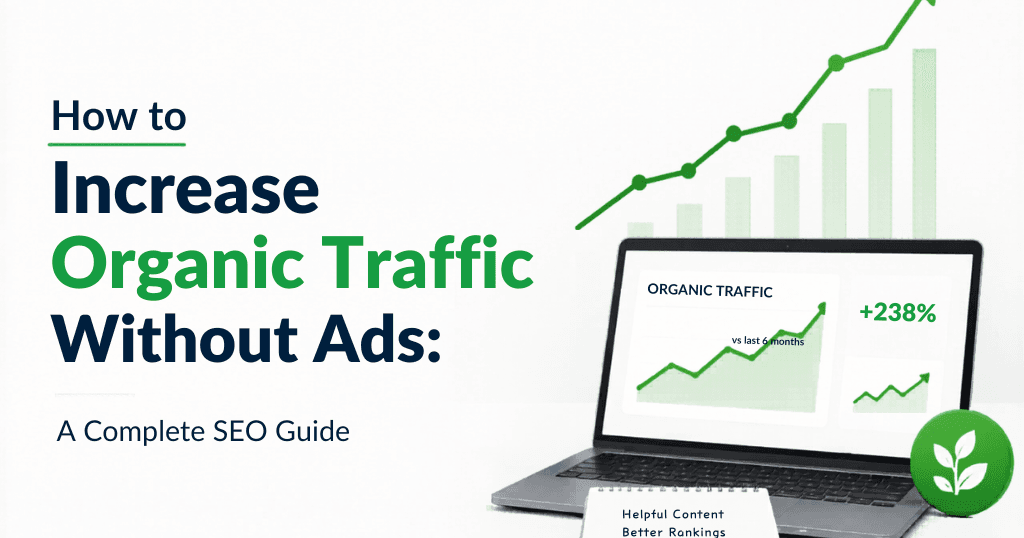
The most reliable way to increase organic traffic without ads is to combine technical SEO, high-quality content, and strategic link building — all working together as a system, not in isolation. Businesses that execute this triad consistently see compounding growth: according to BrightEdge, organic search drives 53% of all website traffic, making it the single largest channel available to any brand, regardless of budget.
This guide is for founders, marketing managers, and growth teams who want real traction — not vanity metrics. Whether you’re working with an in-house team or partnering with a digital marketing agency in Chennai, every strategy here is actionable, measurable, and sustainable.
What Is Organic Traffic and Why Does It Matter More Than Paid?
Organic traffic refers to visitors who land on your website through unpaid search engine results — Google, Bing, or DuckDuckGo — without you paying for each click. It is earned through relevance, authority, and user trust.
Here’s why organic beats paid in the long game:
| Factor | Organic Traffic | Paid (PPC) Traffic |
|---|---|---|
| Cost per click over time | Decreases as authority grows | Stays constant or rises |
| Traffic when budget stops | Continues | Stops immediately |
| Trust signals | High (users trust organic results) | Lower (users see “Sponsored” label) |
| Compounding ROI | Yes — content works for years | No — ROI resets each campaign |
| Brand authority built | Strong | Minimal |
A 2023 study by SparkToro found that Google’s organic results receive approximately 25x more clicks than paid ads for the same keyword. The math is simple: organic is the highest-leverage investment a brand can make in its digital presence.
The 8 Core Pillars to Increase Organic Traffic Without Ads
1. Master Keyword Research Before Writing a Single Word
Keyword research is not about finding words with high volume. It’s about finding intent gaps — topics your audience is actively searching for that your competitors haven’t answered well.
How to do keyword research like an expert:
- Start with seed topics, not seed keywords. For a digital marketing company in Chennai, seed topics might include “local SEO,” “content marketing for startups,” or “Google Business Profile optimization.”
- Use tools like Ahrefs, SEMrush, or Google Search Console to find keywords with high intent and manageable difficulty.
- Segment by intent — informational (how-to), navigational (brand search), commercial (best/vs), and transactional (buy/hire/contact).
- Analyze SERP features — if a keyword shows a featured snippet, FAQ box, or People Also Ask block, you can capture that real estate with the right formatting.
Key metrics to evaluate:
- Keyword Difficulty (KD): Aim for KD under 40 if your domain authority is below 30.
- Search Volume: Don’t ignore low-volume keywords (50–500/month). They often convert at 3–5x the rate of high-volume terms.
- Traffic Potential: In Ahrefs, this shows how much traffic the top-ranking page actually gets — more accurate than raw volume.
- CPC (Cost per Click): High CPC = high commercial intent. Great for conversion-focused content.
LSI Keywords to include naturally: search engine optimization, SERP rankings, keyword intent, on-page SEO, content strategy, link authority, search visibility.
2. Build a Topic Cluster Architecture (Not a Blog Silo)
Google’s algorithms — especially after the Helpful Content Update (2023) and the March 2024 Core Update — reward topical authority, not keyword density. The way to signal authority is through topic clusters.
What is a topic cluster?
A topic cluster consists of:
- One pillar page — a comprehensive, long-form guide on a broad topic (e.g., “The Complete Guide to SEO for Businesses in Chennai”)
- Multiple cluster pages — in-depth articles on subtopics (e.g., “Local SEO for Restaurants,” “Technical SEO Checklist,” “How to Do Keyword Research”)
- Internal links — all cluster pages link back to the pillar, and the pillar links out to each cluster
This structure tells Google: “This website is the authority on this topic.”
Why it works:
HubSpot, which pioneered the topic cluster model, reported a 55% increase in traffic after restructuring their blog into clusters. The reason is simple — when multiple pages on your site rank for related keywords, Google’s algorithm assigns higher trust to your domain for that entire topic area.
For an SEO agency in Chennai targeting local businesses, a pillar page might be: “The Complete Digital Marketing Guide for Chennai Businesses” with clusters covering Google Ads basics, social media marketing, content creation, technical SEO, and local citation building.
3. Execute On-Page SEO With Precision
On-page SEO is the foundation. If your pages aren’t optimized, even great content will underperform. Here’s a checklist that covers every critical element:
Title Tag (H1 and <title>):
- Include the primary keyword in the first 60 characters
- Write for humans, not robots — make it compelling
- Avoid clickbait; Google will rewrite your title if it mismatches content
Meta Description:
- 150–160 characters
- Include primary and one secondary keyword naturally
- End with a clear value proposition or CTA
Header Structure (H2, H3, H4):
- Use H2 for major sections, H3 for subsections
- Include keywords in at least 2–3 headers naturally
- Structure headers so they answer “People Also Ask” questions directly
URL Structure:
- Short, descriptive, hyphen-separated
- Include the primary keyword
- Example: /seo-company-in-chennai-services not /page?id=2341
Image Optimization:
- Compress images with WebP format (saves 25–35% file size over JPEG)
- Use descriptive alt text with keywords where relevant
- Add structured data for image sitemaps
Content Depth:
- Pages ranking in the top 3 for competitive terms average 1,500–2,500 words (Backlinko, 2023)
- Use tables, bullet lists, and visuals to break up content
- Answer the primary question within the first 100 words (answer-first approach)
Internal Linking:
- Link every new page to at least 3–5 existing pages
- Use descriptive anchor text (not “click here”)
- Prioritize linking to your highest-converting pages
4. Technical SEO: Fix What’s Invisible But Critical
Technical SEO is often the difference between a site that ranks and one that doesn’t — even when the content is good. A digital marketing agency in Chennai working with enterprise clients will almost always start with a technical audit before touching content.
Core technical priorities:
Page Speed (Core Web Vitals): Google’s Core Web Vitals — Largest Contentful Paint (LCP), Interaction to Next Paint (INP), and Cumulative Layout Shift (CLS) — are confirmed ranking factors since 2021. According to Google’s own data, pages that meet Core Web Vitals thresholds are 24% less likely to be abandoned before loading.
- LCP target: under 2.5 seconds
- INP target: under 200 milliseconds
- CLS target: under 0.1
Tools: Google PageSpeed Insights, GTmetrix, WebPageTest
Crawlability and Indexability:
- Submit an XML sitemap to Google Search Console
- Audit your robots.txt — ensure no important pages are accidentally blocked
- Fix redirect chains (A → B → C should become A → C directly)
- Resolve duplicate content issues using canonical tags
Mobile-First Indexing: Google indexes the mobile version of your site first. If your mobile experience is broken or significantly different from desktop, your rankings will suffer. Test with Google’s Mobile-Friendly Test tool.
Schema Markup (Structured Data): Schema markup helps search engines understand your content and enables rich results — star ratings, FAQ dropdowns, breadcrumbs, and event details. Pages with rich results have been shown to have higher click-through rates by 20–30% compared to plain blue links.
Recommended schema types:
- Article — for blog posts
- LocalBusiness — critical for an SEO company in Chennai targeting local search
- FAQ — for pages with question-and-answer sections
- HowTo — for instructional content
- Review / AggregateRating — for service pages
HTTPS and Security: HTTPS has been a ranking signal since 2014. In 2024, having a non-HTTPS site also triggers browser warnings that crush user trust and increase bounce rates.
5. Create Content That Earns Links Naturally (Link Bait Strategy)
Backlinks remain one of Google’s top 3 ranking factors. A 2023 analysis by Ahrefs found that 96.55% of all pages on the internet get zero organic traffic from Google — and the #1 reason is a lack of backlinks.
But cold outreach for links is slow and often ignored. The faster path is creating content formats that earn links passively — commonly called “link bait.”
High-performing link bait formats:
| Content Format | Why It Earns Links | Examples |
|---|---|---|
| Original Research & Data | Journalists and bloggers cite stats | Annual surveys, industry benchmarks |
| Free Tools & Calculators | Tools get embedded and shared | ROI calculator, SEO audit tool |
| Comprehensive Guides | Referenced as the “definitive resource” | This article format |
| Infographics with data | Visual sharing with embed codes | Industry stat visualizations |
| Expert Roundups | Contributors share with their audience | “25 SEO experts on 2025 predictions” |
| Case Studies | Specific, results-driven proof | “How we grew organic traffic 300%” |
Supplementary link building tactics:
- HARO (Help a Reporter Out) / Connectively: Respond to journalist queries to earn editorial links from high-authority publications like Forbes, Inc., or industry-specific media.
- Broken link building: Find broken links on relevant sites using Ahrefs’ “broken backlinks” report, then offer your content as a replacement.
- Digital PR: Publish newsworthy data or announce partnerships that local and national media will cover.
- Guest posting: Write for authoritative blogs in your niche — focus on quality (DA 40+) over quantity.
6. Local SEO: The Fast Lane for Businesses in Chennai
For any business operating in a specific geography, local SEO is the single highest-ROI investment available. According to Google, “near me” searches have grown by over 500% in recent years, and 76% of people who search locally on their smartphone visit a business within 24 hours.
For businesses working with a digital marketing company in Chennai or targeting Chennai-based customers, here’s the local SEO playbook:
Google Business Profile (GBP) Optimization:
- Claim and verify your GBP listing
- Select accurate primary and secondary categories
- Add all business hours, including holiday hours
- Upload high-quality photos (businesses with photos get 42% more direction requests)
- Enable messaging and respond to all reviews within 24 hours
- Post weekly GBP updates (offers, events, news)
Local Citation Building: Citations are mentions of your business name, address, and phone number (NAP) across the web. Consistency across directories signals legitimacy to Google.
Top citation sources for Chennai businesses:
- Justdial
- Sulekha
- IndiaMart
- TradeIndia
- Google Business Profile
- Bing Places
- Apple Maps
- Facebook Business
Localized Content Strategy: Create content that targets location-specific keywords:
- “SEO company in Chennai for startups”
- “Digital marketing services Anna Nagar”
- “Best content marketing agency Chennai”
- “Local SEO for restaurants in Chennai”
Develop neighborhood-specific landing pages if you serve multiple areas. A well-structured local landing page for each area (Anna Nagar, T. Nagar, OMR, Velachery) can multiply your local organic footprint significantly.
Reviews and Reputation: Google reviews are a confirmed local ranking factor. A strategy to earn consistent reviews:
- Send post-purchase SMS or email with a direct GBP review link
- Train your team to ask satisfied clients verbally
- Respond to every review (positive and negative) professionally
7. Content Refresh Strategy: Revive Before You Create
Most brands default to publishing new content rather than refreshing existing content. This is a strategic mistake. Refreshing an existing article with rankings is almost always faster than publishing something new and waiting for it to rank.
How to identify content worth refreshing:
Using Google Search Console, filter pages that:
- Rank in positions 4–20 (close to page 1, just need a push)
- Have declining clicks or impressions over the past 6 months
- Have high impressions but low click-through rate (CTR)
What a content refresh includes:
- Update all statistics and data points to current year
- Add new sections addressing related queries (use “People Also Ask” on Google for ideas)
- Improve header structure to target featured snippet formats
- Add or update internal links to newer, relevant content
- Improve readability: break up long paragraphs, add tables, add bullet points
- Update the publish date after making substantive changes (this alone can improve CTR)
Real-world impact: Backlinko reported that refreshing content increased organic traffic to updated articles by an average of 111.3%. For content-heavy websites, this strategy alone can double traffic within a quarter.
8. Measure What Matters: The Right Organic Traffic KPIs
Increasing organic traffic without a measurement framework is flying blind. Many teams track the wrong metrics — chasing pageviews while ignoring the metrics that actually matter to business outcomes.
KPIs every SEO-focused team should track:
| KPI | What It Tells You | Tool |
|---|---|---|
| Organic Sessions | Raw traffic volume from search | Google Analytics 4 |
| Organic Impressions | How often you appear in search | Google Search Console |
| Average Position | Where you rank on average | Google Search Console |
| Click-Through Rate (CTR) | How compelling your title/meta is | Google Search Console |
| Organic Conversions | Revenue/leads from organic | GA4 + CRM |
| Pages per Organic Session | Engagement depth | GA4 |
| Core Web Vitals | Technical performance | Search Console / PageSpeed |
| Backlinks Acquired | Authority growth | Ahrefs / SEMrush |
| Keyword Rankings | Visibility for target terms | Ahrefs / SERPWatcher |
The most important metric most teams ignore: Organic Conversion Rate by landing page. This tells you which organic pages actually drive business, not just traffic. A page with 500 organic visits and 20 conversions is worth far more than one with 5,000 visits and 0 conversions.
Set up conversion tracking in GA4 for:
- Contact form submissions
- Phone number clicks
- WhatsApp chat initiations
- Demo or consultation bookings
- Email newsletter signups
Advanced Strategies to Accelerate Organic Growth
E-E-A-T: Build the Signals Google Is Looking For
Google’s Search Quality Evaluator Guidelines (the manual used by human quality raters) emphasize E-E-A-T: Experience, Expertise, Authoritativeness, and Trustworthiness. These are not direct ranking factors, but they heavily influence how Google’s algorithms assess content quality.
How to build E-E-A-T signals:
- Author bios with credentials: Every article should have a named author with a bio linking to their LinkedIn, social profiles, and other published work.
- About Us page: Be specific about your team’s experience, years in business, and client results.
- Testimonials and case studies: Real client outcomes on your site signal credibility.
- Press mentions: Get covered in reputable publications and link to those mentions.
- Awards and certifications: Google Partner status, industry awards, certifications — display them prominently.
For an SEO agency in Chennai, showcasing specific client results (e.g., “Helped a Chennai-based e-commerce brand grow organic traffic by 180% in 6 months”) builds far more trust than generic claims.
The Content Velocity Principle
Content velocity refers to the rate at which you publish high-quality content. Research by HubSpot found that companies that publish 16+ blog posts per month get 3.5x more traffic than those publishing 4 or fewer. However, quality cannot be sacrificed for quantity.
A realistic velocity for a team with a professional content strategy:
- Small business (1 writer): 4–6 articles per month
- Growing brand (2–3 writers): 8–12 articles per month
- Agency-level (content team): 20+ pieces per month
The key is a documented content calendar, a consistent brief template, and a review process that ensures every piece meets on-page SEO standards before publishing.
Voice Search and Conversational Queries
Voice search has changed how people phrase queries. Instead of “SEO company Chennai,” users ask “Which is the best SEO company in Chennai for small businesses?” This shift means:
- Target long-tail, conversational keywords
- Create FAQ sections on every major page
- Structure content to answer “who, what, where, when, why, how” questions directly
- Aim for featured snippets — voice assistants read the featured snippet aloud
Video SEO and YouTube as a Search Engine
YouTube is the second largest search engine in the world. Creating video content that ranks on YouTube also improves your overall domain authority and signals to Google that your brand has multi-format expertise.
Video SEO best practices:
- Research keywords using TubeBuddy or vidIQ before filming
- Include target keyword in video title, description (first 100 characters), and tags
- Add full transcripts (boosts indexability)
- Create a companion blog post for each video (creates a content cluster)
- Embed YouTube videos in related blog posts to increase dwell time
How Weboin Approaches Organic Traffic Growth
At Weboin, a results-driven digital marketing agency in Chennai, we treat organic traffic growth as a business outcome — not a vanity metric. Our approach integrates technical SEO, content strategy, local SEO, and authority building into a unified system tailored for each client’s specific market.
As a trusted SEO company in Chennai, we’ve helped businesses across industries — e-commerce, SaaS, hospitality, real estate, education, and healthcare — build sustainable organic growth without dependence on paid advertising.
What separates an expert SEO agency in Chennai from a generic one is the ability to read algorithm signals quickly, adapt strategy, and balance short-term wins with long-term authority building. This is what Weboin delivers.
Industries we’ve helped grow organic traffic:
- D2C and e-commerce brands targeting pan-India and Chennai markets
- B2B SaaS companies targeting enterprise decision-makers
- Local service businesses (legal, medical, financial, hospitality)
- Educational institutions targeting student audiences
- Real estate developers targeting homebuyers in specific Chennai localities
Common Mistakes That Kill Organic Traffic Growth
Even experienced teams make mistakes that stall or reverse organic growth. Avoid these:
- Publishing Without a Keyword Strategy Writing blog posts on topics that feel interesting but have no search demand is a common trap. Every piece of content should be connected to a keyword with measurable search volume and intent alignment.
- Ignoring Technical SEO Even the best content won’t rank if Google can’t crawl and index it properly. Technical audits should happen at least quarterly.
- Building Toxic Backlinks Quantity-over-quality link building — buying links from link farms or using PBNs (private blog networks) — can trigger Google manual penalties. Focus on earning editorial links from relevant, authoritative sites.
- Neglecting Internal Linking Internal links distribute PageRank (link equity) across your site. Orphan pages — pages with no internal links — are effectively invisible to Google’s crawler.
- Writing for Search Engines, Not Humans Keyword stuffing, unnatural phrasing, and thin content are all signals that trigger Google’s Helpful Content system. Write for your reader first; optimize second.
- Expecting Overnight Results Organic SEO is a 6–12 month investment before you see significant returns. Brands that abandon strategy at month 3 miss the compounding returns that kick in at months 6–12.
- Not Tracking the Right Metrics Tracking only rankings or pageviews without tying them to conversions leads to misaligned priorities. Always connect organic traffic performance to revenue and pipeline metrics.
Organic Traffic Growth: A 90-Day Action Plan
If you’re starting from scratch or relaunching your SEO strategy, here’s a prioritized 90-day roadmap:
Days 1–30: Foundation
- Conduct a full technical SEO audit (use Screaming Frog or Sitebulb)
- Fix critical issues: broken links, crawl errors, speed problems, missing meta tags
- Set up or optimize Google Search Console and GA4
- Claim and optimize Google Business Profile
- Conduct keyword research and build a topic cluster map
Days 31–60: Content and On-Page
- Publish 4–8 pillar and cluster articles based on your keyword map
- Optimize your top 10 existing pages for on-page SEO
- Refresh your 5 highest-impression, lowest-CTR pages
- Implement schema markup on key pages (FAQ, LocalBusiness, Article)
- Build 5–10 local citations
Days 61–90: Authority and Link Building
- Launch a digital PR campaign or original research piece
- Begin HARO outreach (submit to 2–3 queries per week)
- Identify 20 guest post opportunities in your niche
- Publish and promote at least 2 link-worthy assets (tool, infographic, or guide)
- Set up a monthly content refresh calendar
Frequently Asked Questions About Organic Traffic
Most websites begin seeing measurable improvements in 3–6 months with consistent effort. Significant traffic growth typically manifests between months 6–12. Competitive industries may take 12–18 months.
For long-term brand building, organic traffic has a higher ROI because it compounds over time and continues without ongoing spend. Paid traffic provides faster results but stops when your budget stops.
No single factor dominates. Google uses hundreds of signals, but the three most consistently cited are: content quality and relevance, backlink authority, and technical SEO health (especially Core Web Vitals).
SEO requires upfront investment in content, technical optimization, and link building, but the cost per click decreases as authority grows. Paid ads have a predictable and consistent cost per click but provide no lasting equity.
Both work, depending on resources and expertise. In-house teams offer speed and brand knowledge; agencies offer specialized expertise, tools, and economies of scale. For most businesses scaling quickly, partnering with a professional digital marketing company in Chennai like Weboin accelerates results significantly.
Final Thought: Organic Traffic Is a System, Not a Tactic
The brands that win in organic search aren’t the ones who tried one tactic. They’re the ones who built a system — keyword research informing content, content earning links, links building authority, authority enabling rankings, rankings driving traffic, traffic converting to revenue.
Every component feeds the next. Skip one, and the whole machine runs below capacity.
If you’re ready to build that system — whether through your own team or with the support of a leading digital marketing agency in Chennai — the strategies in this guide give you the blueprint. The only variable is execution.
Weboin’s team of SEO specialists, content strategists, and technical experts has helped dozens of businesses across Chennai and India build durable organic traffic systems that don’t stop working when ad budgets run out. If you want a partner who treats your growth as seriously as their own, get in touch with Weboin today.
About Weboin: Weboin is a full-service digital marketing company in Chennai specializing in SEO, content marketing, paid media, and web development. As a recognized SEO agency in Chennai, Weboin helps brands across industries grow their organic presence and convert digital traffic into measurable business outcomes.

No comment yet, add your voice below!